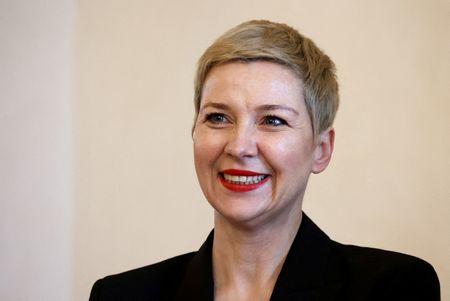

A prominent Belarusian opposition activist who was recently released from prison is calling on European leaders to open diplomatic channels with the country’s authoritarian president, warning that continued isolation will only drive Belarus deeper into Russia’s sphere of influence.
Maria Kalesnikava made these remarks during a virtual discussion hosted by the London-based Chatham House think tank on Tuesday. She spent over five years behind bars for her role in organizing demonstrations that were violently suppressed by President Alexander Lukashenko after Belarus’s controversial 2020 election. Kalesnikava was freed and forced to leave the country last December.
Her comments contribute to an ongoing discussion about whether European nations should follow the United States’ lead in pursuing talks with the long-serving dictator, or maintain their current policy of diplomatic isolation due to his poor human rights record and support for Vladimir Putin’s military campaign in Ukraine.
“Belarusians must feel that they are part of Europe… The more Belarus is cut off from Europe, the more it’s structurally tied to Moscow,” Kalesnikava stated during the online forum.
“If Europe wants a stable and secure eastern neighbourhood, it cannot afford to disengage,” she continued.
However, Nobel Peace Prize winner Ales Bialiatski, who was also released from prison in December, expressed doubt about Lukashenko’s commitment to reforming the authoritarian structure he has maintained since assuming power in 1994.
“Currently Belarus resembles scorched earth,” Bialiatski observed, describing the atmosphere of political oppression and the nation’s economic reliance on Russia and China.
“Society is like a pressure cooker and the lid has been tightly screwed down with all the bolts,” he added.
Bialiatski characterized Lukashenko’s decision to negotiate with American officials as a strategic move motivated by economic struggles.
“Regimes like Lukashenko’s understand only the language of strength,” he stated.
Both activists were part of a group of 123 political prisoners freed by Lukashenko in December following discussions with a representative of President Donald Trump. In exchange, the United States removed sanctions on Belarusian potash exports, though European Union restrictions remain active.
Opposition critics argue this prisoner exchange follows a long-established pattern where Lukashenko releases jailed political opponents to secure concessions from Western nations while offering minimal reforms in return.
Despite this criticism, Kalesnikava credited a previous period of improved Western relations between 2016 and 2019 with inspiring Belarusians to envision a democratic European future, ultimately motivating the 2020 street protests.
The former professional musician suggested that providing travel documents to ordinary Belarusian citizens and resuming educational, cultural, and professional exchange programs could help restore those democratic aspirations.
She warned that failing to take such steps would waste a crucial opportunity when the 71-year-old Lukashenko eventually exits the political stage.
“If the West is absent at that moment, it will lose influence over the outcome,” she concluded.