
THE HAGUE, Netherlands (AP) — After more than six decades of doubt, a painting once dismissed as a fake has been verified as an authentic work by renowned Dutch artist Rembrandt van Rijn, according to an announcement Monday from a prominent Netherlands museum.
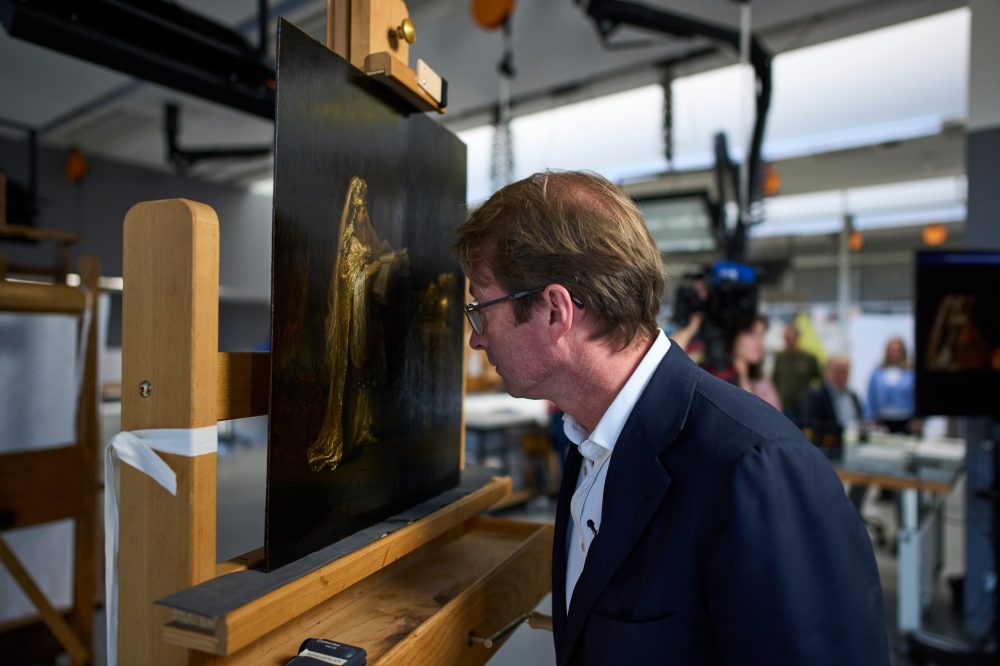
The Rijksmuseum, which serves as the country’s premier art and history institution, revealed that “Vision of Zacharias in the Temple” is indeed a genuine piece created by Rembrandt when he was 27 years old in Amsterdam during 1633. The confirmation came after two years of intensive examination and advanced technological analysis.
The artwork had disappeared from public view for decades following its purchase by an unnamed private collector in 1961. This acquisition occurred just one year after art experts had concluded the piece was not created by the famous Golden Age painter. Beginning Wednesday, visitors will be able to view the painting alongside other renowned works at the Rijksmuseum, where it will remain as part of a long-term lending arrangement.
Museum Director Taco Dibbits explained that the institution frequently receives inquiries from individuals wondering whether their paintings might be undiscovered Rembrandt works. “We always hope to find a new Rembrandt, but this happens rarely,” Dibbits told The Associated Press. He described making such a discovery as being “just like (finding) a needle in a haystack.”
The anonymous owner initially approached the museum with a simple question about whether the painting was of Dutch origin. “He really didn’t know what he had. And then to discover that it’s a Rembrandt is something that’s amazing to experience,” Dibbits explained.
The composition illustrates a religious narrative featuring high priest Zacharias receiving a divine visit from the Archangel Gabriel, who announces that Zacharias and his spouse will become parents to John the Baptist. According to the museum, the painting captures Zacharias’s astonished reaction through dramatic lighting that signals Gabriel’s celestial presence.
Jonathan Bikker, the museum’s specialist in 17th-century Dutch art, detailed the comprehensive research process that led to the authentication. The investigation included advanced macro X-ray fluorescence scanning technology and detailed comparisons with other confirmed Rembrandt pieces.
“So the wood that was used for the panel on which it’s painted, that is definitely from a tree that was cut down before 1633, the date on the painting,” Bikker explained.
“All the pigments, the paint in the painting were used by Rembrandt in other paintings. And the layers of paint and how he painted it, that is also precisely the same as in other works by Rembrandt,” he continued.
This authentication increases the catalog of known Rembrandt paintings to approximately 350 works and raises optimism about potential future discoveries.
“We’re not actively looking for new paintings by Rembrandt, but I think this gives us hope — not just us, but everyone who’s interested in Rembrandt,” Bikker stated.