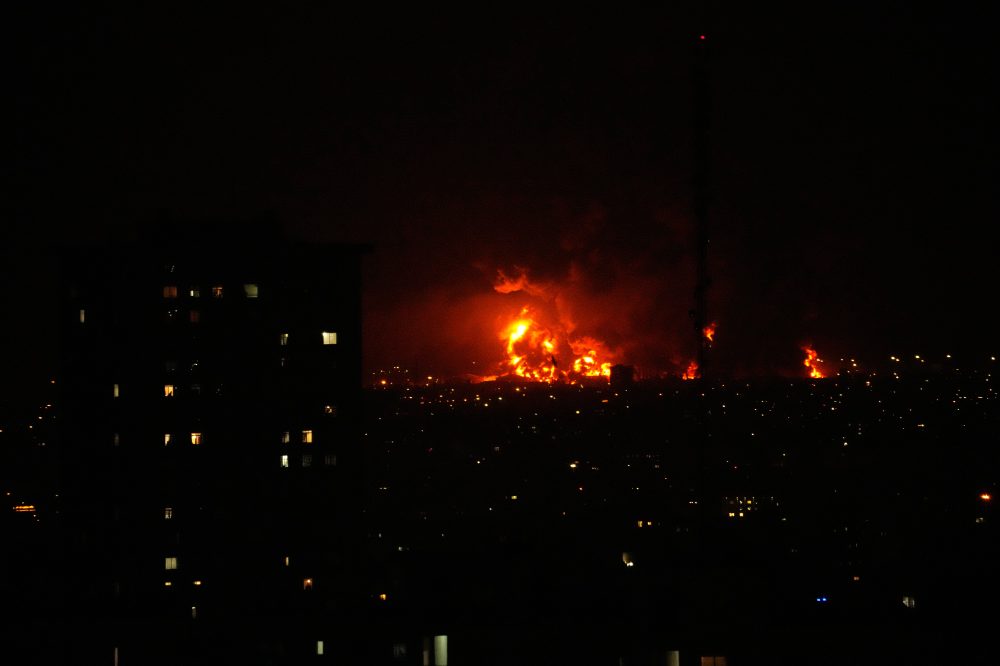

DUBAI, United Arab Emirates (AP) — Israeli forces continued their bombardment of southern Lebanon on Sunday as a regional conflict stretched into its ninth day, with Prime Minister Benjamin Netanyahu vowing “many surprises” in upcoming military operations spreading throughout the Middle East.
Sunday’s attacks in Lebanon resulted in 12 additional deaths, bringing the Lebanese casualty count beyond 300 following Israel’s evacuation orders for vast areas of the nation during military operations designed to eliminate Iranian-backed forces operating there.
The conflict began February 28 when Israel and the United States launched coordinated strikes, claiming they were targeting Iran’s nuclear facilities and missile capabilities while suggesting regime change as a goal. The warfare has now expanded regionally, causing global market instability, aviation disruptions, and significantly weakening Iran’s leadership through hundreds of combined Israeli and American bombardments.
Iranian forces have launched missile and drone attacks against Gulf neighbors, Israel has escalated Lebanese operations, and military strikes have been documented from Cyprus to waters near Sri Lanka.
During Saturday evening remarks outlining future war plans, Netanyahu stated Israel’s intention to destabilize Iran’s government and facilitate political transformation. Israel subsequently conducted another strike wave late Saturday, targeting a Tehran oil storage complex — marking the first apparent civilian industrial facility hit — creating massive fire columns illuminating the night.
Iran has issued apologies for strikes against “neighboring countries,” though its missiles and drones continue hitting Gulf state targets — including attacks killing civilians — while hardliners indicate Tehran will maintain its current strategy.
President Masoud Pezeshkian adopted conciliatory language Sunday, describing Iran’s neighbors as friends and brothers while accusing the United States and Israel of using “manipulation” to create regional divisions in televised state media comments.
“We will not bow our heads to bullying, injustice or intrusion,” he stated.
Pezeshkian and other Iranian officials have emphasized the restricted authority held by the theocracy’s leadership over the paramilitary Revolutionary Guard, which operates ballistic missiles targeting Israel and other nations. This force reports exclusively to Khamenei and appears to select its own objectives. The president serves as one of three leadership council members governing Iran since Supreme Leader Ayatollah Ali Khamenei died in the war’s initial airstrikes.
Divisions between politicians seeking conflict de-escalation and others committed to fighting the United States and Israel may hinder diplomatic initiatives.
Pezeshkian’s statements followed his previous day’s announcement that the leadership council had contacted armed forces and “from now on, they should not attack neighboring countries or fire missiles at them, unless we are attacked by those countries. I think we should solve this through diplomacy.”
The U.S. operations originate from American bases and vessels regionally, not from the Gulf Arab governments experiencing attacks.
However, hardline judiciary chief Gholam Hossein Mohseni-Ejei, another council member, indicated war strategy would continue unchanged.
“The geography of some countries in the region — both overtly and covertly — is in the hands of the enemy, and those points are used against our country in acts of aggression. Intense attacks on these targets will continue,” he posted on X.
Pezeshkian also rejected U.S. President Donald Trump’s unconditional surrender demands, saying: “That’s a dream that they should take to their grave.”
Trump warned Iran would be “hit very hard” and additional “areas and groups of people” would become targets, without providing specifics. The conflict has already disrupted global markets and weakened Iran’s leadership through hundreds of Israeli and American airstrikes.
“We’re not looking to settle,” Trump informed reporters Saturday aboard Air Force One. “They’d like to settle. We’re not looking to settle.”
He characterized ongoing U.S. Iranian operations as an “excursion” and predicted improvements in gas prices and American safety once fighting concludes.
The U.S. and Israel have focused on Iran’s military assets, leadership structure, and nuclear program. War objectives and timelines have shifted repeatedly as the U.S. has alternately suggested toppling Iran’s government or installing new leadership.
Combat operations have killed at least 1,230 Iranians, over 290 Lebanese, and 11 Israelis, according to respective government officials. Six American troops have died.
Following Pezeshkian’s apology, Iranian attacks continued.
Bahrain reports an Iranian drone strike caused “material damage” to a desalination facility — the first Gulf nation to report Iran targeting such infrastructure during the nine-day conflict.
Hundreds of desalination facilities operate along Persian Gulf coastlines, with the region depending heavily on them for water supplies.
Earlier Sunday, the United Arab Emirates reported debris from aerial interception fell on a vehicle, killing the driver. Four people have now died in the UAE since fighting began. Officials state all victims were foreign nationals.
The UAE advised residents to remain indoors Sunday morning as its military responded to drone attacks. In Kuwait, authorities reported drone waves targeting critical infrastructure, including Kuwait International Airport fuel tanks and a Kuwait City government building. At least two people died from strikes in Iraq’s semi-autonomous Kurdish region.
Saudi Arabia announced destroying a drone approaching its extensive Shaybah oil field Sunday and shooting down four drones over Riyadh, including one targeting the diplomatic quarter. Bahrain’s Interior Ministry reported missile fragments falling on a Manama road, injuring one person and damaging several shops.