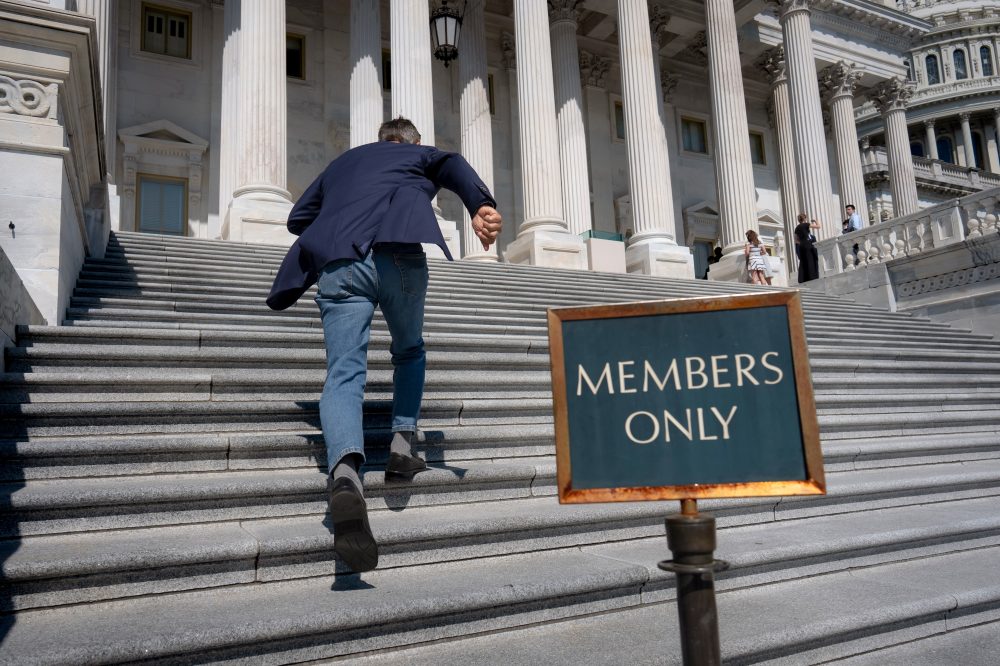

WASHINGTON — After one of the most turbulent congressional sessions in recent memory, House leaders sent members home to campaign for the summer, as voters prepare to decide which party will hold power in Congress through the remainder of President Donald Trump’s term.
For members hoping to keep their seats — especially those newly elected — making that pitch to voters is no easy task.
“I only know a dysfunctional Congress,” said Rep. Suhas Subramanyam, a freshman Democrat from Virginia.
Subramanyam said he believes the best approach is to focus on his own record of delivering results for the people he represents, rather than defending how Congress as a whole has performed, as his party works to flip control away from Republicans.
“It’s virtually impossible to sell the performance of Congress to the American people because Congress is such an easy punching bag,” he said. “And this particular Congress has been ceding too much of its authority to the executive branch.”
His advice to fellow members: “I tell people to sell yourself and what you’ve tried to do.”
On the Republican side, freshman Rep. Brandon Gill of Texas — who has become one of the party’s prominent voices, especially on Trump’s tough immigration enforcement policies — took a very different view, arguing there is a strong record to present to voters.
“We’ve gotten a lot done,” he said.
Gill pointed to a list of accomplishments: “Cutting taxes across the board, over $100 billion for border security, repealing half the Green New Deal, the biggest mandatory spending reform in history — pretty historic stuff.”
“Everybody always wants Congress to move faster than it does, but we’ve been extremely productive,” he added.
While congressional races often take a back seat during presidential election years, midterm elections tend to function as a direct judgment on whichever party is in power. History has not been kind to the president’s party in midterms — a pattern described as a “thumping” by former President George W. Bush and a “shellacking” by former President Barack Obama.
House Speaker Mike Johnson, who is preparing to travel the country to raise money for Republican candidates and visit members’ home districts, said he is confident Republicans will not just hold their House majority — but expand it.
“This week we continued to deliver for the people, and we’re going to continue that straight through the end of this year,” Johnson said before sending lawmakers home for the summer recess.
In a single legislative day before the break, Republicans passed a budget resolution seeking $95 billion for the Iran war and other priorities, moved forward a $1 trillion Pentagon spending bill renaming the department the Department of War, and approved a measure to restrict stock trading by members of Congress — all over Democratic opposition.
“We’re going to run through the tape,” Johnson said.
Meanwhile, Democratic Leader Hakeem Jeffries, who would become House speaker if Democrats win the majority, announced plans to kick off “100 Days of Action” on Sunday as his party works to take control and serve as a check on Trump’s White House.
“It’s not going to be easy, right?” Jeffries told reporters. “No one’s going to give it to us. We have to take it in a way that is consistent with the values of the American people.”
With all 435 House seats on the ballot, the fight for control typically comes down to a very small number of competitive districts. Analysts say fewer than 20 seats are considered genuine toss-ups, with the rest drawn to favor one party or the other. New district maps are still being drawn in parts of the Deep South to eliminate Black majority districts following a Supreme Court ruling that significantly weakened the Voting Rights Act.
Tens of millions of dollars are being spent on these races, with the outcome determining whether Republicans pursue further budget cuts or Democrats launch sweeping investigations into the Trump administration.
Johnson has expressed a desire for a more stable Congress while also positioning himself as a steady partner with the White House on Trump’s agenda — and as a shield against Democratic-led investigations and potential impeachment efforts.
“We are increasingly confident that we will hold and grow this majority in the House — and we must,” he said.
Democrats under Jeffries argue that Trump and the Republican majority have failed to address the financial pressures facing everyday Americans. They contend that Trump launched a war with Iran that drove up gas prices, imposed tariffs that have raised the cost of goods, carried out deportations of long-established immigrants, and cut health care and food assistance programs as part of a major tax cuts package passed last summer.
“They’re flailing all over the place,” Jeffries said.
Jeffries also pledged that Democrats “will hold the crooks accountable” on a range of issues, including business dealings involving the Trump family.
Johnson, for his part, has warned that a Democratic victory — fueled in part by far-left candidates backed by the Democratic Socialists of America — would bring a communist-style threat reminiscent of the mid-20th century.
“We have been saying that this is an election that’s shaping up as a contest between common sense and crazy,” Johnson said, adding that it has now become “common sense versus communism.”
Jeffries dismissed those warnings as unserious. “House Democrats aren’t a cult,” he said — a charge his party frequently directs at Trump’s congressional supporters. “We’re a coalition of people, public servants, who are committed to getting things done.”
One of the newest members of Congress, Rep. James Gallagher, R-Calif., said he is simply trying to stay focused on the issues that matter most to his constituents.
“We’re in a time where there’s a lot of division, unfortunately,” he said. “And I think one key is like, Hey, trying to bring people together to solve problems for Americans, right?”