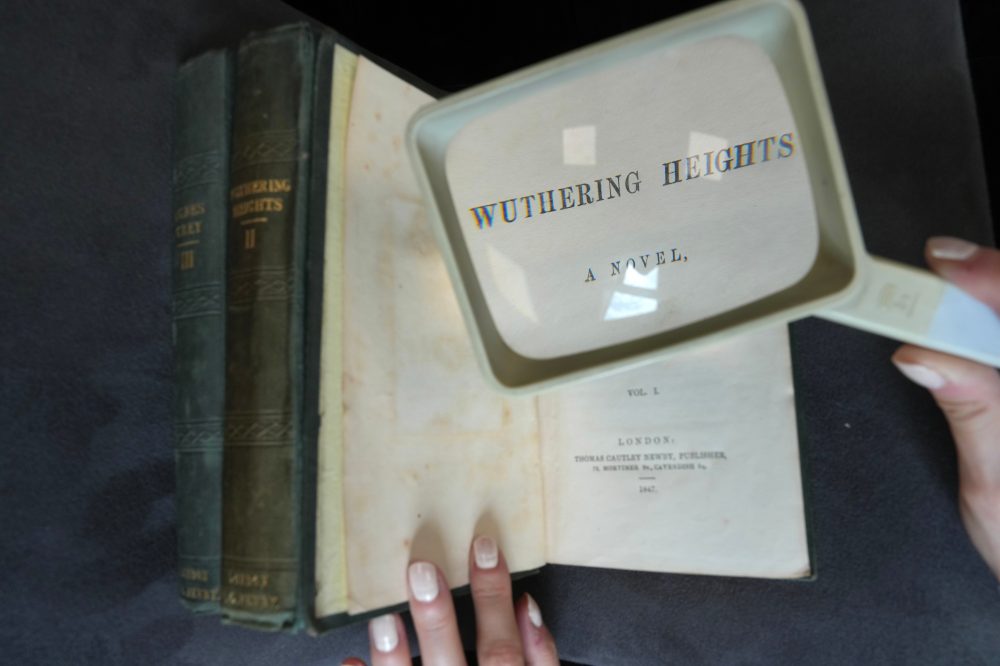

LONDON — A first-edition copy of Emily Brontë’s “Wuthering Heights” — typos and all — is going under the hammer for the first time in more than a century, drawing renewed attention as a new Hollywood film brings the beloved story to a fresh generation of fans.
Christie’s auction house announced Monday that this is the first copy of the novel still in its publisher’s original cloth binding to be auctioned since 1908. Approximately 250 copies of the first edition were ever produced, and this particular volume has sat in a private library since shortly after it was first published in 1847.
“The vast majority of surviving copies were rebound for collectors or libraries, meaning original cloth examples are now extremely scarce,” said Christie’s books and manuscripts specialist Mark Wiltshire.
The “Wuthering Heights” volume is being sold alongside a copy of Anne Brontë’s “Agnes Grey” and is expected to bring in between 400,000 and 600,000 British pounds — roughly $540,000 to $800,000 — at a June 30 sale in London. Both books were originally published under male pen names the sisters used to break into the publishing world: Emily wrote as Ellis Bell, and Anne as Acton Bell.
“Wuthering Heights” was rushed to press following the runaway success of Charlotte Brontë’s “Jane Eyre,” and the hasty production left its mark. The first edition became well known for its printing errors — including, as Wiltshire pointed out, occasional misspellings of the word “heights” itself.
The novel is enjoying a fresh wave of popularity thanks to director Emerald Fennell’s recent film adaptation starring Margot Robbie and Jacob Elordi as the ill-fated pair Cathy and Heathcliff, which takes its own creative liberties with Brontë’s dark, Gothic story.
When the book first appeared, it scandalized some readers. A critic in 1848 condemned it for its “vulgar depravity and unnatural horrors.”
In the nearly two centuries since, Wiltshire said, the novel has “moved beyond literature to become a cultural touchstone,” influencing visual art, music — most notably Kate Bush’s 1978 pop-operatic song — and numerous film versions over the decades.
“It remains a work that artists return to again and again because of its emotional force, its atmosphere, and its psychological intensity, ensuring its place not only in literary history but in wider cultural imagination,” Wiltshire said.