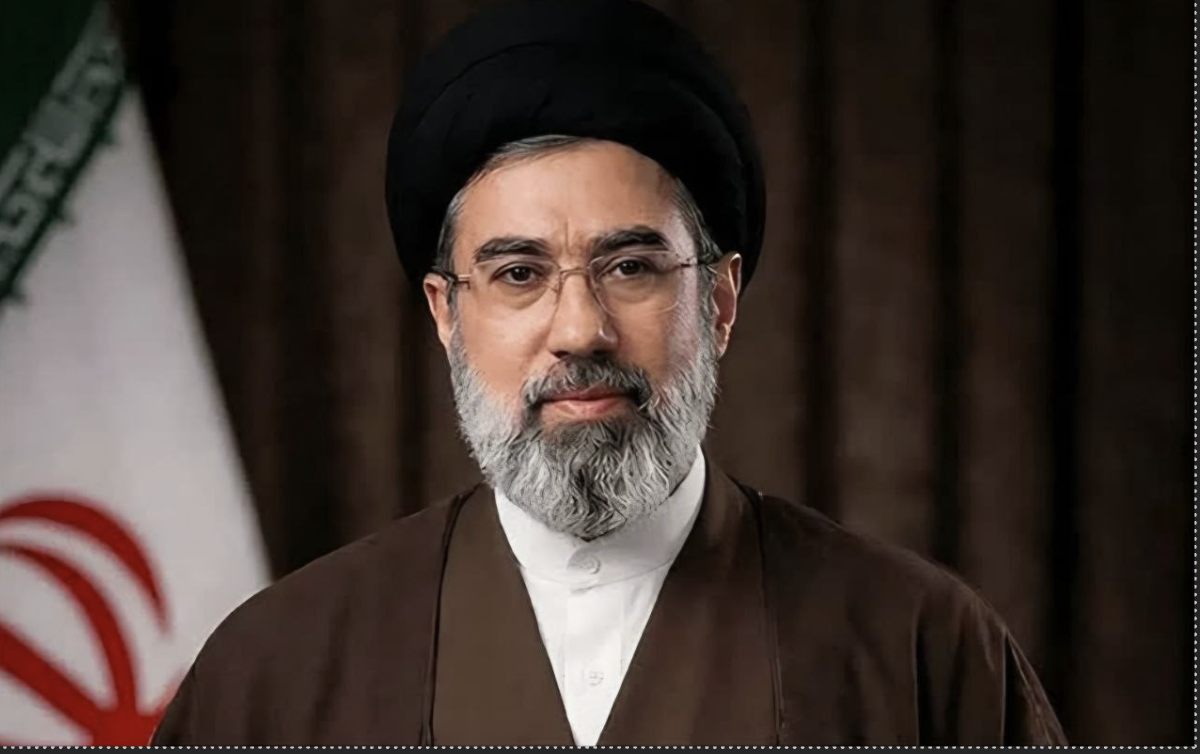

Iran’s recently appointed leader Mojtaba Khamenei released his inaugural written communication on Thursday afternoon, breaking nearly two weeks of silence following his selection as the Islamic Republic’s new head four days earlier.
According to an informed source in Tehran, the Revolutionary Guard Corps (IRGC) actually composed the statement and published it under Khamenei’s name. The message featured multiple spelling mistakes when Iranian state media outlets distributed it.
In his debut statement, released two weeks after his predecessor’s death, Mojtaba Khamenei made threats to establish additional war zones throughout the region, particularly emphasizing plans to obstruct the Strait of Hormuz. He made specific mentions of Iran’s allied forces operating in Iraq, Yemen, and Lebanon. The newly installed leader also demanded retaliation against Israel and the United States, while supporting continued strikes against nearby nations that house American and Israeli military and financial installations.
Saturday saw President Masoud Pezeshkian release a video statement offering apologies to neighboring nations for recent missile and drone attacks, explaining that these operations resulted from the deaths of top military officials whose troops had operated independently. He claimed the interim Leadership Council had authorized ending these strikes. However, within an hour, the IRGC conducted an assault on Dubai. Judiciary Chief Gholam-Hossein Mohseni-Eje’i completely rejected any such decision, declaring that attacks on these nations would persist.
Speculation continues regarding Mojtaba Khamenei’s health status, with reports suggesting he sustained serious injuries during Israel’s strike on the leadership compound (Beit e-Rahbari) at the conflict’s beginning, potentially leaving him unable to walk or make camera appearances. In his initial message, he urged his followers to “remain present on the scene” and maintain solidarity.
He also stated he had viewed Ali Khamenei’s remains, a notable claim considering that no funeral or burial arrangements have been scheduled thirteen days following the death.
This situation demonstrates both Iranian officials’ reluctance to participate in public ceremonies and the disarray affecting government institutions during the past two weeks.
Speculation persists that minimal remains existed of Khamenei’s body, along with military commanders who were located on the bunker’s ground level during the attack. While the Israeli strikes killed most Khamenei family members, supreme leader’s office staff, and on-site security personnel, Mojtaba Khamenei’s survival—who would have been a key target for Israel and the United States—continues generating significant debate.
Unlike his father, Mojtaba Khamenei maintains a reserved personality with roots in traditional religious education. He possesses limited skills in public speaking, administrative management, or modern Persian writing.
His preference for the Arabic Hijri lunar calendar over Iran’s official Iranian Solar calendar demonstrates his separation from contemporary Iranian social conditions. This contrasts sharply with his father, who projected intellectual sophistication, organized literary events with followers, and exclusively used the solar calendar in official correspondence.
Mojtaba Khamenei has never given a public address. His sole video message dates to last year, when he announced in traditional clerical style the postponement of his religious classes indefinitely. Additionally, despite previously holding significant sway within his father’s office regarding political and security issues, he has been noticeably absent from such responsibilities during the past year.
The new leader’s digital office has encouraged supporters to follow his Instagram, X, and Telegram accounts, platforms that remain officially prohibited within Iran. Recently, social media users have ridiculed the new leader through artificial intelligence-created content, while IRGC-affiliated media organizations have employed similar technology to create images of him with Ali Khamenei, due to limited recent photographs, and to digitally improve his appearance.
A knowledgeable Tehran source informed The Media Line that following the message’s publication, the IRGC had originally composed it before adapting it to match Mojtaba Khamenei’s writing style. Many high-ranking officials have not met him personally, and reports indicate he is receiving medical care in a secure underground location outside Tehran. This occurs as the IRGC-connected Fars News Agency reported that the new “supreme leader” had become a janbaaz, a term specifically describing someone who has experienced severe physical trauma, including limb loss.
Early Monday morning, immediately after announcing Mojtaba Khamenei’s appointment, residents across various sections of the capital climbed onto their rooftops, shouting “Death to Mojtaba.”
A witness informed The Media Line that recently the Basij and IRGC have significantly increased their use of deadly force, resulting in multiple fatalities in Tehran. The casualties include civilians who had celebrated Ali Khamenei’s death in the streets, dancing and expressing joy, before being shot by security forces equipped with heavy infantry weapons and semi-heavy military gear.