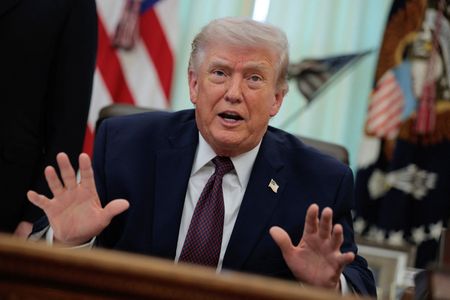

Diplomatic relations between America and its NATO partners have reached a new low after President Donald Trump announced he is contemplating withdrawing the United States from the decades-old military alliance.
The president’s consideration stems from European nations’ refusal to deploy naval vessels to help clear the Strait of Hormuz, according to statements he made to Britain’s Daily Telegraph on Wednesday.
NATO was established in 1949 as a defense partnership against Soviet threats and has served as the foundation of Western security policy for over seven decades. The alliance encompasses European nations, the United States, and Canada.
Trump’s comments followed Defense Secretary Pete Hegseth’s refusal to confirm America’s dedication to NATO’s mutual defense principle during a Tuesday briefing.
“I was never swayed by NATO. I always knew they were a paper tiger, and (Russian President Vladimir) Putin knows that too, by the way,” Trump stated in the Telegraph interview, adding that he had moved “beyond reconsideration” of U.S. membership.
Defense analysts have consistently cautioned that questioning American commitment to NATO obligations could embolden Russia to challenge member nations’ willingness to uphold Article 5, which declares that an assault on any member constitutes an attack on the entire alliance.
France became one of the first European NATO countries to respond, though officials avoided directly addressing Trump’s withdrawal threat.
“Let me recall what NATO is,” said French junior army minister Alice Rufo. “It is a military alliance concerned with the security of territories in the Euro-Atlantic area. It is not intended to carry out an operation in the Strait of Hormuz, which is not in accordance with international law.”
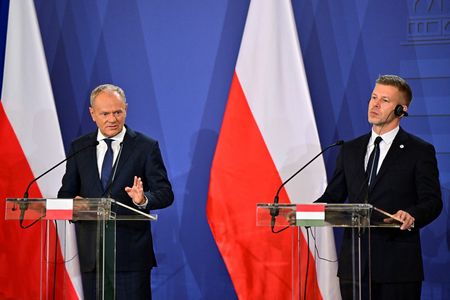
Polish Defence Minister Wladyslaw Kosiniak-Kamysz urged restraint in response to the escalating situation.
“I hope that amid the emotions surrounding the President of the United States today, a moment of calm will come,” he stated. “And why? Because there is no NATO without the United States, and it is in our interest that this calm comes. But there is also no American power without NATO.”
NATO leadership has not yet issued an official response to Trump’s remarks.
A German government representative reaffirmed Berlin’s commitment to the alliance when questioned about Trump’s statements. “This isn’t the first time he’s done this, and since it’s a recurring phenomenon, you can probably judge the consequences for yourself,” the spokesperson said during a routine press briefing.
British Prime Minister Keir Starmer indicated he would prioritize his nation’s interests regardless of political “noise.” He suggested that instability from the Iran conflict should prompt Britain to strengthen economic and defense partnerships with Europe.
The ongoing Iran conflict has intensified existing friction between America and Europe that has grown since Trump began his second presidential term. Disputes have emerged over trade policies and Trump’s territorial claims regarding Greenland, which belongs to NATO member Denmark.
European leaders are also monitoring Trump’s diplomatic efforts to end the Russia-Ukraine conflict, with some senior officials worried that any agreement might favor Moscow’s interests.
When questioned Tuesday about America’s continued support for NATO’s collective defense principle, Hegseth responded: “As far as NATO is concerned, that’s a decision that will be left to the president. But I’ll just say a lot has been laid bare.”
“You don’t have much of an alliance if you have countries that are not willing to stand with you when you need them,” Hegseth added.
According to Reuters sources, France has blocked Israel from using its airspace for resupply missions carrying American weapons in the Iran conflict, while Italy has denied landing rights for U.S. military aircraft at Sicily’s Sigonella base before Middle East deployments. Both nations maintain these represent standard policies with no recent changes.
Spain has publicly announced a complete closure of its airspace to American aircraft participating in Iran operations.
Trump has also repeatedly criticized Britain for declining to join the United States in launching military action.