
LUANDA, Angola (AP) — During his African journey, the pontiff’s message resonated powerfully across the continent.
Some observers argue that Pope Leo XIV, known for his cautious and reserved Midwestern Augustinian approach, discovered his strongest voice during his extensive African tour, condemning what he called a “handful of tyrants” and “chains of corruption” that have plagued portions of the continent for generations.
However, Leo has been delivering similar messages for some time, including regarding the U.S.-Israeli conflict in Iran. It wasn’t until President Donald Trump’s unprecedented attack and Vice President JD Vance’s assertions of theological authority that many began listening closely, particularly American Catholics.
“Certainly, Pope Leo may appear to be actively engaging in his understated manner with authority, and this is the perception among global media and social platforms,” Cardinal Michael Czerny, a senior Vatican official and Leo’s advisor, explained to The Associated Press.
“However, the Holy Father’s sermons and addresses in Africa were prepared well beforehand, focusing on local African circumstances and the church,” Czerny stated. “Therefore, if they appear connected to current conflicts and controversies, this brings to mind Jesus’s words, ‘Whoever has ears to hear, let them hear!’”
Leo attempted to clarify this point when he addressed reporters aboard Air Pope One on April 18, traveling from Cameroon to Angola, expressing frustration that “a certain narrative” had emerged suggesting he was feuding with Trump regarding the Iran conflict and that his African peace messages targeted the president.
Leo maintained his statements about tyrants and religious justifications for warfare had been misunderstood, emphasizing he was addressing only African situations, specifically a separatist struggle in western Cameroon.
Nevertheless, Leo appeared to be taking both positions. While he was indeed discussing the separatist conflict during a peace gathering in Bamenda and preaching Gospel messages of peace and brotherhood, he has also been addressing Trump frequently.
“Pope Leo’s distancing from certain interpretations represented an effort to defuse a very precarious situation,” explained Massimo Faggioli, a theology professor at Trinity College Dublin. “The Vatican requires the United States to establish some form of peaceful framework — not necessarily order — but a vision of peace, hope for peace.”
Leo had criticized Trump directly before arriving in Africa. In one notable statement two weeks prior, he urged believers to contact their congressional representatives demanding an end to the conflict.
The major story from the April 7 meeting outside Leo’s country residence in Castel Gandolfo was Leo describing Trump’s threat to destroy Iranian civilization as “truly unacceptable.”
However, his subsequent message carried greater significance. “I would encourage citizens from all involved nations to reach out to authorities, political leaders, congressmen, asking them, telling them to pursue peace and reject warfare,” Leo declared.
Faggioli described this statement as “the Vatican’s nuclear option,” representing a direct appeal to American voters to take action, driven by genuine concern that Trump might escalate the Iran conflict catastrophically.
The Holy See had never issued such an explicitly political papal message, even during the Cuban Missile Crisis when Catholic president John F. Kennedy faced potential nuclear confrontation with the Soviet Union, Faggioli noted.
During that crisis, Pope John XXIII did make a public appeal — his renowned October 25, 1962, radio broadcast — with an urgent, direct peace plea including to “those bearing the responsibility of power” to “do everything possible to preserve peace.”
That pope also sent private correspondence to Kennedy and Soviet Premier Nikita Khrushchev while working diplomatically behind the scenes to reduce tensions. However, he didn’t encourage U.S. voters to essentially choose between their president and their pope.
“What’s at stake currently is that during wartime, Catholic loyalties face particular testing,” Faggioli observed. He noted that regardless of how the situation resolves, this tension will affect future political ambitions of Catholics seeking high office, whether Vance on the Republican side or California Governor Gavin Newsom for Democrats, as long as an American-born pope leads in Rome.
Kathleen Sprows Cummings, director of the Global Catholic Research Initiative at the University of Notre Dame, said Leo has consistently functioned “on a higher plane,” but American Catholics typically encounter church moral discussions regarding sexuality, gender and abortion, making foreign policy through a moral framework unsettling.
“So JD Vance can say the pope should stick to morality,” she noted, “but war and peace are ancient moral issues.”
The Reverend Antonio Spadaro, under-secretary in the Vatican’s culture department, said Leo continues the tradition of previous popes preaching Gospel peace messages. What changed, he said, was Trump’s response.
“The forceful reaction came from America,” he stated. “It was America responding to Leo’s words, not the reverse.”
Despite Leo’s direct Trump comments, he wasn’t launching an attack, Spadaro emphasized.
“It’s extremely dangerous to think the pope is battling Trump, because it reduces the pope to a confrontational level, one against another, which Trump might desire but the pope has no intention of pursuing,” he explained.
Spadaro added that from his perspective, Leo remains unchanged from when he was known as Robert Prevost, the Chicago-born missionary priest.
“I observe the same Prevost I’ve always known,” Spadaro said. “The setting has transformed, so his composed yet very direct approach contrasts sharply with a chaotic environment, which makes it remarkable.”
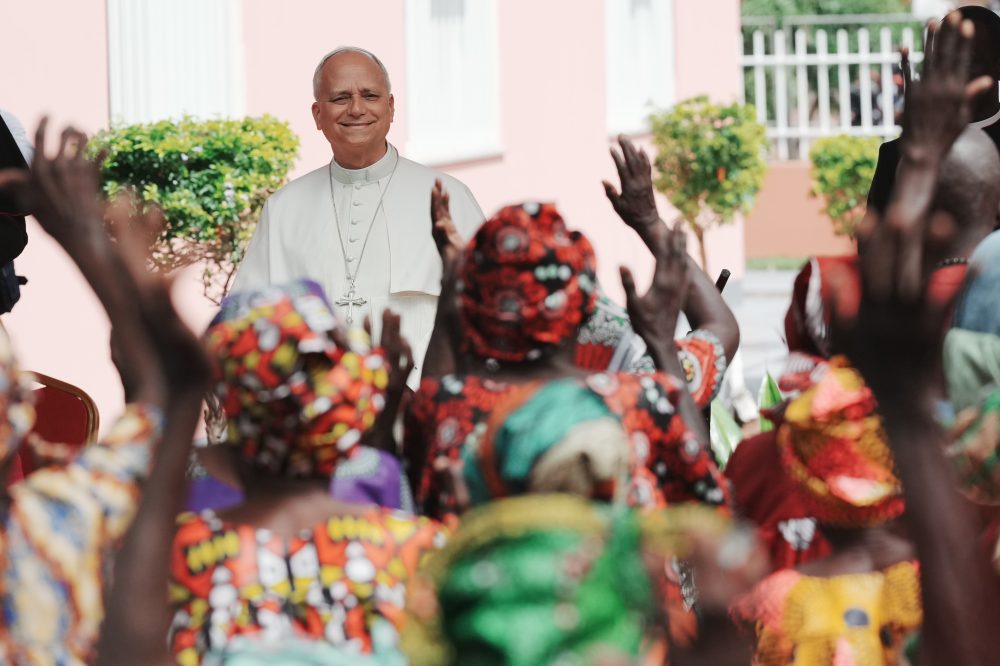
For better or worse, the extraordinary drama involving Trump, warfare and geopolitics seems distant from Leo’s daily ministry to his African congregations, who have gathered in massive numbers to welcome the American pope at each location during his four-nation journey.
The multilingual pope has facilitated communication with his audiences, delivering addresses, sermons and prayers in local languages: French in Algeria, English and French in Cameroon, Portuguese in Angola and, beginning Tuesday, Spanish in Equatorial Guinea.
Lucineia Francisco left her family Sunday to witness Leo at the Shrine of Mama Muxima, Angola’s most beloved pilgrimage site. Approximately 30,000 people attended Leo’s rosary prayer service.
“My children were crying to accompany me, but I refused,” Francisco said. “This is a spiritual journey I’m truly undertaking alone.”