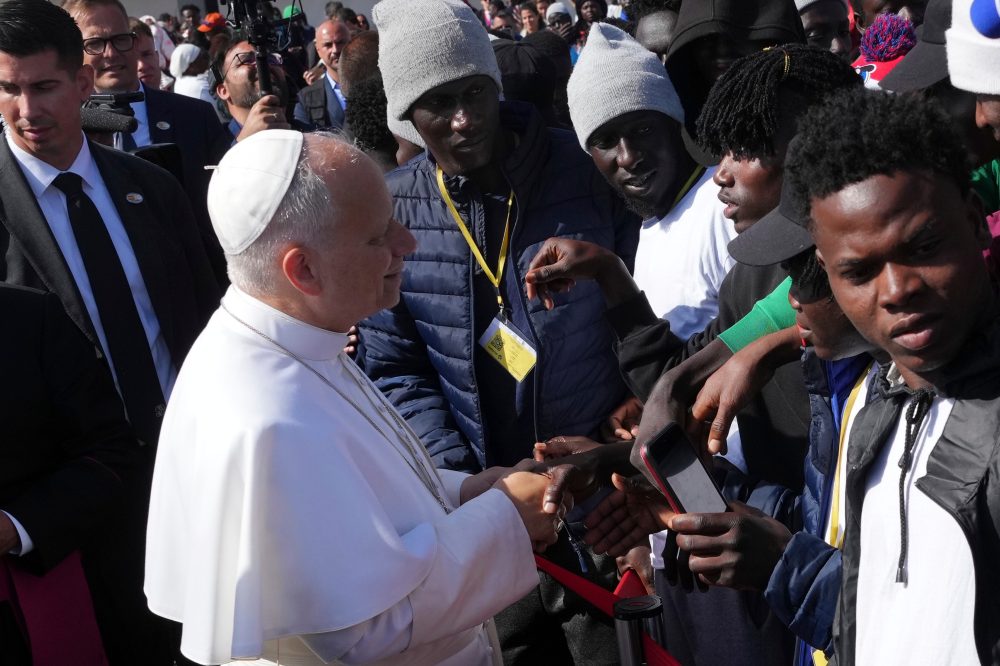

SAN CRISTOBAL DE LA LAGUNA, Spain — During the concluding day of his Spanish visit, Pope Leo XIV issued a forceful condemnation of human smugglers on Friday, warning they would encounter divine judgment for taking advantage of desperate migrants at this crucial hub of the African migration pathway to Europe.
“Break those chains and free those you hold in bondage,” Leo declared while addressing human traffickers during his meeting with humanitarian organizations in the Canary Islands that assist migrants.
The pontiff concluded his week-long Spanish journey in the Canary Islands, a Spanish island chain positioned nearer to Africa than mainland Spain and serving as a critical entry location for migrants undertaking the dangerous Atlantic voyage from West Africa.
Leo’s visit honored Pope Francis’ desire to travel to these islands to remember the thousands who perished at sea. The trip also highlighted the Catholic Church’s scriptural obligation to “welcome the stranger” during a time of growing anti-immigrant feelings across Europe and mass deportation efforts by the Trump administration in his home country of the United States.
While meeting with relief organizations in Tenerife, Leo urged host communities to welcome people escaping conflict, poverty and environmental disasters, protecting them from the “silent shipwreck” of abandonment that leaves them homeless after surviving treacherous sea journeys.
“A human conscience, and even more so a Christian conscience, cannot remain indifferent in the face of these graveyards of the sea, to the victims of shipwrecks and the lack of aid,” Leo stated. “Every life lost on these routes is a failure for the human family.”
The Canary Islands have served as a traditional gateway for migrants attempting to reach Europe from West Africa and Morocco.
Although human smugglers and traffickers control the Atlantic pathway, many boats contain self-organized groups of migrants, including numerous former fishermen from Senegal who lost their livelihoods due to recent overfishing.
Migration arrivals to the Canary Islands reached their highest point in 2024 with nearly 47,000 people. Numbers have dropped significantly, with more than 3,000 individuals arriving during the first five months of 2026.
Due to the ocean’s enormous size and limited rescue vessels or surveillance, some authorities believe the Atlantic passage poses greater dangers than the more publicized central Mediterranean smuggling corridor from Libya and Tunisia to Italy. Starting in 2020, multiple West African vessels have been discovered in the Caribbean and Latin America carrying only deceased passengers after drifting across the Atlantic, carried by trade winds and ocean currents.
Leo focused his Friday comments on criminal networks and individual smugglers who organize these “death routes” to Europe. These traffickers demand thousands of euros per person and frequently force passengers into prostitution or illegal labor by keeping their identification documents to collect debt payments.
“Stop. Repent,” Leo told traffickers in his message. “For every life lost, every family deceived, every body subjugated, every woman threatened, every worker exploited, you will have to appear before divine justice.”
“Repent while there is still time, for God’s mercy can reach even the most hardened sinner, but it enters only through the narrow gate of truth, justice and conversion,” he continued.
Through his two-day Canary Islands visit, Leo has established himself as Francis’ successor in migration advocacy, which remained a central focus throughout Francis’ 12-year leadership and frequently created tensions with American and European authorities.
The first American-born pope has not merely repeated Francis’ messages and actions, but has expanded them during this highly symbolic journey. Upon arriving Thursday, Leo tossed flower petals into the ocean from a harbor called the “Dock of Shame” in 2020, when migrants were forced to endure terrible conditions during an increase in arrivals.
Leo’s action echoed Francis’ 2013 visit to Lampedusa, Sicily, another European migration crisis location, where he criticized the “globalization of indifference” shown toward asylum seekers worldwide.
Demonstrating his personal approach to the papacy, the 70-year-old pope added his own touch: Following a former migrant’s personal story, Leo performed the popular “6-7” hand signal favored by young people while joking with him. This gesture generated cheers and applause from attendees.
During his time in the Canary Islands and earlier remarks on the Spanish mainland, Leo has reinforced migrants’ rights both to flee and to remain in their homelands, calling on their origin countries to provide adequate economic and security conditions. He criticized European nations that ignore migrants’ suffering and emphasized that no Christian can stay indifferent.
On Friday, he observed that for the Catholic Church, helping migrants integrate into communities can create opportunities for sharing faith, “without imposing” it while respecting migrants’ personal beliefs.
Leo began his final day by touring the Las Raíces migrant facility and meeting with migrants. Leo received enthusiastic applause when he departed from his prepared remarks to announce he would speak in French and English.
One woman shared her desperation that led her to abandon her homeland and family, the trauma of dangerous crossings, and her appreciation for finding safety and a fresh start. The woman, named as Bousso Diouf, requested respect and dignity for all migrants.
In the coming month, on July 4, the American pope will observe U.S. Independence Day on Lampedusa island, where Francis first condemned the “globalization of indifference” toward migrants in 2013.