
LOS ANGELES (AP) — Steven Spielberg’s latest film “Disclosure Day,” released Friday, once again asks viewers to consider whether extraterrestrial beings exist — and what their presence might mean for religious faith on Earth.
However, Spielberg isn’t alone in generating recent news coverage about UFOs and potential life beyond our planet.
Topics once dismissed as fringe conspiracy theories have recently appeared in discussions from the White House to the Catholic Church, as public interest in unidentified anomalous phenomena — known as UAPs in government terminology — enters mainstream conversation.
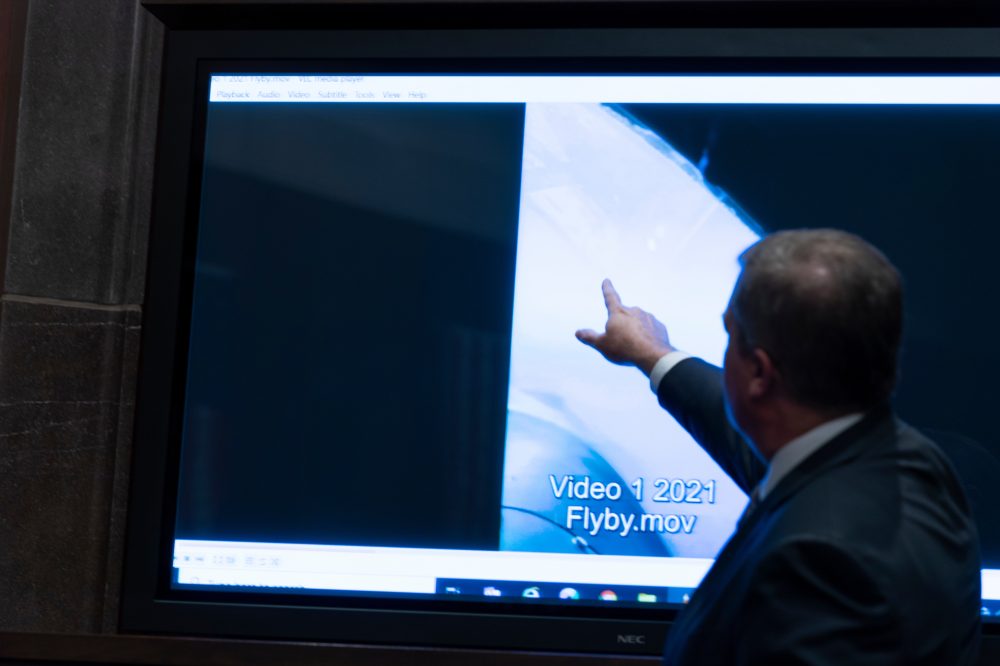
In May, the Pentagon released extensive UFO documentation with minimal explanation, allowing interested researchers to draw their own conclusions. This disclosure occurred weeks after former President Barack Obama sparked media attention by stating definitively in an interview that aliens exist, though he subsequently clarified his position.
“Statistically, the universe is so vast that the odds are good there’s life out there,” the former president wrote on social media after making an unexpected appearance on the “Disclosure Day” film set. “I saw no evidence during my presidency that extraterrestrials have made contact with us. Really!”
While some religious followers and non-believers argue that extraterrestrial life might challenge many faiths by questioning human uniqueness, others present opposing viewpoints.
“Belief in UFOs is really one of the best things that’s happened to religion in a long time,” stated Diana Walsh Pasulka, a religion scholar at the University of North Carolina Wilmington. “It’s a blow to the secular, materialist worldview.”
Although widespread UAP interest may support belief in a mystical universe, some Christians view these phenomena with suspicion.
“I don’t think they’re aliens. I think they’re demons,” Vice President JD Vance, a Catholic convert, stated during a recent podcast appearance.
Monsignor Stephen Rossetti, previously an exorcist with the Archdiocese of Washington, shared similar views. The archbishop dismissed him last week, stating that Rossetti’s comments “gravely undermine” Catholic doctrine regarding demons and the devil.
“It’s my personal belief that probably many, if not most, of these UFO sightings are in fact demons,” Rossetti stated in a May 29 video on his Facebook page. “Aliens, if there are aliens, don’t possess people.”
Christopher Baglow, who directs a science and religion program at the University of Notre Dame, expressed surprise at the dismissal since Rossetti clearly indicated he was sharing personal views. Baglow suggested additional factors may have influenced the decision.
“I ask forgiveness for any ways that I have not been faithful to the teachings of the Church’s Magisterium,” Rossetti wrote in an online statement.
Despite claims by Vance and Rossetti regarding demons, Baglow asserts the Catholic Church has historically remained open to extraterrestrial possibilities. “Theologians have been speculating about this for centuries and the church has never ever taught one way or the other,” he explained.
During a meeting with astronomy students at the Vatican last year, Pope Leo XIV discussed the “ancient light of distant galaxies” and the “mysterious joy” inspired by space exploration. Some interpreted his comments as indirect consideration of life on other worlds.
Concepts of otherworldly visitors to Earth have ancient origins.
“People would call it the plurality of worlds. So even back in the time of Socrates and Aristotle, there were Greek philosophers who talked about beings on other planets and other stars,” Walsh Pasulka explained.
Modern UFO concepts emerged after 1945, according to Jeffrey Kripal, a religious historian at Rice University. “The flying saucer and the alien and the UFO — it’s definitely a Cold War invasion narrative,” he noted.
This narrative explains why UAPs often appear threatening to humans. However, it has transformed over time, leading to religious movements — including Scientology, which attracts numerous Hollywood celebrities — that view extraterrestrials positively or as part of divine purpose. Some Nation of Islam followers believe their founder will return to Earth apocalyptically via spaceship.
The International Raëlian Movement, or Raëlism, represents a UFO-based religion established in France during the 1970s. It continues today with significant followings in parts of Asia, Africa and Canada, according to Susan Palmer, a sociologist studying new religious movements at Concordia University in Montreal.
Raël, the movement’s founder, claims direct descent from Yahweh, whom Raël allegedly visited on the planet Elohim in 1975. Raëlism teaches that Buddha, Jesus and Muhammad are human-extraterrestrial hybrids and Raël’s half brothers.
Among groups Palmer has researched, she considers Raëlism most favorable toward UFOs. “They’re not interested in extraterrestrial wars,” she observed.
Some believe this positive attitude may be expanding.
Kripal, who oversees Rice’s archival collection of reported paranormal experiences called the Center for the Impossible, notices growing acceptance of UFO discussions — and possibilities that they aren’t threatening.
“People are reporting these experiences or these encounters with entities and they’re religious through and through,” he said. “My colleagues in the academy, they’re really starting to listen in a different way.”