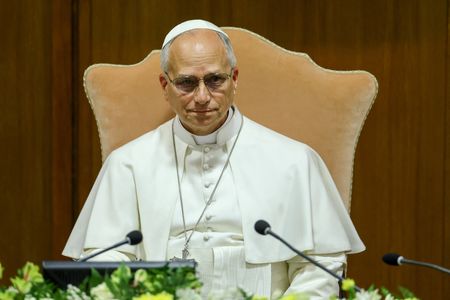

Pope Leo has issued his inaugural major papal teaching document, calling on world governments to decelerate artificial intelligence advancement while warning these systems spread false information, fuel conflicts, and could push humanity toward perpetual warfare.
The pontiff, who has taken increasingly bold stances in recent months and faced criticism from U.S. President Donald Trump following his condemnation of the Iran war, delivered numerous passionate pleas to global leaders in the extensive document, known as an encyclical.
The first American pope advocated for preventing AI data ownership from remaining exclusively with private entities, protecting worker rights and children’s safety from the technology, and reducing competitive tensions among AI corporations.
“What is needed is a more active political involvement that is capable of slowing things down when everything is accelerating,” Leo stated in the document titled “Magnifica Humanitas” (Magnificent Humanity).
The pontiff demanded “robust legal frameworks, independent oversight, informed users and a political system that does not abdicate its responsibility.”
Encyclicals represent among the most significant forms of papal instruction to the Church’s 1.4 billion followers worldwide.
The eagerly awaited document released Monday, containing nearly 43,000 words, has been under development almost since Leo’s papal election just over a year ago.
While artificial intelligence served as the primary focus, the encyclical also condemned ongoing global conflicts, criticized the erosion of international organizations, and cautioned that weapons industry profits drive warfare.
“The past 60 years have been marked by conflicts of astonishing brutality, often affecting civilian populations on a massive scale,” Leo declared in the English version.
“Humanity is slipping into a violent culture of power, where peace no longer appears as a responsibility to be taken on, but as a fragile interval between conflicts,” he continued.
Leo delivered one of the most definitive papal rejections of just war theory, a principle the Church has employed since at least the fifth century to assess global conflicts.
This doctrine, which typically permits warfare only for defensive purposes against aggression, has been referenced by Trump administration officials, including Vice President JD Vance, a Catholic, to support the Iran war.
“The ‘just war’ theory which has all too often been used to justify any kind of war, is now outdated,” Leo declared.
“The use of force, violence and weapons reflects a relational poverty that always has disastrous consequences for civilian populations.”
The pope also worried that leaders might initiate conflicts to divert public attention from internal problems.
“We cannot rule out the possibility that some leaders may consider armed conflict as an effective way of diverting attention from domestic problems and a cynical tool for managing difficulties,” he wrote.
Regarding AI in military applications, the pope insisted any use “must be subject to the most rigorous ethical constraints” and declared it “not permissible” to allow AI systems to make deadly decisions.
Leo, the 14th pontiff to select that name, referenced centuries of previous papal social justice teachings before examining AI ethics.
He particularly mentioned his predecessor Leo XIII, who issued a renowned 1891 encyclical demanding improved wages and working conditions for laborers during the Industrial Revolution.
Leo XIV condemned what he termed “new forms of slavery” experienced by workers maintaining AI systems and factory employees producing technological devices like computers and smartphones that run AI.
“In some regions of the world, children and adolescents work in dangerous conditions, crushing the materials from which rare earth elements are extracted,” the pope wrote.
“The bodies of these people are scarred, injured and worn down so that computational flow may continue uninterruptedly,” he stated. “This reality deeply challenges the moral conscience of our time.”
The pontiff also recognized that the Catholic Church failed to strongly oppose transatlantic slavery until the 19th century, offering a personal apology.
“This constitutes a wound in Christian memory,” he wrote. “For this, in the name of the Church, I sincerely ask for pardon.”
Leo, who indicated at the document’s beginning his intention to address Catholics and all people of goodwill, said society must confront “crucial questions” about AI development and global leadership direction.
Referencing the biblical Tower of Babel story — where human pride drives attempts to build a tower reaching Heaven, provoking divine anger — the pope highlighted risks of any endeavor that “aspires to reach heaven without God’s blessing.”
“With the heart of a shepherd and a father, I ask everyone to abandon the construction of yet another Tower of Babel and to join forces in building up the common good,” the pope declared.
Leo encouraged the world to persist in addressing potential AI dangers.
“A subtle temptation may emerge, namely the thought that the problems are too big and we are too small, and that our choices, therefore, cannot make a difference,” he wrote.
“Certainly, not everyone has the same power to make a difference,” Leo concluded. “Yet, no one is without responsibility. We all have our own areas for action.”