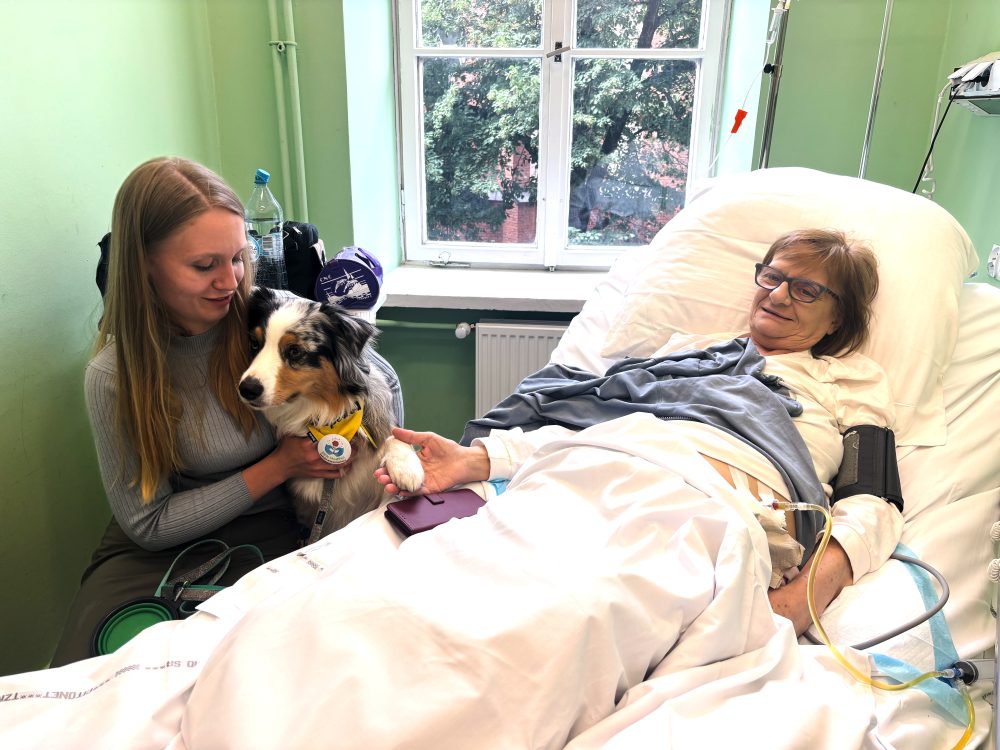

WARSAW, Poland — When Ewa Lutka-Krawczyk received her gallbladder cancer diagnosis, her immediate concern wasn’t for herself — it was for Gaja, a shelter dog she had welcomed into her home three years earlier. She pleaded with her doctor to promise her she would survive long enough that the deeply bonded Gaja “wouldn’t be left behind.”
The outlook, however, was not hopeful. This month, the 70-year-old was admitted to the palliative care ward of a Warsaw hospital. Back home with Lutka-Krawczyk’s husband, Gaja had nearly stopped eating.
“She is waiting for me,” Lutka-Krawczyk said from her hospital bed, where she lay resting with a drainage tube connected to her abdomen.
A new bill working its way through Poland’s parliament could soon change the situation for patients like her. The proposed legislation would establish a legal right for patients in hospices and palliative care wards to receive visits from their pets. While many clinics already permit such visits, no universal legal protection currently exists.
The proposal was championed by Dr. Tomasz Dzierżanowski, director of the Palliative Medicine Clinic at the Medical University of Warsaw — the very facility where Lutka-Krawczyk is receiving care. A member of Prime Minister Donald Tusk’s centrist party introduced the measure to parliament.
Dzierżanowski believes that having a cherished animal companion nearby can ease both the physical and emotional suffering of terminally ill patients, especially at a time when society is gripped by what he calls “an epidemic of loneliness.”
“We make sure that no patient dies alone,” Dzierżanowski told The Associated Press. “When someone is suffering, it is important that someone is there for them. Ideally, that should be another human being. Sometimes, however, there is no one.”
He frequently encounters elderly patients who have outlived their closest friends, as well as younger patients who, shaped by a world of screens and online connections, never formed the deep personal bonds that previous generations often had.
The turning point for Dzierżanowski came when he treated a gravely ill cancer patient named Waldemar, whose greatest fear was not death itself but what would become of his two cats. Dzierżanowski arranged for the cats to be brought to the ward. The man’s tearful joy and the cats’ emotional response — along with the reaction of fellow patients and hospital staff who witnessed the moment — “made me realize that this issue finally needed to be addressed,” he said.
Dzierżanowski already permits pet visits in his clinic when circumstances allow, which means Lutka-Krawczyk can look forward to seeing Gaja. When she found out, she was visibly relieved.
Katarzyna Piekarska, the lawmaker who introduced the bill — which is currently before parliament’s health committee — noted that the practice is already happening informally. “In reality, animals in hospitals are already there anyway,” she said. “That’s why it needs to be regulated in the law.”
Dzierżanowski also welcomes therapy dog visits at the clinic. During a visit by the AP, an Australian shepherd named Kluska was making her rounds alongside her owner, Małgorzata Brzozowska.
Kluska — whose name translates to “dumpling” — brought a moment of lightness to Lutka-Krawczyk, who held the dog’s paw and broke into a smile. Nearby, another patient, 58-year-old Wojciech Zelik, who was admitted with a tumor, propped himself up to watch as Brzozowska had Kluska perform tricks.
“She has such lovely fur to pet, so fluffy,” he said, reaching over to rub the dog’s head.
Brzozowska noted that therapy dog visits benefit not just the patients but also the nurses, cooks, and other staff who care for the terminally ill. Several staff members stopped to fuss over Kluska in the hallway — with one cook slipping her slices of ham.
Brzozowska, a medical student, said the positive effects are even stronger when patients are visited by their own animals. The visits tend to calm the patients, their family members, and the animals themselves.
“The dog isn’t as stressed,” she said. “We interpret this as meaning that he simply knows what’s happening, that he knows where the owner, who was always there before, has disappeared to.”