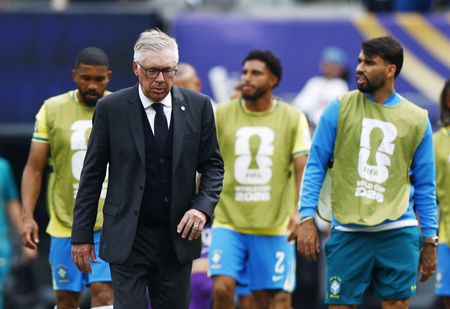

EAST RUTHERFORD, New Jersey — Brazil spent three years desperately trying to bring Carlo Ancelotti on board, treating the Italian manager as though he held the secret to a sixth World Cup title. But after falling 2-1 to Norway in the sweltering New Jersey heat on Sunday, the five-time world champions found out the hard way that even one of club football’s most accomplished managers can’t work miracles with a squad held together by reputation, sentiment, and worn-out legs.
Italy’s footballing decline has long served as a cautionary tale — proof that nations can fall behind quickly if they neglect the game at home. Brazil is now writing its own uncomfortable chapter in that same story.
The years-long courtship of Ancelotti while he was still managing elsewhere left Brazil’s national program adrift under three different caretaker managers. By the time he finally took charge, the damage was already deep. One year was simply not enough to undo three years of drift and disorganization.
Ancelotti’s reputation as one of the most trophy-laden managers in football history couldn’t shield him from the consequences of his own squad decisions. His choice to lean on aging players who appeared well past their prime proved especially costly.
Casemiro, Danilo, and Neymar all arrived carrying storied careers — and heavy legs to match. Against Norway, those limitations were impossible to ignore.
Both of Norway’s goals came through Brazil’s left side, where substitute Andreas Schjelderup brought an energy that Brazil simply couldn’t match. Danilo, 34, was deployed at right back — a position he hadn’t regularly played in years, having been used more as a backup center back at club level. The result was a mismatch that Norway exploited with purpose. Schjelderup attacked with drive and directness; Danilo looked lost.
Casemiro fared no better throughout the tournament. He was repeatedly beaten for pace, gave the ball away too often, and on Sunday — grinding through the oppressive New Jersey heat — looked like a vehicle well past its service life struggling up a steep mountain pass.
Neymar was brought on late, with the match still scoreless and Brazil in desperate need of a spark. He did manage to convert a stoppage-time penalty, but it was a consolation goal rather than a rescue mission.
The deeper issue was everything that came before that moment. Neymar arrived at the tournament carrying an injury and offered almost none of the explosive pace, creativity, or unpredictability that once made him one of the most dangerous attackers in the world. He moved slowly, predictably, and without urgency — a shadow of the player he once was.
If the broader plan was to use this tournament to develop a new generation ahead of the 2030 World Cup, Brazil’s roster choices become even harder to defend. With a full international cycle ahead and less pressure on this group to deliver a title immediately, Ancelotti had the opportunity to leave the veterans at home and give younger players meaningful experience on the biggest stage. Instead, Brazil tried to honor the past while building toward the future — and managed to do neither.
The consequence is at least a 28-year wait for a sixth World Cup crown — an almost unimaginable drought for a nation whose footballing identity has always been built on creativity, boldness, and dominance.
For much of this tournament, Brazil looked like a team that had lost its identity. Only Vinicius Jr. offered glimpses of the flair and brilliance the country is known for, a sign that the talent hasn’t completely disappeared.
But around him, Brazil lacked sharpness, speed, and — most tellingly — looked nothing like themselves.