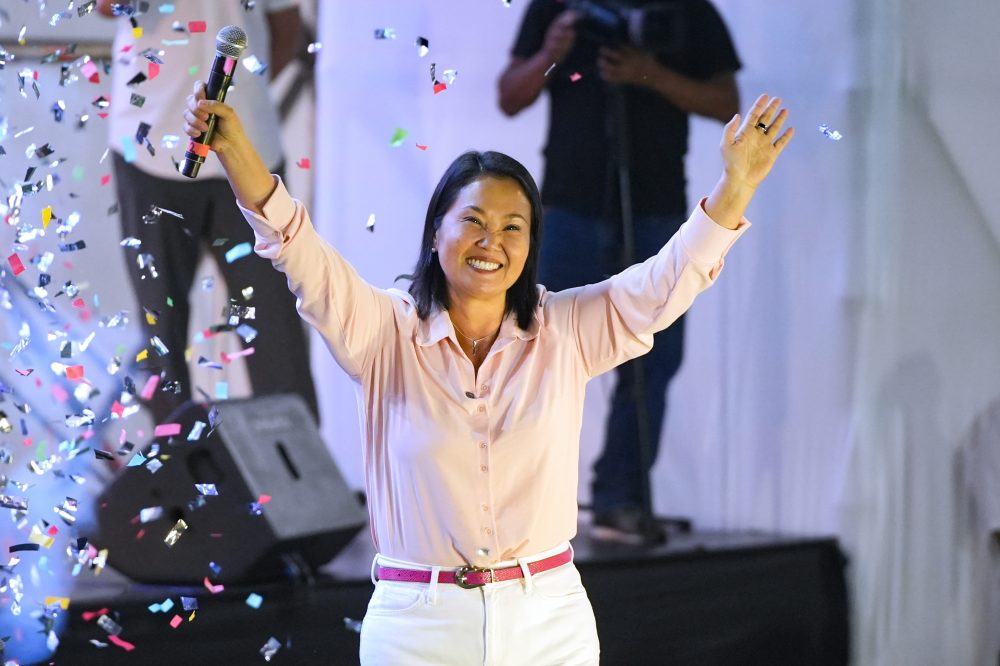

LIMA, Peru — Peru’s voters will decide between two distinct candidates for their country’s top office following the conclusion of the nation’s presidential primary, which determined the finalists for a June runoff contest.
The daughter of a former president, Keiko Fujimori, representing the conservative wing, will compete against Roberto Sánchez, a nationalist congressman who previously served as a trade minister, as they seek to become Peru’s ninth leader in a decade. The pair emerged victorious from a field of 35 total contenders by pledging to address rampant criminal activity, which ranks as the primary concern for citizens in this South American nation whose mineral-based economy has remained stable despite ongoing governmental upheaval.
Final tallies from the April 12 voting showed Keiko Fujimori of Fuerza Popular capturing the largest share at 17.18% of all votes cast. Roberto Sánchez of Juntos por el Perú claimed the second position with 12.03%, according to official results released Friday by the National Office of Electoral Processes, guaranteeing his advancement to the June 7 decisive round.
Significant operational problems plagued the electoral process, preventing thousands of citizens both domestically and internationally from participating on the designated voting day. Officials responded by permitting over 52,000 Lima residents to cast their ballots the following Monday. This unprecedented extension, declared after vote tabulation had already commenced Sunday night, also applied to Peruvian citizens registered in Orlando, Florida, and Paterson, New Jersey.
The electoral contest occurred during a period of escalating violent criminal activity and governmental corruption that has generated substantial voter dissatisfaction, with citizens generally regarding political candidates as corrupt and ill-equipped for executive leadership.
Numerous contenders addressed public safety fears through extensive policy proposals, including constructing large-scale detention facilities, limiting prisoner meal provisions, and restoring capital punishment for severe offenses.
Despite ongoing criminal violence and political chaos resulting from frequent leadership changes — with three different presidents since October — Peru’s economic performance has remained strong. Benefiting from its position as the globe’s second-largest copper producer, the nation achieved growth exceeding 3% in both 2024 and 2025.
The upcoming June 7 runoff will mirror the dynamics of Peru’s 2021 final election round. During that contest, Fujimori faced Pedro Castillo, a rural educator and political newcomer whom Sánchez actively endorses and whose signature wide-brimmed hat style he has adopted.
Castillo narrowly defeated Fujimori by approximately 42,000 votes through strong backing from Peru’s impoverished rural populations. His presidency lasted until December 2022, when lawmakers removed him from office following his attempt to disband the legislative branch.
In her fourth presidential campaign, Fujimori has vowed to implement harsh anti-crime measures, yet she has simultaneously supported legislation that analysts claim hampers criminal prosecutions. These laws, which her political organization endorsed in recent years, abolished pretrial detention in specific situations and increased requirements for confiscating criminal proceeds.
Conversely, Sánchez has promised to overturn these statutes. He has also committed to enhancing police investigative resources to fight extortion crimes, which have multiplied five times over the past five years.
Sánchez distinguished himself throughout the campaign by proposing economic policies that diverge from the market-oriented approach Peru has maintained for twenty years. The legislator has expressed interest in renegotiating agreements with mining corporations operating domestically, contending that government tax collection should increase. He has additionally stated that rural communities should receive ownership stakes in local mining operations and has opposed surface mining techniques. However, implementing these changes would prove challenging for Sánchez, who lacks legislative majority support.
Will Freeman, a fellow for Latin American Studies at the Council on Foreign Relations, described Fujimori as “perhaps Peru’s only remaining career politician and the only one with a real political party,” noting her nationwide organizational structure and long-term presence. While this foundation could enable her to address rising crime rates, he anticipates she would do so in a targeted manner.
“She and that party have in the past sponsored legislation against organized crime that ironically created many of the tools that prosecutors used to investigate them in the 2010s,” Freeman said, referencing the corruption cases Fujimori previously faced. “Now, they have since led the charge to destroy a lot of those mechanisms in the legislation.”
The runoff victor will take the oath of office on July 28 for a five-year presidential term.