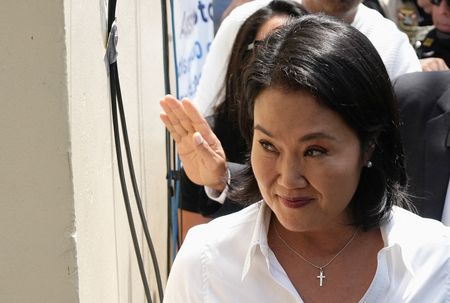

Tensions are rising in Peru as ballot counting from Sunday’s presidential election enters its third day, generating accusations of electoral misconduct and prompting legislative intervention, while uncertainty persists over who will challenge conservative candidate Keiko Fujimori in the runoff.
Fujimori, who previously served in Congress and is the child of deceased former President Alberto Fujimori, continues to hold the top position with 16.8% of votes cast in Sunday’s contest, based on official tallies covering approximately 80% of all ballots.
The former congresswoman is positioned to move forward to a second-round election scheduled for June 7, as no contender has approached the 50% threshold required for an immediate victory. This marks Fujimori’s fourth attempt at securing the presidency.
Behind her, a competitive battle is developing, with right-leaning former Lima Mayor Rafael Lopez Aliaga holding second position at roughly 12% of votes, while center-left contender Jorge Nieto follows closely at approximately 11%, based on data from ONPE, the South American country’s election oversight body.
Left-wing legislator Roberto Sanchez occupied fourth position, capturing slightly more than 10% of the vote.
While ballot processing continues, claims of electoral misconduct have gained broader circulation. Lopez Aliaga, who previously declared that a “brutal fraud” was occurring, received support Tuesday from Sanchez, who expressed doubts about the process’s legitimacy, though both failed to present supporting evidence for their claims.
Several observers noted that the delayed counting mirrors patterns from past elections in the mineral-rich nation, pointing out that former President Pedro Castillo’s victory wasn’t officially validated until eight days following the 2021 runoff election.
INTERNATIONAL MONITORING
Election monitors from the European Union reported finding no substantial proof supporting fraud claims that have emerged since Sunday, while recognizing notable difficulties in the process.
“It is clear that there have been serious problems,” stated Annalisa Corrado, who leads the EU Election Observation Mission to Peru, during Tuesday’s media briefing, while noting that observers had “not found objective elements to support the narrative of fraud.”
The extended counting period resulted from operational breakdowns that disrupted the transport of voting supplies on Sunday, forcing officials to extend polling hours into Monday for over 50,000 citizens who couldn’t vote on the designated election day, primarily affecting areas within Lima, the nation’s capital housing roughly one-third of all voters.
Piero Corvetto, who heads Peru’s election commission, testified before Congress following lawmakers’ demands for explanations regarding the delays. He rejected suggestions of major irregularities, blaming the postponements on a single mistake in ballot material distribution. Corvetto issued an apology for the disruptions.
The election, encompassing both presidential and congressional contests, created multiple obstacles for both voters and election officials, Corvetto explained, following extended political instability in Peru that has weakened institutional trust and left numerous citizens feeling discouraged.
Peru has experienced a succession of different presidents in recent years, creating doubt about whether any new government will complete a full five-year mandate given ongoing impeachment efforts, corruption investigations, and unstable governing partnerships.
The nation’s temporary President Jose Balcazar assumed office through legislative appointment in February, succeeding removed President Jose Jeri, who was ousted by Congress after serving only four months due to controversy over undisclosed communications with a Chinese business figure.