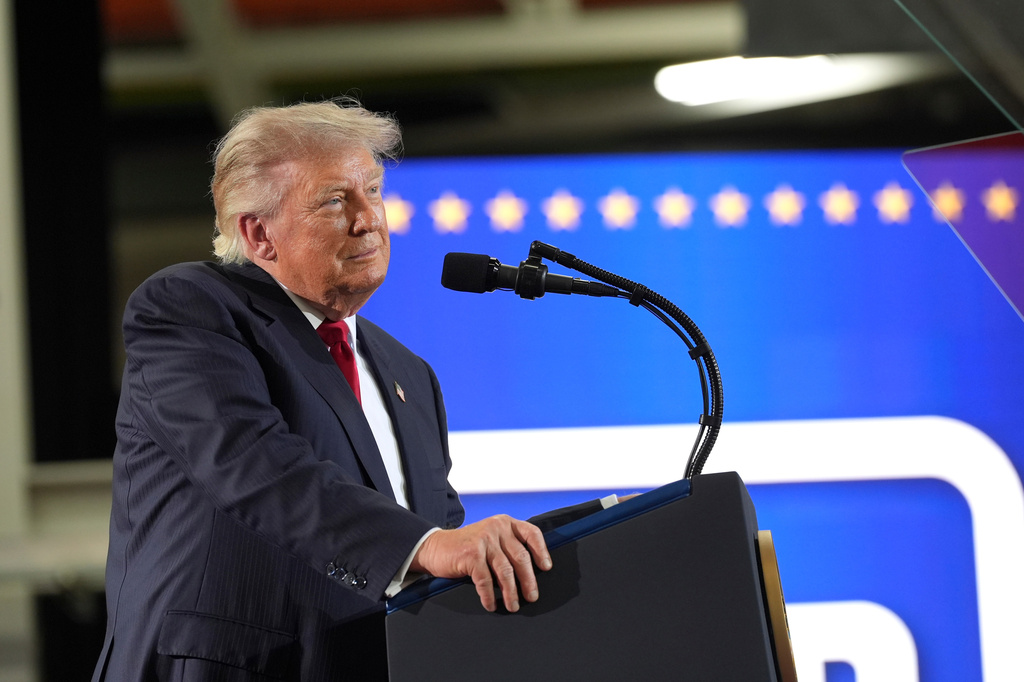

President Trump’s Monday stop in Michigan was far more than a ceremonial appearance — it was a pointed message to auto workers, Republican voters, and anyone who measures the economy by whether factories are open and hiring. Speaking at a General Motors facility in Milford, located in the suburbs of Detroit, Trump made the case that his trade policies — particularly his tariffs — have pushed American manufacturing forward and forced the rest of the world to stop taking the United States for granted.
The atmosphere was both politically charged and unmistakably tied to American industrial heritage. Trump walked through a display of GM vehicles spanning the company’s history, took a seat in several cars, and watched drag races featuring the Corvette, Cadillac, and Hummer. After each race, he pumped his fist — sending a clear and repeated signal that American-made products are back and gaining strength.
During his remarks, Trump insisted his policies have breathed new life into the auto industry and brought jobs and opportunity back to the United States. He highlighted GM’s plans to grow its domestic production in the years ahead and described himself as the president who finally “stood up for auto workers at long last.” He also quipped that he has done more for workers than “your parents” — a line clearly intended to drive home that the issues at stake are not abstract. They’re jobs, paychecks, and the sense of pride that comes from building things in America.
On the subject of tariffs, Trump was blunt: “It’s amazing what tariffs are doing for GM.” His argument was straightforward — when trade barriers level the playing field, companies that manufacture on American soil stand to benefit. He tied that economic reasoning to his signature “America first” political brand, suggesting that pushback from other countries is irrelevant as long as the end result is more production happening at home.
That message, however, landed against a backdrop of genuine economic anxiety in Michigan. Many businesses and workers are concerned that the president’s sweeping import levies — now hitting dozens of trading partners — are driving up costs throughout supply chains. Michigan’s economy is deeply tied to trade with Canada, and tariffs that Trump says could reach as high as 50 percent on a wide range of Canadian goods, including automobiles, threaten to raise prices and create uncertainty for manufacturers. Even companies expanding their domestic footprint can feel the pinch in the short term when parts and components still cross international borders.
The political stakes in Michigan are also significant. The visit came close to the state’s August 4th primary, with early voting already underway. Trump used the occasion to align himself with several Republican candidates, bringing them onstage one by one. Among them was Mike Rogers, who faces no opposition in the Senate primary, along with gubernatorial hopefuls John James and Perry Johnson.
The dynamic between those two governor’s race candidates is telling: James carries Trump’s endorsement, while Johnson is working to present himself in Trump’s mold without having secured that backing. Meanwhile, a closely watched Democratic Senate primary is also drawing national attention, making Trump’s timing appear deliberate — a move to maximize his influence right as Michigan voters are making up their minds.
The trip also connects to a larger and increasingly tense trade dispute with Canada. The opening of the Gordie Howe International Bridge has been overshadowed by the ongoing tariff fight. Canada held its own separate event after the tariffs were announced, and plans for joint celebrations were called off or disrupted — a vivid illustration that trade policy doesn’t just affect balance sheets. It reshapes relationships and everyday realities on both sides of the border.
In the end, Trump’s message in Michigan came down to a simple chain of logic: tariffs create leverage, leverage attracts investment, and investment creates jobs. His critics counter that the same leverage is generating unnecessary costs — particularly damaging in a state whose economy depends on auto parts, cross-border supply chains, and the ability to plan ahead with some degree of certainty. The upcoming primary will offer an early indication of which version of that story Michigan voters find more convincing.