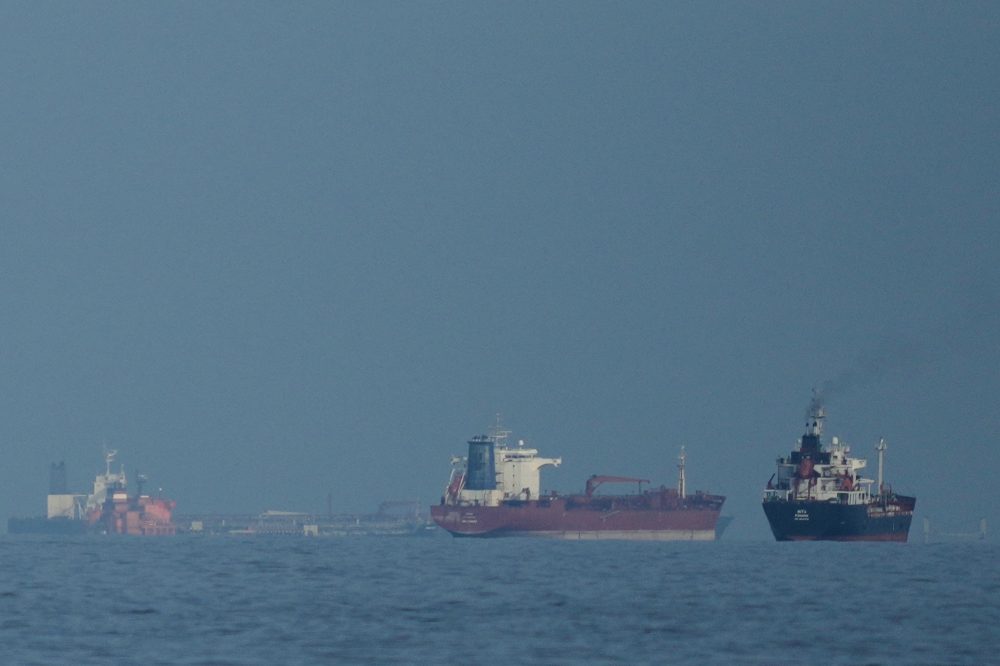

The Pentagon announced plans to impose a naval blockade on all Iranian ports starting Monday, scaling back from President Trump’s initial threat to completely seal off the vital Strait of Hormuz as vessel movement through the waterway appears to have ceased.
This development follows the collapse of extensive U.S.-Iran peace negotiations held in Pakistan over the weekend, which failed to produce any ceasefire agreement and has set up a potential military confrontation. Tehran’s leadership has promised to respond forcefully to the blockade.
U.S. Central Command stated the port blockade will take effect Monday at 10 a.m. Eastern time (5:30 p.m. Iranian time) and will be “enforced impartially against vessels of all nations.” However, CENTCOM indicated ships traveling between non-Iranian ports would still be permitted to pass through the strait, representing a more limited approach than the president’s original proposal to shut down the entire waterway.
According to Lloyd’s List intelligence, the blockade announcement caused the remaining limited shipping activity in the strait to stop completely. Maritime tracking data shows approximately 40 commercial vessels have passed through since ceasefire talks began, a dramatic decrease from the typical 100 to 135 daily ship transits recorded before hostilities commenced.
On Sunday evening, Trump escalated his criticism of Pope Leo XIV regarding the conflict, posting on Truth Social that the pontiff was “terrible on foreign policy.” This unprecedented attack followed the Pope’s condemnation of the war and his call for political leaders to pursue peaceful negotiations.
The port restrictions appear designed to increase economic pressure on Iran, which has continued exporting substantial quantities of oil throughout the conflict, much of it through covert shipping operations that avoid Western sanctions and monitoring.
Trump seeks to challenge Iran’s dominance over the Strait of Hormuz after demanding the country reopen the critical shipping lane, through which 20% of the world’s oil flowed before fighting erupted. The American blockade threatens to further destabilize global energy markets.
Energy prices jumped following news of the blockade. U.S. crude oil climbed 8% to $104.24 per barrel, while Brent crude, the global benchmark, increased 7% to $102.29. Brent crude traded around $70 per barrel before the war started in late February.
Senior Iranian officials issued strong warnings of retaliation. Mohsen Rezaei, a military advisor and former Revolutionary Guard commander, posted on X that Iran’s military possessed “major untouched levers” to respond to a Hormuz blockade. He declared Iran would not be intimidated by “tweets and imaginary plans.”
Mohammad Bagher Qalibaf, Iran’s parliament speaker who headed the Iranian negotiating team, delivered a direct message to Trump upon returning to Iran: “If you fight, we will fight.”
Iran’s Revolutionary Guard subsequently declared the strait remained under Iranian “full control” and open to civilian ships, while warning that military vessels would face a “forceful response,” according to two semi-official Iranian news outlets.
During the 21-hour weekend negotiations in Pakistan, the U.S. military reported that two destroyers had passed through the strait to conduct mine-clearing operations, marking the first such transit since the conflict began. Iran disputed this claim.
The direct discussions that concluded early Sunday represented the highest-level diplomatic engagement between the adversaries since Iran’s 1979 Islamic Revolution.
Trump blamed Iran’s nuclear ambitions for the talks’ breakdown. Speaking to Fox News, he renewed threats against civilian infrastructure if Tehran refused to abandon its nuclear program.
“In one half of a day they wouldn’t have one bridge standing, they wouldn’t have one electric generating plant standing, and they’re back in the stone ages,” Trump stated.
Vice President JD Vance, who headed the American delegation, said Washington required “an affirmative commitment that they will not seek a nuclear weapon.”
Iranian negotiators were unable to accept all U.S. “red lines,” according to an American official speaking anonymously due to lack of authorization to discuss negotiating positions publicly. These demands included Iran permanently forgoing nuclear weapons, halting uranium enrichment, dismantling key enrichment facilities, allowing removal of highly enriched uranium, reopening the Strait of Hormuz, and ceasing support for Hamas, Hezbollah, and Houthi militants.
Iranian officials blamed the talks’ failure on two or three critical issues, citing what they characterized as excessive U.S. demands. Qalibaf, while acknowledging negotiating progress, said America needed “to decide whether it can gain our trust or not.”
Iran’s foreign minister accused the United States of sabotaging negotiations when they were “inches” from agreement, though he offered no supporting evidence.
“We encountered maximalism, shifting goalposts, and blockade,” Abbas Araghchi wrote on X.
Both Iran and the United States have remained silent about their plans after the current ceasefire ends on April 22.
Pakistani Foreign Minister Ishaq Dar announced his nation would attempt to broker renewed discussions in the coming days. Iran expressed willingness to continue diplomatic efforts, according to state-run IRNA news agency.
Iran’s nuclear program has been a source of tension long before the U.S. and Israel initiated military action on February 28. The conflict has claimed at least 3,000 lives in Iran, 2,055 in Lebanon, 23 in Israel, and more than a dozen across Gulf Arab nations, while damaging infrastructure in six countries.
Tehran has consistently denied pursuing nuclear weapons while asserting its right to civilian nuclear technology. The historic 2015 nuclear agreement, which Trump later withdrew the U.S. from, required over a year of negotiations. Nuclear experts warn Iran’s enriched uranium stockpile, while not weapons-grade, could be quickly converted for military use.