
BRUSSELS — Just hours after U.S. Defense Secretary Pete Hegseth publicly criticized NATO allies and announced a Pentagon review of their performance, leaders of numerous European nations were already going through their own checklist of security progress — covering many of the same issues Hegseth raised.
In many ways, Hegseth was telling the Europeans what they already know.
The European agenda included increased defense spending, investment in military production industries, lessons drawn from the ongoing war in Ukraine, and the development or purchase of drones, air defense systems, and long-range weapons.
At a summit that wrapped up Friday, European leaders discussed how to best deploy joint European Union funding, eliminate bureaucratic obstacles to speed up procurement, improve “military mobility” for faster troop and equipment deployment, and upgrade ports and airports.
“Europe’s defense readiness must be decisively ramped up by 2030,” they reaffirmed — a goal they have been working toward since Russia launched its full-scale invasion of Ukraine in 2022.
Intelligence agencies have cautioned that Russian President Vladimir Putin could order military action elsewhere in Europe before the decade is out, particularly if he manages to defeat Ukraine. European nations have also accused Russia of carrying out acts of sabotage and spreading disinformation across the continent.
Roughly two-thirds of European Union member countries are also NATO members, and the unpredictability of the Trump administration has pushed them to accelerate their own independent efforts. Hegseth’s announced review was simply the most recent unexpected development.
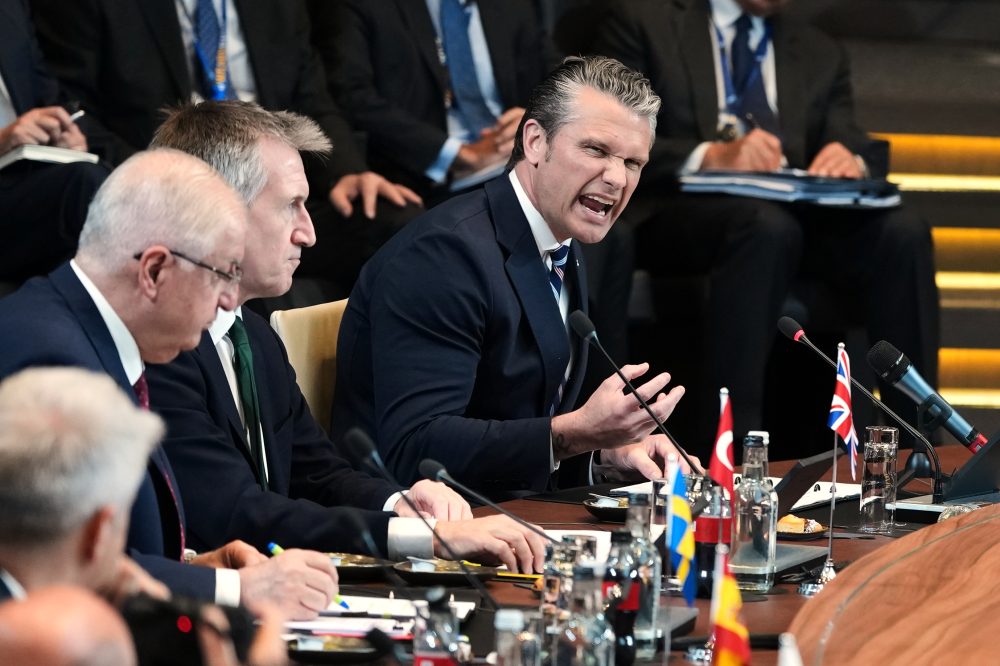
Hegseth does not regularly attend NATO meetings, and he departed Thursday’s gathering of defense ministers before it concluded. Still, his first major address to the alliance in February 2025 and his follow-up appearance this week left a strong impression.
On Thursday, he branded NATO a “paper-tiger,” called allies “shameful,” and declared that “too many failed” a test set by President Donald Trump — who had sought use of European bases to launch strikes against Iran.
He also criticized allies for emphasizing “gender equity and climate change” and attacked their immigration policies.
Hegseth then gave NATO members six months to demonstrate improvement before a Pentagon performance review that would tie the continued presence of American forces in Europe — and U.S. financial contributions to NATO — to whether he judges them to be doing enough.
“It’s protection racket framing that undermines NATO solidarity, trust in the U.S. commitment to NATO, and, ultimately, U.S. security interests,” said Rachel Ellehuus, Director-General of the Royal United Services Institute think-tank.
The specifics of what the review will actually examine remain unclear.
“It will be designed to ensure that NATO is moving fast and irreversibly toward Europe leading, stepping up to take primary responsibility for the defense of Europe,” Hegseth said. “Some countries will fail and others will pass with flying colors.”
He said the process might last “up to six months, could be less,” and would involve U.S. military commanders, members of Congress, and the allies themselves.
Hegseth also said that American contributions to the shared NATO budget — which funds its headquarters and other facilities — would be tied to ally performance. “Where other allies do not spend with urgency, our dues contributions will go down,” he said.
Speaking to reporters at Brussels airport before departing, he added that the review would also look at “where is the right place for basing. Where can we make sure we have access and overflight when we need it, so that America is properly postured on the continent.”
NATO itself played no direct role in the Iran conflict, though it did work to protect alliance territory from potential attack.
NATO Secretary-General Mark Rutte said he could not yet explain what Hegseth’s review would involve.
“There’s still no clarity on exactly what the outcome will be, because that will depend on the review. So, we’ll see what happens,” Rutte said, adding that “wherever we can be helpful, we will be helpful.” Rutte is expected to travel to Washington next week, where he may learn more.
From Rutte’s perspective, European allies and Canada are making solid progress, even if more can always be done.
“What we are seeing is staggering amounts of money coming in,” he told reporters. “Europe and Canada are spending in 2025 more than $90 billion extra compared to 2024, which is almost a 20% increase in defense spending.”
That additional funding must now be converted into actual military equipment, weapons, and ammunition.
At last year’s summit, allies agreed to raise their defense budgets to match the United States as a share of gross domestic product. President Trump left that meeting satisfied, describing his NATO counterparts as a “nice group of people.” But the new review casts a shadow over the alliance’s next summit, scheduled for July 7-8 in Turkey.
Despite the tension, senior European military officers have taken on more command roles within NATO, and U.S. allies have stepped up to lead the effort to channel arms and money into Ukraine as the Trump administration has pulled back.
Some European nations and Canada are also spending billions to purchase critical air defense systems from the United States, which they then donate to Ukraine — a conflict they view as an existential threat to Europe as a whole.
By most measures, it is difficult to identify what more the allies could be doing or doing faster — unless the expectation is that they provide unrestricted access to their airspace and military bases for American military operations beyond Europe.
Ellehuus, a former senior U.S. advisor at NATO, argued that decisions about troop positioning “should be driven by detailed threat assessments, operational requirements, and military planning – not used as a form of reward, punishment or revenge.”
“Such framing undermines allies while they’re actively trying to solve the problem and telegraphs to adversaries that U.S. security commitments have a price tag,” she said.