
PARIS (AP) — A record-breaking heat wave descended on Paris this week, forcing the city’s elite fashion houses into a frantic scramble to keep guests comfortable — handing out ice packs, deploying mist machines, and serving chilled water on silver trays.
Despite those efforts, many venues remained stifling. Water supplies ran low, and air conditioning was either nonexistent or simply not up to the task.
And yet, the models kept walking — wearing leather, neoprene, and wool.
That striking contradiction defined Paris Fashion Week Men’s, where an extreme heat wave transformed a spring-summer showcase into a real-world question: Can the luxury fashion world dress — or even behave — in ways appropriate for the warming planet it often claims to care about?
“I honestly thought I was going to pass out,” said Ben Freeman, a London-based fashion critic originally from Australia.
Several attendees seated in the front row suggested that Paris may need to rethink the timing of fashion week altogether if climate change continues to produce more frequent and severe heat waves.
“I don’t know how the models did it this week in some of the leather and knit coats,” said Thomas Levy, a 24-year-old fashion student who spoke outside one of the shows. “The heat rarely seems to make it into the clothes. It shows up in the sets like at waterfalls and mist machines and ice packs.”
Throughout the week, designers largely treated the heat as a problem of hospitality, staging, or scheduling — almost never as a challenge for the clothing itself.
Attendees received cold towels, ice packs, and bottled water. Stage sets featured waves, fog, and cooling mist. Show times were pushed earlier in the day, with punctuality reframed as a safety measure against the heat.
Dior shifted its Wednesday show from 2:30 in the afternoon to 9 in the morning, but the heat still took its toll. Water was in short supply, there was no air conditioning, and some guests appeared to be feeling unwell.
Jonathan Anderson offered one of the more climate-conscious design responses with sheer silk-chiffon tailoring — but other collections leaned into heavy knits that seemed better suited for cooler climates than a Paris June.
“The calendar does not make any sense,” Anderson told reporters, pointing to disrupted delivery schedules and a shifting business model that has left the fashion calendar out of step with both actual weather patterns and the way luxury clothing is now sold.
These shows are labeled spring-summer, but the collections are far more complex than simple warm-weather wear.
Luxury lines are designed for worldwide markets, with deliveries staggered across months and customers who often spend the hottest parts of the year in air-conditioned environments. For many buyers, a wool coat purchased in June is not a seasonal oddity — it’s a deliberate choice.
At Saint Laurent, models moved through billowing clouds of vapor produced by a fog installation by artist Fujiko Nakaya inside the Bourse de Commerce, transforming heat into a visual experience rather than a problem to escape. Designer Anthony Vaccarello stripped down his tailoring to unlined jackets and soft, pale looks — lighter, he told reporters, because of the heat — before dialing the temperature back up with leather briefs, choker scarves, bare legs, and transparent shoes fogged with condensation.
The collection wasn’t a concession to summer — it was Saint Laurent’s own interpretation of it: cooler in construction, bolder in attitude.
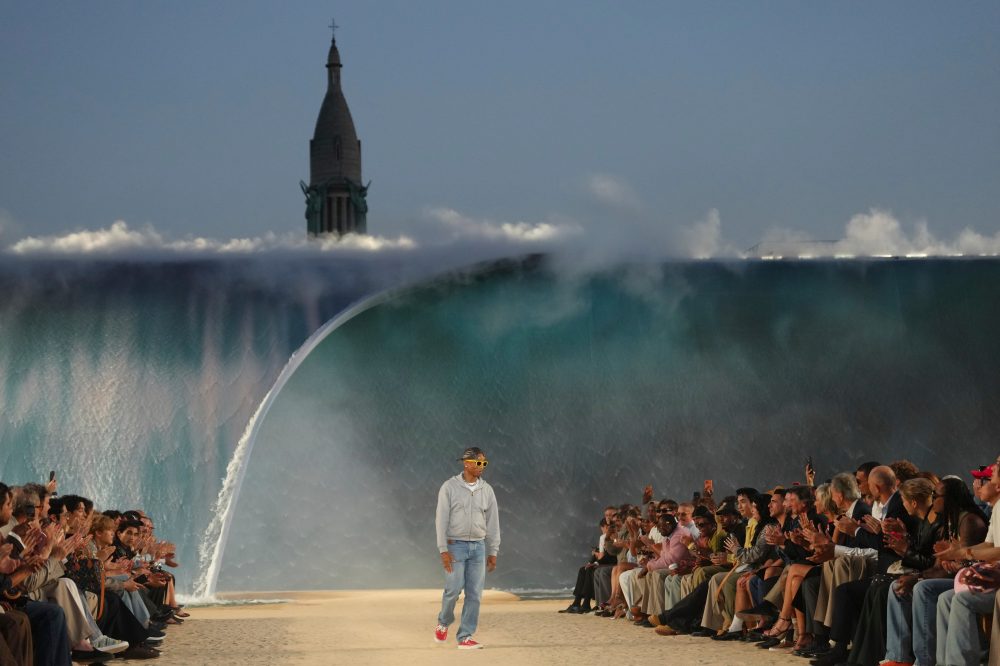
At Louis Vuitton, designer Pharrell Williams sent models emerging from a massive artificial wave onto sand. Even so, the wetsuits were neoprene and the coats were cashmere and fur.
Issey Miyake’s IM Men label offered one of the week’s most practical responses. The show, titled “In Praise of Bamboo Shadows,” greeted guests with ice packs at the entrance, then showcased garments made from bamboo-thread fabrics blended with organic cotton and light nylon, featuring shadowy prints. The silhouettes were designed to hang away from the body, treating circulating air as part of the design concept rather than something the venue alone had to provide.
At Ami, designer Alexandre Mattiussi stated the obvious while standing next to an industrial fan — “Paris is burning” — and dressed the moment like a Parisian simply living through it: loose shorts, relaxed washed trench coats, and “I Love Paris” T-shirts.
Rick Owens came perhaps closest to making heat itself the central theme. He moved his Thursday show to an earlier time slot due to the heat, then sent models through mist at the Palais de Tokyo wearing garments with small fans built inside them. One prominent fashion critic described the show as “a metaphor for climate catastrophe.”
Pascal Morand, who leads France’s Haute Couture and Fashion Federation, said organizers were adhering to the French government’s official heat-wave response plan.
“We are conscious of the challenges and very attentive to preserving the Fashion Week experience in this context of structural change,” he told the Associated Press.
Fashion wasn’t the only Paris institution feeling the strain. The Louvre museum cut its operating hours during the heat wave, acknowledging that its historic building “remains vulnerable and is not sufficiently adapted to climate change.”
That vulnerability feeds into a broader French debate over air conditioning, which remains widely viewed with suspicion across much of Europe — seen by many as wasteful or environmentally irresponsible.
Fashion week became a glamorous version of the same challenge facing France as a whole: how to keep public events, workplaces, and cultural spectacles functioning in heat the country was never designed to handle — without simply filling every building with air conditioning.
President Emmanuel Macron’s government has leaned, as much of France has, toward solutions like shade, better insulation, and urban tree planting.
Europe is warming faster than any other continent, with cities built largely of stone and largely without air conditioning.
“Paris Fashion Week is the canary in the mine,” Freeman said.
From sports to tourism to construction, industries built around fixed schedules and outdoor audiences are being forced to adapt to heat that arrives earlier, lingers longer, and reaches higher temperatures than before.
Paris Fashion Week — outdoor, fixed in time, and watched by the world — became one of the most visible tests yet of that new reality.