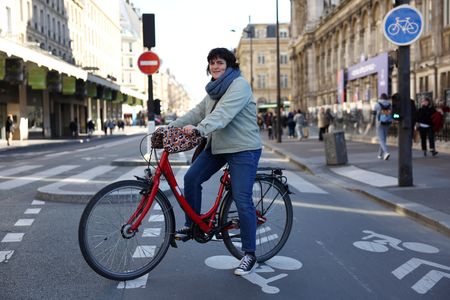

Marion Soulet navigates her bicycle through Paris City Hall via a street that previously overflowed with automobiles but now serves as a dedicated cycling path, representing the French capital’s environmental makeover that will be evaluated in this Sunday’s mayoral contest.
The cyclist advocacy leader from Paris en Selle appreciates the approximately 1,000 kilometers (620 miles) of bicycle infrastructure developed under progressive Mayor Anne Hidalgo’s administration during the past ten years, noting that close to half of all Parisians now use bicycles weekly.
“The more the city is redesigned to accommodate it, the more cycling increases,” Soulet explained to Reuters following her journey down Rue de Rivoli. “People like it because it’s easy, inexpensive, and fast.”
The campaign to convert Paris from a contaminated urban center into a “15-minute-city” featuring extensive cycling infrastructure and increased greenery stems from initiatives by Hidalgo and her progressive predecessors, who have controlled City Hall for decades.
This environmental record now confronts judgment in Sunday’s voting, as Hidalgo steps aside while conservative opponents hope to capitalize on citizen exhaustion regarding the increasingly automobile-restricted metropolis, construction-related disruptions, and growing municipal debt.
Polling data indicates the victor will likely be either Socialist Emmanuel Grégoire, who advocates intensifying environmental policies, or conservative former minister Rachida Dati, who claims Paris’s traditional charm is being eroded.
Far-right nationalist candidate Sarah Knafo, age 32, shows increasing poll strength and might complicate Dati’s prospects if she advances to the March 22 runoff. Knafo’s support exceeds the 10% minimum required for second-round qualification.
Current polling shows Grégoire, 48, leading with approximately 33%, while Dati, 60, follows at roughly 30%.
“We’re not fighting an ideological battle on mobility issues,” Dati stated to Reuters while meeting shoppers in northern Paris. “We just want things to be organised.”
During Hidalgo’s tenure, municipal officials have worked to prepare Paris for climate challenges while improving livability for its 2 million inhabitants within the broader metropolitan area of 10 million people.
City administrators have added 130,000 trees and eliminated thousands of street-level parking spots. Roadways alongside the Seine River have been converted to pedestrian areas.
Municipal statistics show automobile traffic has decreased more than 60% since 2002 while bicycle usage has increased threefold. Air quality has also improved.
“There aren’t many major cities in the world that have known such a spectacular transformation,” commented Patrick Le Gales, an urban planning expert at Sciences-Po University in Paris.
“But there’s been strong criticism over cleanliness and the debt,” he added, referencing municipal obligations totaling approximately 10 billion euros ($11 billion), representing a 42% increase since 2020.
Pierre Chasseray, director of the motorists’ advocacy organization 40 Million Motorists, accused Hidalgo of creating a “Berlin Wall” separating affluent central Paris residents from automobile-dependent citizens in economically disadvantaged suburbs who lack influence over municipal policies.
“We’ve ended up with a caricatured image of the capital: motorists on one side, cyclists on the other — the good guys versus the bad guys,” he explained.
Hidalgo has additionally encountered widespread social media criticism using the #saccageParis hashtag that showcases urban problems ranging from persistent construction projects to litter-covered walkways.
Grégoire attributed these issues to Hidalgo’s excessive ambition.
“We did too many things at the same time,” he acknowledged. “I would have chosen a different timetable, above all for reasons of implementation quality.”
Dati, an attorney with North African heritage, has softened her opposition to well-received cycling lanes, instead emphasizing concerns about unsanitary streets, and published footage of herself wearing safety gear while accompanying sanitation workers.
“The city is increasingly dirty — it hasn’t escaped anybody,” she observed.
Dati’s evolving moderate position on transportation matters — combined with her upcoming September corruption trial on charges she disputes — has created opportunities for Knafo.
Knafo has presented an Artificial Intelligence-developed proposal to restore automobile access to Seine riverbanks and conducted interviews from vehicle passenger seats while traveling through Paris.
Soulet considers Knafo’s influence restricted to “a very small group of Parisians who…want to turn the clock back.”