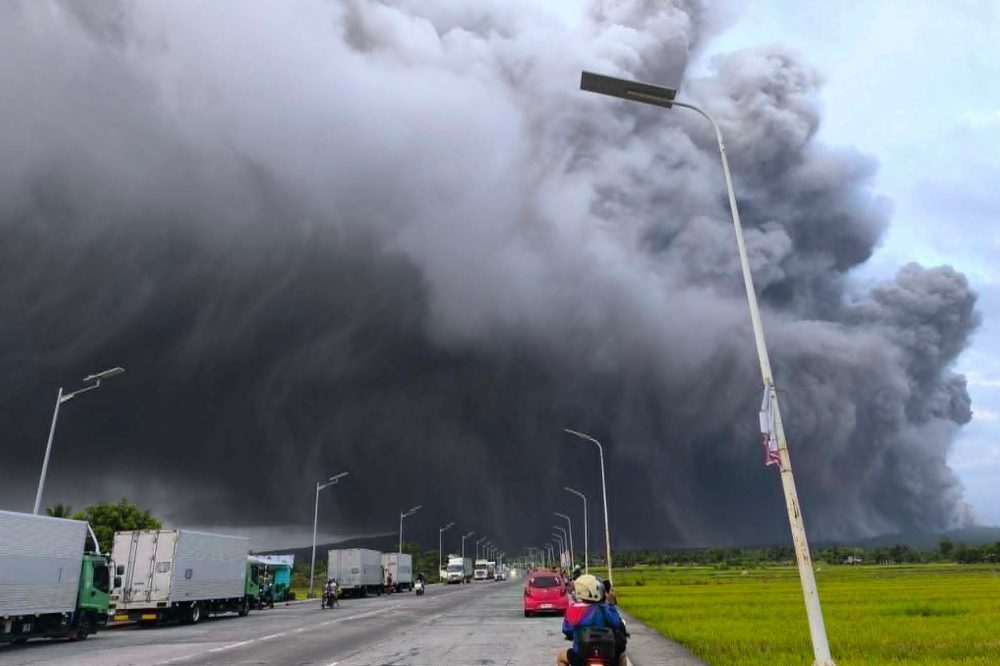

MANILA, Philippines — Philippine officials report that over 300 families were forced to leave their homes following a weekend incident where the Mayon volcano released enormous ash clouds after lava deposits collapsed from its mountainside.
According to Teresito Bacolcol, who heads the Philippine Institute of Volcanology and Seismology, the volcano did not experience an explosive eruption. Instead, substantial lava accumulations on the volcano’s southwestern side suddenly tumbled downward in what scientists call a pyroclastic flow — a dangerous avalanche containing hot rocks, ash and gas — occurring Saturday evening. The volcano has been experiencing minor eruptions intermittently since January.
While no fatalities or injuries occurred, enormous ash clouds spread across 87 communities in three municipalities, surprising many residents and creating hazardous driving conditions due to limited visibility, according to local authorities.
“The ashfall was just so thick and there was zero visibility even in our national road,” Mayor Caloy Baldo of Camalig town, which lies near the volcano’s foothills, said.
“Some villagers panicked but we advised them to calm down,” Baldo told The Associated Press.
The ashfall destroyed vegetable crops and resulted in the deaths of four water buffalo and one cow in Camalig, according to Baldo. He noted that cleanup efforts are ongoing in his community of 8,000 residents located in Albay province.
“It’s calm again now but the danger is always there,” Bacolcol said of Mayon’s condition Monday.
Standing at 2,462 meters (8,077 feet) tall, the volcano attracts numerous tourists due to its nearly perfect cone formation. However, it ranks as the most active among the Philippines’ 24 volcanoes.
Officials elevated the five-level warning system around Mayon to level 3 in January following a sequence of minor eruptions that triggered periodic rockfalls, some the size of automobiles, from its summit crater along with dangerous pyroclastic flows.
The highest warning level, Alert 5, indicates an explosive and life-threatening eruption is occurring with deadly volcanic lava and pyroclastic flows along with heavy ashfall.