
DUBAI, United Arab Emirates (AP) — A coordinated military campaign by Israel and the United States resulted in more than 25 deaths across Iran on Monday, while Tehran launched retaliatory missile strikes against Israel and neighboring Gulf states. The escalation comes as President Donald Trump’s ultimatum for Iran to reopen the Strait of Hormuz approaches its Monday night deadline.
Throughout the night, explosions echoed across Tehran as low-altitude aircraft conducted sustained operations over Iran’s capital city. Dense black smoke billowed near Azadi Square following a strike that damaged Sharif University of Technology facilities.
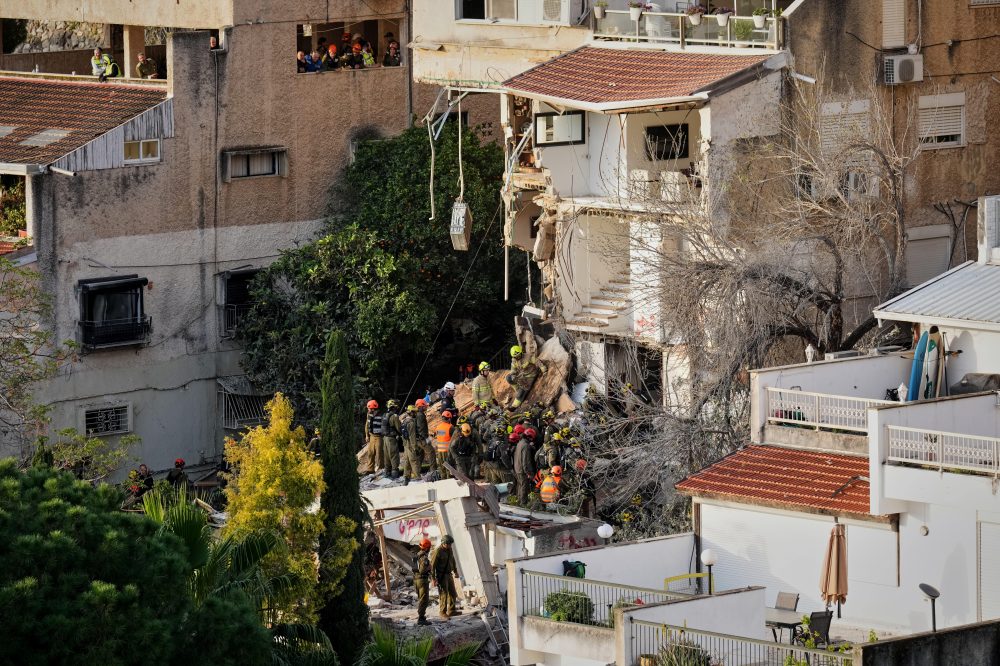
Israeli officials confirmed two fatalities in Haifa after debris from a residential building collapse, with search teams continuing efforts to locate two additional missing persons amid ongoing Iranian missile bombardments targeting northern Israeli communities early Monday.
Both Kuwait and the United Arab Emirates deployed their air defense networks to counter incoming Iranian missiles and unmanned aircraft as Tehran maintained pressure on regional allies. Iran’s continued assault on energy infrastructure throughout the region, combined with its control over the Strait of Hormuz—a waterway that typically handles one-fifth of global oil shipments during peacetime—has driven worldwide energy costs dramatically higher.
Facing mounting domestic pressure from worried consumers, Trump established a Monday night deadline for Tehran, warning that failure to negotiate the strait’s reopening would trigger American attacks on Iranian power facilities and infrastructure, potentially setting the nation “back to the stone ages.”
“Tuesday will be Power Plant Day, and Bridge Day, all wrapped up in one, in Iran,” Trump declared in a social media message, warning that Iran would be “living in Hell” if the strait remained closed.
Tehran has demonstrated no indication of abandoning its control over maritime traffic through the strait, which operated without restrictions before the February 28 U.S.-Israeli assault that initiated the current conflict.
After Trump’s profanity-filled Easter Sunday social media posts, Iranian parliamentary speaker Mohammad Bagher Qalibaf condemned the infrastructure targeting threats as “reckless.”
“You won’t gain anything through war crimes,” Qalibaf posted on X. “The only real solution is respecting the rights of the Iranian people and ending this dangerous game.”
Brent crude oil prices climbed to $109 during early Monday trading, representing approximately 50% growth since hostilities began.
While Iran has permitted limited vessel passage through the strait since fighting commenced, no ships from the United States, Israel, or nations perceived as supporting them have been allowed through. Some vessels have secured passage through payments to Iran, though overall maritime traffic has declined more than 90% compared to the same timeframe last year.
Despite Trump’s military ultimatums, diplomatic initiatives continue seeking solutions to restore waterway access.
Oman’s Foreign Ministry announced meetings between deputy foreign ministers and specialists from Iran and Oman to explore proposals ensuring “smooth transit” through the strategic passage.
Egypt reported that Foreign Minister Badr Abdelatty conducted discussions with U.S. envoy Steve Witkoff and Iranian Foreign Minister Abbas Araghchi, along with officials from Turkey and Pakistan. Russia confirmed that Araghchi also held talks with Russian Foreign Minister Sergey Lavrov.
Monday morning’s strikes included an attack on Tehran’s Sharif University of Technology, where Iranian outlets documented damage to campus structures and an adjacent natural gas distribution facility.
The specific targets within the university grounds remained unclear, as the institution has suspended in-person classes for online instruction due to the conflict. Multiple nations have previously imposed sanctions on the university due to its military collaboration, particularly regarding Iran’s ballistic missile development program overseen by the Revolutionary Guard paramilitary forces.
An attack near Eslamshar, located southwest of Tehran, claimed at least 13 lives according to the semi-official Fars news agency. The state-run IRAN daily newspaper reported five additional deaths when residential areas in Qom were struck, with six more fatalities in strikes across other cities.
Iranian state television confirmed three more deaths when an airstrike destroyed a Tehran residence.
Iranian casualties have exceeded 1,900 since the conflict began, though government officials have not provided updated figures in recent days.
In Lebanon, where Israeli ground forces have conducted operations, more than 1,400 people have died and over 1 million have been displaced. Eleven Israeli soldiers have lost their lives while engaging Iranian-supported Hezbollah fighters.
Additional casualties include more than two dozen deaths across Gulf Arab states and the occupied West Bank, 19 reported deaths in Israel, and 13 U.S. service members killed.