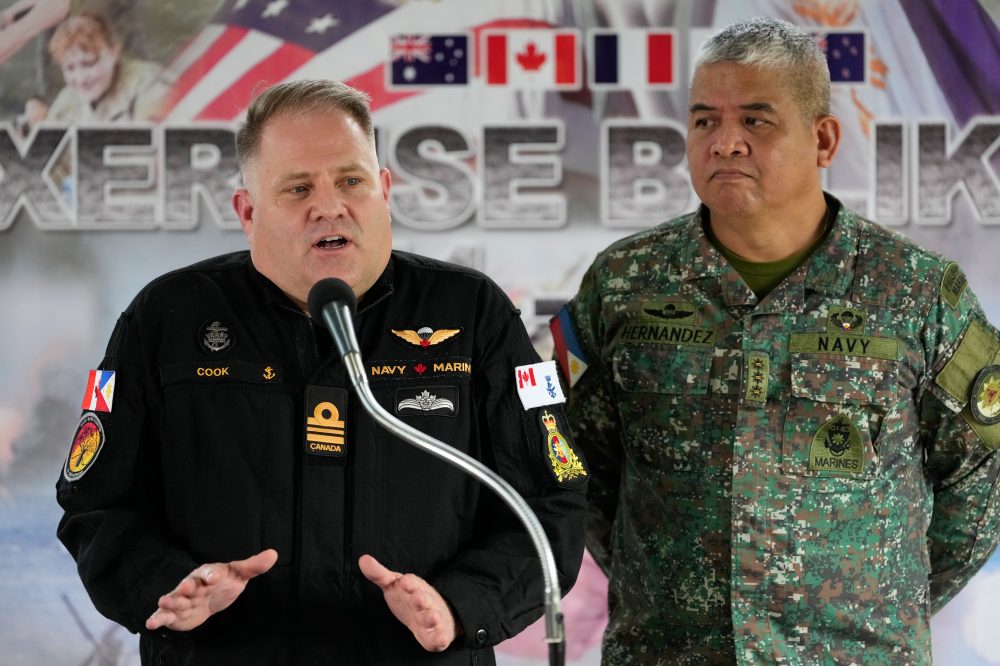

MANILA, Philippines — Over 17,000 military personnel from the United States and Philippines will take part in one of their biggest yearly combat training exercises, demonstrating America’s strong dedication to the Asia-Pacific region even as conflicts continue in the Middle East, according to a U.S. military spokesperson announced Tuesday.
The training exercises, known as Balikatan, will run from April 20 through May 8 and will feature Japanese forces conducting live missile firing drills aimed at sinking ships in Philippine waters near the contested South China Sea. Officials from the Philippine military confirmed that Japan’s defense minister has been invited to observe the live-fire demonstration.
This year’s extensive military training between the U.S. and Philippines, who maintain a long-standing defense treaty, will grow to incorporate additional allied nations including Japan, France and Canada, all of which have established visiting forces agreements with Manila, Philippine military representatives stated.
“Our message is our dedication and commitment to our alliance and regional security,” said Col. Robert Bunn, spokesperson for U.S. forces, during a media briefing when questioned about what signal the military intended to convey through the substantial Balikatan presence amid ongoing Middle Eastern conflicts.
Bunn did not provide immediate details regarding the exact number of American troops participating in the combat exercises. During last year’s Balikatan drills — a Tagalog term meaning shoulder-to-shoulder — approximately 9,000 U.S. military members took part.
“The defensive aspect of countering drones is very much a part of the exercise,” Bunn explained when asked about the specific types of simulated combat scenarios planned for the training.
Beijing has consistently criticized military exercises, particularly those involving American forces, conducted in the region and in areas near the disputed South China Sea, which China claims almost entirely as its territory.
The Philippines, Vietnam, Malaysia, Brunei and Taiwan also maintain territorial claims over these waters, which serve as a crucial international shipping route. However, territorial disputes have intensified significantly between Chinese and Filipino military forces in recent years.
Philippine military leaders state that the combat training exercises do not target any specific nation but recognize that the joint drills with the U.S. and security partners would strengthen the Philippines’ ability to protect its interests in the disputed maritime areas.
During a visit to Manila last year, U.S. Defense Secretary Pete Hegseth provided assurance to Philippine officials that the Trump administration would collaborate with allies to strengthen deterrence against global threats, including China’s aggressive actions in the South China Sea.
“Friends need to stand shoulder to shoulder to deter conflict, to ensure that there is free navigation whether you call it the South China Sea or the West Philippine Sea,” Hegseth told Philippine President Ferdinand Marcos Jr.