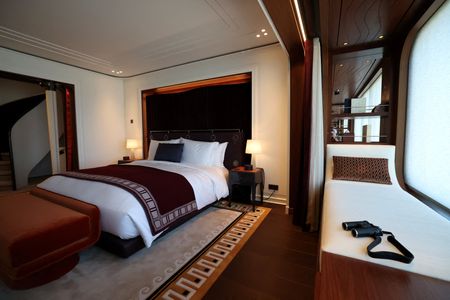

Cruising along the coastlines of France and Italy, Orient Express has unveiled its first large-scale luxury yacht — and the target clientele is a new generation of billionaires minted by the tech industry.
Orient Express, now operated as a joint venture between French hotel company Accor and LVMH, the parent company of Louis Vuitton, was created to breathe new life into the storied 19th century travel brand. The newly launched yacht is the first of two planned vessels aimed at the ultra-wealthy. The venture also includes a collection of upscale hotels and a historic art deco train that has yet to begin service.
Accor serves as the operational head of Orient Express, and its Chief Executive Sebastien Bazin told Reuters the company is counting on a fresh wave of billionaires emerging from the artificial intelligence industry to help push the brand further into the luxury experience market.
“When you are getting rich, very rich, money hasn’t got the same meaning,” Bazin said. “The only thing that has a meaning is recognition. Have you become someone?”
According to a Bain study released this week, spending on premium experiences is projected to grow between 9% and 11% this year — far exceeding the 1% to 4% growth expected for traditional luxury goods.
That surge is being driven in part by a technology boom in the United States and beyond, swelling the ranks of so-called ultra-high net worth individuals who are turning to private jets, yachts, and high-profile events like Formula One racing as ways to display their status.
“When people are very rich and they have seven homes, and 12 cars, and 17 watches… they still have a bucket list of things they promised themselves to do before dying. It’s not to have an 18th watch,” Bazin said in a recent interview with Reuters.
Bazin also confirmed that Accor and LVMH hold mutual options to purchase each other’s stake in the venture in the years ahead — offering the clearest picture yet of a partnership designed to capitalize on growing appetite for experiences at a time when the broader luxury goods sector is struggling with sluggish demand for items like handbags, clothing, and watches.
Neither company has publicly disclosed the joint venture’s operating profit or overall value, though Orient Express’s high-end assets are estimated to be worth approximately 1 billion euros, or about $1.07 billion.
Should either partner choose to exercise its buyout option, analysts suggest an acquisition by LVMH would be the more probable outcome. Accor faces pressure from investors to improve returns, as its core hotel chains have seen flat performance for several years. LVMH, by contrast, is a far larger luxury powerhouse with more than ten times Accor’s sales and significant resources available for acquisitions.
The Orient Express yacht has already been making appearances at high-profile gatherings, including the Cannes film festival and the Formula One race in Monaco, venues where social status is on full display.
“If you’ve been to a Monaco Formula One, if you want to go around, you need badges everywhere. Certain people would have certain badges,” said Estelle Dinh, a professor at Switzerland-based hospitality school Gilon and an industry advisor.
Guests booking a four-day cruise can expect to pay approximately €25,000 for a suite. Throughout the vessel, LVMH brands are prominently featured — from a Guerlain beauty salon to bottles of Hennessy cognac placed on display in the most expensive penthouse suites.