
CHICAGO (AP) — Energy markets experienced dramatic volatility Monday as crude oil costs climbed beyond $115 per barrel amid escalating Middle Eastern conflict that jeopardizes regional oil production and transportation networks.
Brent crude, which serves as the global benchmark, jumped to $115.31 per barrel — a substantial 24% increase from Friday’s closing figure of $92.69.
Meanwhile, West Texas Intermediate crude, the domestic light sweet oil standard, reached $116.33 per barrel, representing a 28% climb from Friday’s $90.90 closing price.
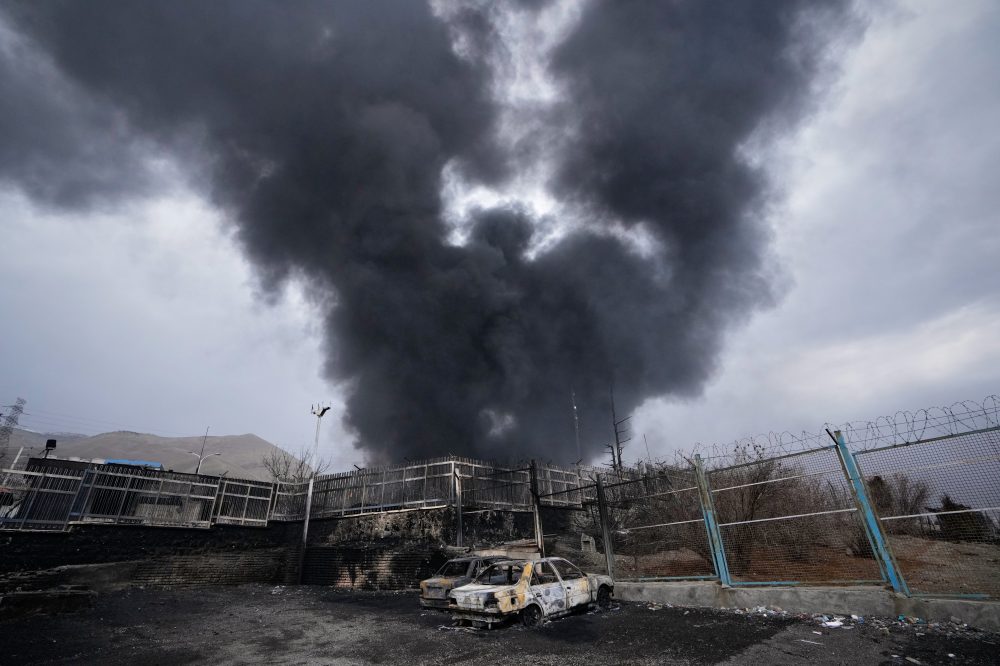
Monday brought fresh evidence of the conflict’s expanding impact on infrastructure as Bahrain reported Iranian attacks on a crucial desalination facility that provides drinking water, while oil storage facilities in Tehran continued burning after overnight Israeli military operations.
These sharp price jumps built upon last week’s already significant gains, when U.S. crude climbed 36% and Brent increased 28%. Energy costs have skyrocketed as the two-week-old conflict has drawn in nations and regions essential to Persian Gulf petroleum production and transportation.
According to independent research company Rystad Energy, approximately 15 million barrels of crude oil — representing roughly 20% of global supply — normally transit the Strait of Hormuz daily. However, concerns about Iranian missile and drone strikes have virtually halted tanker traffic through this waterway, which borders Iran to the north and facilitates oil and gas shipments from Saudi Arabia, Kuwait, Iraq, Qatar, Bahrain, the United Arab Emirates and Iran.
Several major producers including Iraq, Kuwait and the UAE have reduced output as storage capacity reaches limits due to constrained export capabilities. Military strikes by Iran, Israel and the United States targeting energy infrastructure since hostilities began have further intensified supply worries.
Current Brent and U.S. crude trading levels haven’t been seen since 2022, when Russia’s invasion of Ukraine disrupted global energy markets.
The petroleum price surge that began when Israel and the U.S. launched attacks on Iran March 1 has created widespread financial market anxiety, raising concerns that elevated energy expenses will drive inflation higher and reduce American consumer spending, which powers the nation’s economy.
Asian markets reflected this uncertainty as Tokyo’s Nikkei 225 index dropped more than 7% in early Monday trading, with other regional exchanges also declining.
Domestic fuel costs have risen sharply, with regular gasoline reaching $3.45 per gallon Sunday — an increase of approximately 47 cents from the previous week, according to AAA data. Diesel prices climbed to about $4.60 per gallon, up roughly 83 cents over seven days.
Energy Secretary Chris Wright, appearing on CNN’s “State of the Union,” predicted American gas prices would return below $3 per gallon “before too long.”
“Look, you never know exactly the time frame of this, but, in the worst case, this is a weeks, this is not a months thing,” Wright added.
Market experts and investors warn that sustained oil prices above $100 per barrel could prove too burdensome for the worldwide economy.
Iranian officials reported that Israeli strikes on Tehran oil storage facilities and a petroleum transfer terminal early Sunday resulted in four fatalities. Israeli military representatives stated these facilities were being utilized by Iran’s armed forces to fuel missile launches. Mohammad Bagher Qalibaf, Iran’s parliamentary speaker, cautioned that the war’s effects on the petroleum sector would continue expanding.
Iran typically exports about 1.6 million barrels daily, primarily to China, which may need alternative suppliers if Iranian shipments face disruption — another factor potentially driving energy prices higher.
Natural gas prices have also increased during the conflict, though less dramatically than oil. Late Sunday trading showed prices at approximately $3.33 per 1,000 cubic feet, up 4.6% from Friday’s $3.19 close, following an 11% weekly gain.
U.S. stock futures, which often signal market direction, declined Sunday evening, indicating Wall Street’s major indices would likely open lower Monday. S&P 500 futures fell 2.2%, while Dow futures dropped 2.3%. Nasdaq composite futures declined 2.6%.
Friday’s trading session saw the S&P 500 fall 1.3% and the Dow plunge as much as 945 points before closing down roughly 450 points. The Nasdaq composite finished 1.6% lower.