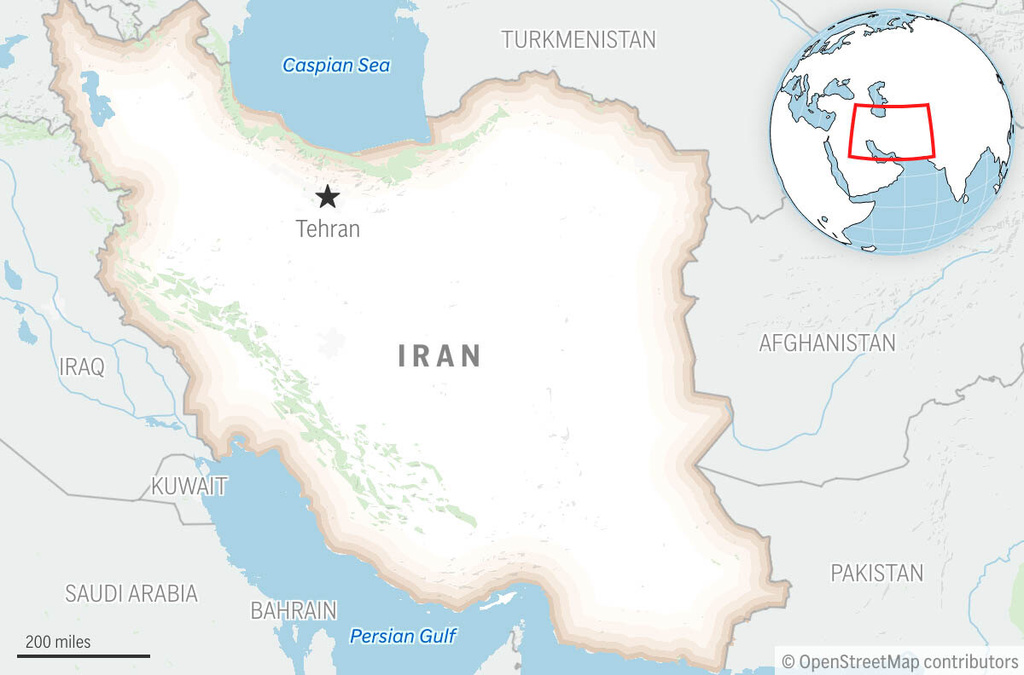

Asian stock markets delivered mixed results Tuesday while oil prices declined following escalating tensions between the United States and Iran.
Trading began sluggishly Tuesday after Wall Street posted modest losses, though U.S. futures showed slight gains.
As uncertainty surrounds diplomatic negotiations between Iran and the U.S. to resolve the conflict, Brent crude oil prices stayed above $95 per barrel, dropping a modest 0.4% to $95.10. American benchmark crude declined 0.9% to $86.66 per barrel.
Tokyo’s Nikkei 225 rose 1.1% to 59,485.54, boosted by technology companies including Tokyo Electron, which surged 4.4%. SoftBank Group Corp., the tech and energy conglomerate, gained 5.5%.
South Korea’s Kospi surged 1.8% to 6,327.73 while Taiwan’s Taiex increased 1.7%.
Hong Kong’s Hang Seng dropped 0.1% to 26,382.30 and Shanghai’s Composite index fell 0.3% to 4,068.28.
Australia’s S&P/ASX 200 decreased 0.1% to 8,942.80.
President Donald Trump criticized opponents after a second diplomatic session with Iran became uncertain due to the U.S. Navy’s capture of an Iranian cargo vessel. Trump announced Vice President JD Vance would travel to Islamabad, though Iranian officials made no promises for additional negotiations.
Monday saw oil prices rise due to increased U.S.-Iran tensions, though the increases were smaller compared to earlier periods of the conflict. American stocks meanwhile pulled back slightly from their record-setting performance.
Monday’s trading saw the S&P 500 decline 0.2% from its record high, while the Dow industrials dropped less than 0.1%. The Nasdaq composite decreased 0.3%.
Concerns about oil supply disruptions from the Persian Gulf region, particularly if Iran continues preventing tankers from leaving the Strait of Hormuz, are affecting investor confidence.
A critical deadline approaches Tuesday evening at 8 p.m. Eastern time, which corresponds to early Wednesday in Tehran, when the current ceasefire between the United States and Iran is set to end.
“The current dynamic is one of a precarious balance of truce,” Mizuho Bank said in a commentary, so “as the ceasefire draws to its 2-week deadline, the all-consuming question is whether both sides can seize on the talks to land on a US-Iran deal that ends the war.”
Currently, oil prices remain significantly below the $119 per barrel peak for Brent crude when concerns reached their highest point. The S&P 500 continues trading above pre-war levels.
Monday’s Wall Street session saw United Airlines drop 2.8% and American Airlines fall 4.2% after American rejected merger discussions with United. Airline shares had climbed last week following reports of United’s interest in combining with its competitor.
TopBuild, which distributes insulation and construction materials, jumped 19.4% on the positive side. QXO announced plans to acquire the company in a transaction worth approximately $17 billion, creating what it described as North America’s second-largest publicly traded building products distributor. QXO shares declined 3.1%.
American corporations have reported strong earnings for the first quarter of 2026, providing market support.
Major U.S. banks indicated last week their expectation that the American economy will maintain its strength, particularly due to robust consumer spending.
Approximately 10% of S&P 500 companies have released their early 2026 results. Nearly 90% exceeded analyst profit projections, according to FactSet data.
If remaining companies meet analyst forecasts, total earnings per share for S&P 500 firms are projected to increase 13% compared to the previous year.
Companies reporting earnings this week include UnitedHealth Group on Tuesday, Tesla on Wednesday, and Procter & Gamble on Friday.
In early Tuesday currency trading, the U.S. dollar strengthened to 158.98 Japanese yen from 158.82 yen. The euro weakened to $1.1782 from $1.1789.