
NEW YORK — Tuesday’s New York state primary is putting Democratic nomination fights for U.S. House seats front and center, even as most of the state’s top elected officials won’t appear on the ballot.
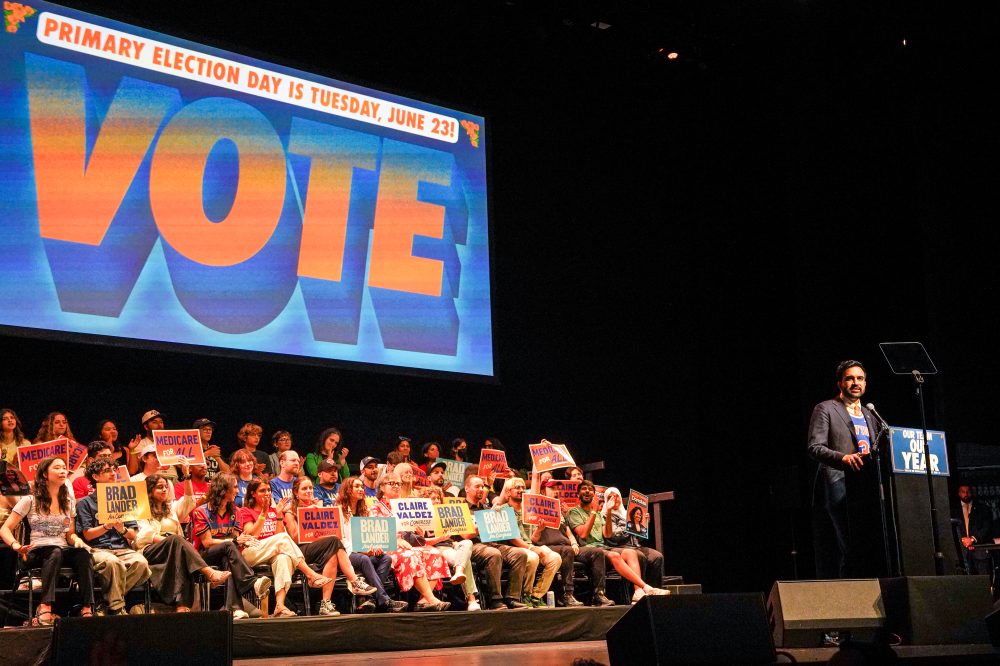
New York City Mayor Zohran Mamdani — himself not on the ballot — has become a central figure in the races by endorsing several candidates, including challengers taking on two sitting Democratic members of Congress.
Control of the U.S. House could hinge on New York’s congressional seats come November.
In New York City, hotly contested primaries in districts that have long leaned Democratic could help define what the party stands for, both in New York and nationally.
In the 10th Congressional District, covering Lower Manhattan and portions of Brooklyn, two-term incumbent Rep. Dan Golden is facing a serious challenge from former New York City Comptroller Brad Lander. Lander has secured endorsements from Mayor Mamdani and Vermont U.S. Sen. Bernie Sanders. Mamdani and Lander previously competed against each other in the mayoral race.
In the 13th Congressional District, which spans Upper Manhattan and parts of the Bronx, five-term incumbent Rep. Adriano Espaillat is being challenged by three candidates. Among them is doctoral student and political organizer Darializa Avila Chevalier, who also carries Mamdani’s endorsement.
In the 7th Congressional District, which straddles Brooklyn and Queens, longtime Rep. Nydia Velázquez is stepping down after 17 terms. She has thrown her support behind Brooklyn Borough President Antonio Reynoso, but he faces a difficult contest against state Assemblywoman Claire Valdez, who has the backing of both Mamdani and Sanders.
Eight Democrats are vying in Manhattan’s 12th Congressional District to fill the seat being vacated by retiring Rep. Jerry Nadler. The leading contenders are state Assemblymen Alex Bores and Micah Lasher, attorney and former Republican George Conway — a vocal Trump critic — and Kennedy family member Jack Schlossberg. Conway has raised the most money, but Lasher has endorsements from Nadler, Democratic Gov. Kathy Hochul, and former New York City Mayor Michael Bloomberg.
Just north of New York City in the 17th Congressional District, five Democrats are competing for the chance to challenge two-term Republican Rep. Mike Lawler, who faces no opposition for his party’s nomination. The Democratic field includes former White House counterterrorism official and Army combat veteran Cait Conley, Rockland County Legislator Beth Davidson, and Tarrytown Village Trustee Effie Phillips-Staley. As of early June, Conley leads in both fundraising and cash on hand, followed by Davidson, with Phillips-Staley a distant third.
This suburban swing district is one of Democrats’ top targets for a pickup. Democrat Kamala Harris narrowly won the district in 2024, performing best in Westchester County — the district’s largest and most city-adjacent county. Donald Trump carried Rockland, Putnam, and Dutchess counties by double-digit margins.
On Long Island, Democratic freshmen Reps. Tom Suozzi and Laura Gillen are defending their seats in the 3rd and 4th Congressional Districts, respectively, and both face primary opposition.
In the sprawling 21st Congressional District in upstate New York, Republican Rep. Elise Stefanik is not running for a seventh term after her bid for governor fell apart and her nomination for United Nations Ambassador was withdrawn. State Assemblyman Robert Smullen has the support of local party leaders to take her place, while business owner Anthony Constantino has received an endorsement from Trump.
The only statewide Democratic contest on Tuesday’s ballot is the primary for state comptroller, where five-term incumbent Tom DiNapoli is facing his first primary challenge in nearly 20 years in office.
Gov. Hochul and state Attorney General Letitia James are both running for reelection but are unopposed for their party’s nominations, meaning they won’t appear on primary ballots. The same applies to their Republican opponents, Bruce Blakeman and Saritha Komatireddy. Under New York state law, primaries are not held when only one candidate is seeking a party’s nomination.
Voters will also weigh in on contested primaries for state Senate and state Assembly seats. All 63 state Senate seats and all 150 state Assembly seats are on the line in 2026. Democrats currently hold roughly a two-to-one advantage over Republicans in both chambers.
Here are key facts and figures to know about Tuesday’s election:
Polls close at 9 p.m. ET.
The Associated Press will report vote totals and declare winners in contested primaries for U.S. House, state comptroller, state Senate, and state Assembly races.
Only voters registered with a political party may participate in that party’s primary. Democrats cannot vote in the Republican primary, and Republicans cannot vote in the Democratic primary. Voters registered as independent or unaffiliated are not eligible to participate in either primary.
As of February 20, New York had approximately 13.4 million registered voters. That includes around 6.4 million registered Democrats, about 3 million registered Republicans, and roughly 3.4 million voters with no party affiliation.
In the 2022 primaries for governor, approximately 899,000 Democratic primary votes and 451,000 Republican primary votes were cast.
About 20% of the 2022 primary vote came through early in-person voting or mail ballots. That figure climbed to roughly 39% during the 2024 presidential primaries.
As of last Wednesday, approximately 107,000 ballots had already been submitted ahead of Tuesday’s election.
New York counties and New York City typically release nearly all results from early and mail voting in the first batch of returns for the night, often before any Election Day in-person votes are reported.
In the 2022 primary, the AP first reported results at 9:04 p.m. ET — just four minutes after polls closed. The final vote update that night came at 3:11 a.m. ET, with about 95% of ballots counted.
The AP does not make projections. A winner will only be declared when it is mathematically impossible for a trailing candidate to catch up. If a race remains uncalled, the AP will continue reporting on significant developments — such as a candidate conceding or claiming victory — while making clear that no winner has been officially declared.
In New York, an automatic recount kicks in for races where more than 1 million votes are cast if the winning margin is fewer than 5,000 votes. In smaller races, a recount is triggered if the margin is 20 votes or fewer, or 0.5% or less of total votes cast. The AP may still call a winner in a recount-eligible race if the lead is large enough that neither a recount nor a legal challenge could change the result.
As of Tuesday, there are 133 days remaining until the 2026 midterm elections.