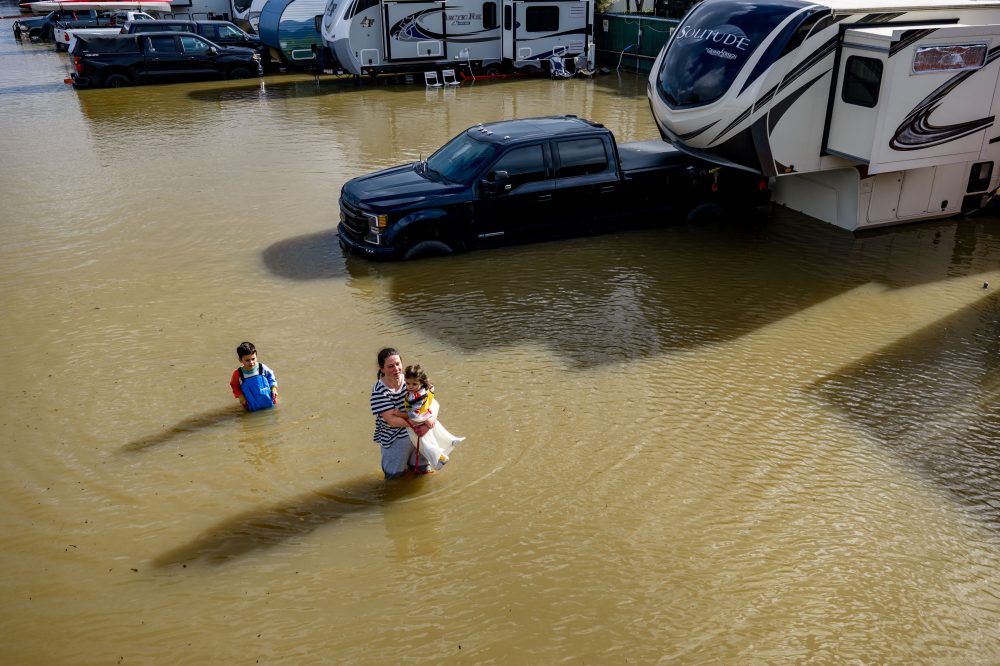

New research released Wednesday reveals that climate change caused by human activities has dramatically increased the occurrence of severe coastal flooding worldwide.
Scientists emphasize these results are vital for developing coastal infrastructure and flood management strategies as global temperatures continue rising.
Severe flooding incidents result from a mix of storm surges, elevated tides, and abnormal sea level increases combined with natural climate variations and human impacts. Hurricane Ian in 2022, which brought devastating flooding, represents an example of a storm that researchers determined was intensified by climate change. Coastal flooding poses threats to hundreds of millions of residents in low-elevation coastal regions globally each year, generates billions in damages, and can prove fatal.
Severe sea level incidents that were historically uncommon — those with a 1% probability of occurring in any given year — now happen approximately 12 times more frequently on average, according to new research published Wednesday in the journal Nature Climate Change. These incidents have become roughly four times more probable due to climate change driven by human activities, the study demonstrates.
Scientists analyzed the occurrence of extreme sea level incidents — which trigger coastal flooding — by examining long-term data from tide monitoring stations at over 100 locations combined with climate modeling. The research examined increases from 1900 through 2005. The timeframe ended at 2005 because of limitations in available models that connect events to human-caused climate change. The study authors noted their findings were cautious, considering that human contributions to coastal extreme changes have only grown since that time.
The researchers distinguished between human activity impacts, natural influences, and local ground movement. While sea level variations early in the 20th century could mostly be linked to natural causes, beginning in the 1960s, human-caused warming became the main driver of rising sea levels, according to scientists.
Additional research published Wednesday in the journal Science Advances also reinforces the idea that human-caused climate change drives extreme water levels. It determined climate change was responsible for 58% of days with extreme water levels during 2000 to 2018. Climate change has also roughly tripled the average number of days surpassing extreme water level thresholds since the 1970s, that study found.
“Essentially every coastal flood today has human fingerprints on it through climate change,” said Ben Strauss, chief scientist at Climate Central and a co-author of the Science Advances study. “Without the extra bit of sea level rise caused by global heating, most of these events would not have reached the status of flood.”
The Nature Climate Change research didn’t completely analyze individual human factors, said Sönke Dangendorf, the lead author, but he pointed out greenhouse gases — produced by burning fossil fuels like oil, gas and coal — represent the most important factor.
“In particular since the 1970s, it’s by far the dominating factor, and this is of course not good news at the moment,” said Dangendorf, also an associate professor at Tulane University. “The risk is evolving and with the evolving risk we need to do more for adaptation.”
Jeff Williams, a retired United States Geological Survey oceanographer who wasn’t involved in either study, said the research demonstrates that planners must account for heightened risks. They should also evaluate costs for enhancing coastal protection and decide who bears those expenses, he said.
Current protections for New Orleans, for example, “will likely not be adequate beyond the next couple decades,” Williams said.
Countries worldwide are increasingly adopting renewable energy sources like solar and wind. Last year, clean energy production surpassed total global electricity demand growth, and renewable energy’s portion reached more than one-third of global electricity generation for the first time. Even in the United States, where the Trump administration has promoted fossil fuels, solar energy is expanding while coal power decreases. Consequently, scientists recently indicated the world is no longer heading toward the worst-case warming scenario — but it’s also not moving toward the best-case outcome.
Dangendorf, the Tulane author, said: “The impacts, even of a relatively little sea level rise, can be pretty impactful on our coasts.”
“There is a silver lining because we have control about how much we emit, right?” he said. “So we can stop that development, at least to some degree.”