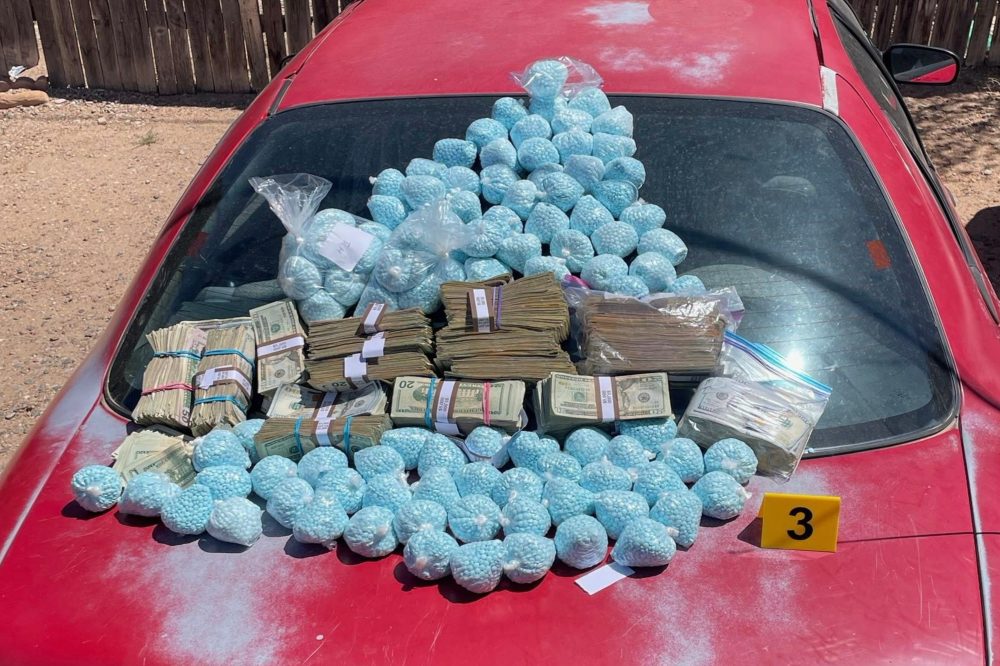

New Mexico’s attorney general launched a criminal investigation Friday to find out whether agents with the U.S. Drug Enforcement Administration violated state law by letting hundreds of thousands of fentanyl pills make their way onto the streets of Albuquerque.
The unusual probe comes just days after the Associated Press published a report revealing that DEA agents repeatedly watched fentanyl shipments move through the area without intervening — a deliberate tactic used from 2023 to 2025 in hopes of building larger criminal cases against drug trafficking networks.
Both current and former DEA agents, including whistleblower David Howell, told the AP that the approach was a dangerous gamble with public safety and may have run afoul of U.S. Justice Department guidelines designed to protect the public.
All of this unfolded during what has become the deadliest drug epidemic in American history — and while the DEA was simultaneously running a public awareness campaign called “One Pill Can Kill,” which warned that even tiny amounts of fentanyl can be fatal.
The criminal investigation transforms what had been a debate over law enforcement strategy into a direct legal question: did federal agents break the law while pursuing bigger targets?
New Mexico Attorney General Raúl Torrez, a Democrat, made clear that federal agents “are not above the law,” while acknowledging they do have significant legal protections when performing official duties.
Despite those protections, Torrez announced he would begin “demanding documents and information about the DEA’s conduct, in New Mexico and nationally, to determine whether what occurred here reflects a broader pattern of reckless or unlawful behavior.”
In a letter to Democratic Gov. Michelle Lujan Grisham — who had called for the investigation earlier in the week — Torrez wrote: “If those allegations are accurate, the consequences for New Mexicans were not abstract. They were fatal.”
He went on to say that “New Mexico already ranks among the states hardest hit by fentanyl overdose deaths, and the families who have lost children, siblings and parents to this crisis deserve a full accounting of what the federal government knew, what it did and what it failed to do.”
The DEA initially pushed back against Howell’s allegations in a statement to the AP, but later asked the Justice Department’s independent watchdog to conduct its own review of the matter.
“Should that review identify areas of improvement, the DEA will of course implement changes to better their practices,” the Justice Department said in a statement. “We welcome a partnership with Governor Lujan Grisham, as well as New Mexico state and local leaders, to fight the scourge of fentanyl and keep her constituents safe.”
While many local and state leaders in New Mexico have voiced outrage over the allegations, that anger is not universally shared — particularly among families who have lost loved ones to overdoses. Paul E. Martin, founder of United Against Fentanyl, a nonprofit representing 5,000 victims’ family members, offered a more measured take.
“Law enforcement makes mistakes,” Martin said. “But the DEA are the men and women putting their lives on the line. Their entire business is the removal of illegal and toxic drugs from our streets.”