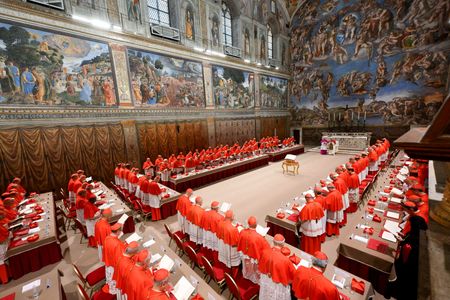

VATICAN CITY – A stunning security violation disrupted the highly secretive papal election that chose Pope Leo as the Catholic Church’s leader last May, according to a new book published this Sunday.
During the closed-door proceedings involving 133 cardinals, Vatican security systems detected an active mobile phone signal inside the Sistine Chapel, despite sophisticated jamming technology designed to block all outside communications.
The discovery occurred just as the religious leaders were about to cast their initial ballots. After security officials identified the breach, the cardinals looked around in disbelief until an elderly cleric realized he still had his device and surrendered it to authorities.
Authors Gerard O’Connell and Elisabetta Pique detail the incident in their new publication “The Election of Pope Leo XIV,” describing the unnamed cardinal as appearing “disoriented and distressed” by the discovery. The writers suggest no intentional wrongdoing occurred.
“The scene was unimaginable even for a film and never before seen in the history of modern conclaves,” the Vatican correspondents wrote in their account.
O’Connell told reporters that the real-life drama exceeded even Hollywood’s imagination, noting that “Reality (was) better than fiction” compared to the 2024 movie “Conclave” which depicted fictional papal election intrigue.
Vatican protocol requires all participating cardinals to pledge complete isolation from external contact and surrender all communication equipment before entering the conclave, which can extend for multiple days.
Vatican officials declined to comment on the book’s revelations about one of the world’s most closely guarded electoral processes.
The two-day selection process unfolded May 7-8 following Pope Francis’s death in April after leading the 1.4 billion-member church for twelve years. Global attention focused on whether cardinals might choose the first pope from Asia or Africa, given the conclave’s unprecedented geographic diversity with representatives from 70 nations.
However, the book reveals that candidates from those continents gained little traction during the actual voting, based on interviews with participating cardinals conducted afterward.
While cardinals are strictly prohibited from discussing conclave details without papal permission, journalists typically gather information through gradual interviews in subsequent years.
Two contenders quickly dominated the competition, according to the authors’ account. Italian Cardinal Pietro Parolin, widely considered a leading prospect by media outlets, faced off against U.S. Cardinal Robert Prevost, a relatively unknown figure outside church leadership who would become America’s first pope.
During the evening vote on May 7, Prevost surprisingly secured between 20-30 ballots, an exceptionally strong initial showing. Philippine Cardinal Luis Antonio Tagle, another pre-election favorite, never exceeded single-digit support throughout the process.
Prevost clinched victory on the fourth ballot May 8 afternoon with 108 votes. The book notes that Tagle, seated beside the future pontiff during final vote counting, offered Prevost a cough drop to ease his throat.