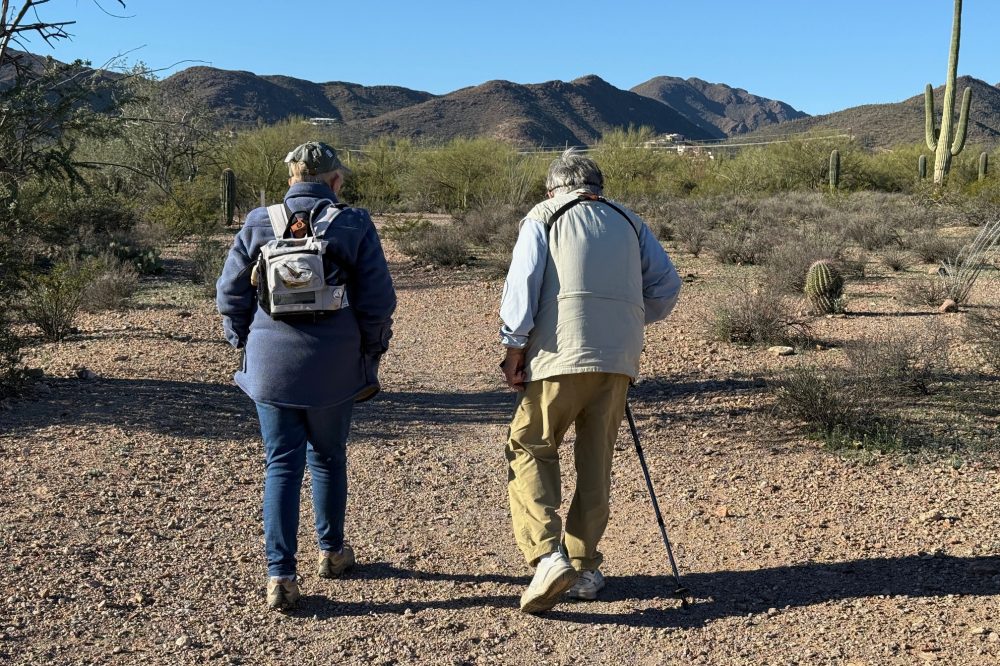

TUCSON, Ariz. — With an oxygen tank strapped to her back due to COPD, Marcia OBara guides a group of bird enthusiasts along flat pathways, each person moving at their own comfortable speed. The atmosphere is relaxed and supportive, free from the competitive spirit often found in traditional birding groups.
OBara leads “Birding for Every BODY,” one of several monthly excursions organized by the Tucson Bird Alliance in partnership with Pima County, Arizona. The program represents a nationwide effort to make bird watching and nature experiences available to individuals with physical and other challenges.
“It’s an opportunity for people to get out and see birds without pressure, no matter how long it takes or how many birds we see,” explained OBara, a former nurse who has coordinated these inclusive outings for three years. She noted that people with disabilities frequently struggle to participate in conventional birding trips, particularly when competitive enthusiasts focus on spotting as many species as possible.
OBara carefully plans each accessible expedition, confirming that pathways are easy to navigate and restroom facilities can accommodate wheelchairs and mobility scooters. She verifies the availability of water fountains, shaded areas, and seating options. During walks, OBara monitors the group’s progress and adjusts the tempo accordingly.
“I used to work in rehab, so I usually know what people need,” OBara said.
Although the excursions welcome participants using wheelchairs and scooters, individuals with such equipment seldom join the walks, possibly due to concerns about keeping pace, OBara observed.
“But we’d encourage them to come,” OBara said.
During one February outing at a Tucson-area park, OBara highlighted a phainopepla, a slim bird with a distinctive crest resting on a mesquite branch, feeding on the bright red mistletoe berries. Nearby, mallards and other waterfowl splashed in ponds and foraged on the ground.
“It’s nice to just be outside and not think of anything else,” commented Rhea Guertin, a retired visitor from Rhode Island who winters in Tucson for four months annually. She relied on a walking stick for balance.
“I’m just slow,” she explained.
Evelyn Spitzer, a former teacher from the Tucson area, also used a walking aid due to a heart condition and recent surgical recovery.
The organized movement to include people with disabilities in birding dates back to at least 2018, when former Texas educator Virginia Rose established the nonprofit organization Birdability. Rose has been wheelchair-bound since sustaining a spinal injury at 14 years old.
“Our vision is that birding be truly for everybody and every BODY, regardless of disability,” stated Cat Fribley, Birdability’s executive director. She explained that participants face various challenges including mobility restrictions, vision impairment, chronic conditions, intellectual or developmental differences, mental health issues, neurodivergence, hearing loss, and other medical concerns.
Fribley, who uses a mobility scooter due to multiple disabilities, can travel five to six miles on accessible trails in her Iowa City, Iowa neighborhood while bird watching.
“In the winter, I bird on my back deck with my coffee,” she said.
Accessible birding takes many forms, including observation from vehicles, canoes on waterways, or simply through home windows, according to advocates.
Birdability has collaborated with the National Audubon Society to create a crowd-sourced database of accessible birding sites across the country and provides guidance to able-bodied birders on creating more welcoming environments.
The organization’s website features numerous resources and adaptive equipment, including camera mounts for car windows and applications that help blind individuals identify and record bird songs.
Occupational therapist Freya McGregor suggests binocular harnesses that distribute weight across the back and chest, reducing strain on shoulders and neck compared to traditional neck straps.
McGregor, who lives with a permanent knee injury, operates Access Birding, which educates nature organizations like state parks and local Audubon groups about trail accessibility.
Birding “really brings you joy,” said Jerry Berrier, a 73-year-old Massachusetts bird enthusiast who has been blind since birth. “There is happiness from being out in nature.”
Berrier discovered his passion as a college student when he learned to recognize numerous bird vocalizations to fulfill a biology course requirement. He later instructed blind and deaf-blind individuals on using computers and mobile devices at the Perkins School for the Blind in Watertown, Massachusetts.
He records bird sounds for his website, www.birdblind.org, helping blind bird lovers document and share their experiences. Last year, he started the “Any Bird, Any Body” podcast with friend Gary Haritz.
Berrier also helped coordinate the first national bird-counting event for blind participants in the United States. The event attracted several hundred people last year, who documented bird calls they heard during a 24-hour period. This year’s event expands internationally on May 3-4.
“We encourage people to reach out to local organizations to help blind people with the bird-a-thon, he said. “A disability can be very isolating.”