
OFF THE COAST OF NORTH CAROLINA — A voice with a distinct Southern drawl crackled over the radio: “Warship! Get out of our waters!”
Norwegian Lieutenant Thomas Johannsen and his crew were in the middle of a simulated boarding operation — a routine mission for their NATO maritime unit. With multiple war games underway in the same waters, the sailors were inadvertently picking up radio traffic from a nearby vessel unrelated to their exercise.
Johannsen switched to a clear channel and turned his attention to the cargo ship he was targeting. “Please stop your vessel and accept my boarding team,” he ordered.
Reuters was granted exclusive access to the NATO exercise last Friday, one of several U.S.-hosted military drills centered on defending the American homeland. The exercises were scheduled to align with the nation’s 250th anniversary celebration.
The timing came at a difficult moment for the alliance. The Trump administration has been openly questioning the worth of the 77-year-old NATO partnership, reassessing its military presence in Europe, and clashing with longtime allies.
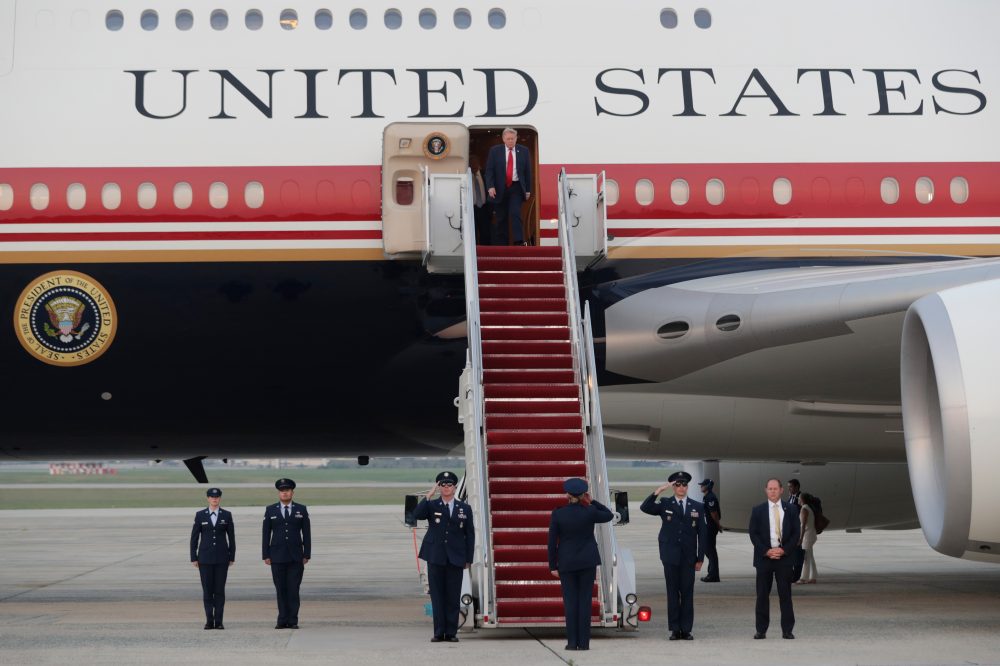
During an Oval Office meeting last week with NATO Secretary General Mark Rutte, President Donald Trump publicly criticized Britain, Spain, Germany, and France for not providing enough support during the U.S. conflict with Iran. “We’re disappointed with most of them,” the president said.
David Cattler, who previously served as NATO’s intelligence chief during Trump’s first term, said the exercises carry a meaningful message about European nations’ capacity and commitment to defending both sides of the Atlantic. However, he expressed doubt that the drills would shift thinking inside the Pentagon. “It’s hard for me to see,” Cattler said.
AN UNEASY ALLIANCE
Trump has long argued that the United States bears a disproportionate share of the burden for European security — a position that has disrupted decades of bipartisan backing for NATO in Washington.
Speaking at NATO headquarters in mid-June, Defense Secretary Pete Hegseth announced a six-month Pentagon review that could result in a reduction of U.S. troops stationed in Europe. He criticized what he called “free riding” by alliance members and insisted the partnership must benefit both sides equally.
Tensions have been further strained by the conflict in Iran. An internal Pentagon email, reported by Reuters in April, raised the possibility of suspending Spain from the alliance after the country refused to allow U.S. military basing and overflight rights during operations against Tehran.
Despite that friction, Spanish Marines participated in the FLEETEX 250 exercises, conducting ship-to-shore amphibious operations. French Marines also took part in training drills, including exercises on heavy machine guns, at U.S. Marine Corps Base Camp Lejeune in North Carolina.
Defense analysts say the continued cooperation at the military working level shows that operational bonds between the U.S. and its allies remain intact, even as political tensions simmer above them. Exercises like these are planned months or even years in advance as part of standard military readiness.
“Absent any intervention that would tell them to stop, they’re gonna continue to do it,” said Mark Cancian, a retired U.S. Marine officer with the Center for Strategic and International Studies. “This is just NATO being NATO,” he added.
ALWAYS AT SEA
Reuters spent the day aboard Standing NATO Maritime Group One, led by British Commodore Maryla Ingham. The group includes frigates from Norway, Germany, Belgium, Denmark, the Netherlands, and Turkey. Journalists traveled to the area by helicopter, flown by the Canadian air force, landing on the ship’s flight deck roughly 40 nautical miles from the North Carolina shore.
Ingham noted that while her unit is accustomed to extended time at sea, they more typically operate in the frigid northern waters near the Arctic and the Baltic region, where they keep watch for Russian military activity. “This area doesn’t require as much patrolling because there isn’t as much threat here,” she said.
For Norwegian commanding officer Stian Buunk of the frigate Fridtjof Nansen, this marked his first time operating in American waters. Though his vessel is smaller than U.S. destroyers, it is well-armed — carrying air defense and anti-ship missiles, submarine-hunting torpedoes, and a 76mm deck gun.
The proximity to the U.S. Navy’s 2nd Fleet headquarters in Norfolk, Virginia, brought additional American military assets into the mix. “We had anti-air warfare exercises two days ago with F-18s. We had drones coming in,” Buunk said. “And that makes it very realistic.”
Anti-submarine warfare is one of Norway’s key contributions to NATO. One exercise involved deploying search-and-attack units to locate, track, and drive off a U.S. submarine. When asked how his ship fared, Buunk answered with measured confidence: “This ship is built for anti-submarine warfare. So, yah.”
Ingham highlighted that many European nations bring unique skills to NATO’s maritime operations. Belgium, for example, is recognized for its expertise in detecting and clearing underwater mines. “We are demonstrating both the flexibility in the reach of our unit, but also our ability to seamlessly operate alongside the Americans,” she said.
‘NO MORE GOAT’
The boarding exercise was built around a fictional scenario involving suspected smuggling aboard a cargo ship from a made-up country called Pyropia. The actual vessel used was a U.S. Navy training support ship.
Before boarding, Norwegian forces cleared their weapons to prevent any accidental discharge. Lieutenant Johannsen then radioed the vessel to ask whether anyone on board was carrying weapons or had any animals. The response from the U.S. ship was memorable: “We had a goat. But we eat goat. So now, no more goat.”
Lieutenant Erik Aasen, a navigation officer who led the boarding team, reported that the search turned up rifles, four bags of narcotics, and currency issued by the “National Bank of Garnet” — yet another fictional nation created for the exercise.
It was Aasen’s first boarding operation conducted outside Norwegian waters, and he called it a success. The highlight for him was the opportunity to work alongside American counterparts. U.S. forces “have a lot of other experiences,” he said.
Looking ahead, experts warned that if the Pentagon moves forward with plans to reduce NATO’s dependence on American troops, joint exercises like these could become less frequent. Still, Cancian expressed cautious optimism that Congress would help curb the impact, pointing to Republican resistance earlier this year when the Pentagon paused the deployment of thousands of rotational forces to Poland and the Baltic states. “The president can do it, but you know there’s clearly a political price,” he said.