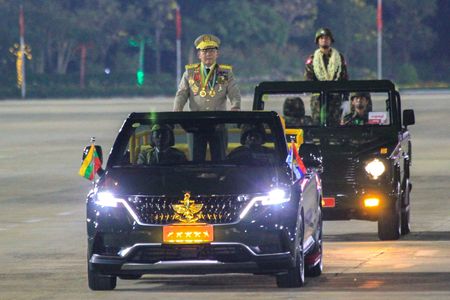

Myanmar’s military commander Min Aung Hlaing is poised for a parliamentary vote Friday that would install him as the nation’s president, cementing his authority five years following his military takeover of the democratically elected government.
The anticipated shift from military general to civilian leader comes after a heavily skewed election that saw an army-supported political party claim victory, which opposition voices and international leaders condemned as fraudulent theater designed to mask continued military control under democratic pretenses.
The 69-year-old military leader was the architect behind the 2021 military takeover that removed Nobel Peace Prize recipient Aung San Suu Kyi’s administration and resulted in her detention, triggering mass demonstrations that evolved into countrywide armed opposition to military rule.
Parliamentary members from the Union Solidarity and Development Party, which secured 81% of contested positions, are anticipated to unite with the military’s designated legislators in supporting the former top military commander among three nominated candidates, with legislative proceedings beginning at 10 a.m. local time.
Min Aung Hlaing’s presidential ambitions — a role that experts believe he has pursued for years — remained secret until recent days and came alongside news of significant changes in Myanmar’s military leadership structure, which he has commanded since 2011.
This past Monday, while receiving his parliamentary nomination for president, Min Aung Hlaing selected Ye Win Oo, a former intelligence director known for unwavering allegiance to the general, as his replacement to head the armed forces.
The military transition and Min Aung Hlaing’s anticipated presidency represent what experts view as a calculated move to strengthen his authority over Myanmar while leading what appears to be a civilian administration, benefiting an armed forces that has directly governed the nation for five out of the last six decades.
“He has long harboured the ambition to trade his title of commander-in-chief for president and it appears his dreams are now becoming a reality,” said Aung Kyaw Soe, an independent Myanmar analyst.
Despite these political maneuvers, the internal conflict that has devastated Myanmar throughout most of the previous five years continues intensely, with anti-military groups — including survivors from Suu Kyi’s political organization and established ethnic minority forces — creating a unified coalition this week to challenge the military.
“Our vision and strategic objectives are to completely dismantle all forms of dictatorship, including the military dictatorship, and to collectively initiate a new political landscape,” the Steering Council for the Emergence of a Federal Democratic Union said in a statement on Monday.
Opposition forces may encounter heightened military action along with greater attention from bordering nations that might attempt to strengthen ties with the emerging government, according to analysts.
“Amidst global oil and fuel shortages and economic crises, maintaining organisational stability could become difficult,” analyst Sai Kyi Zin Soe said of the opposition.
“As these hardships grow, it may become even harder to build mutual understanding and trust between groups, reach firmer agreements, and sustain cooperation.”