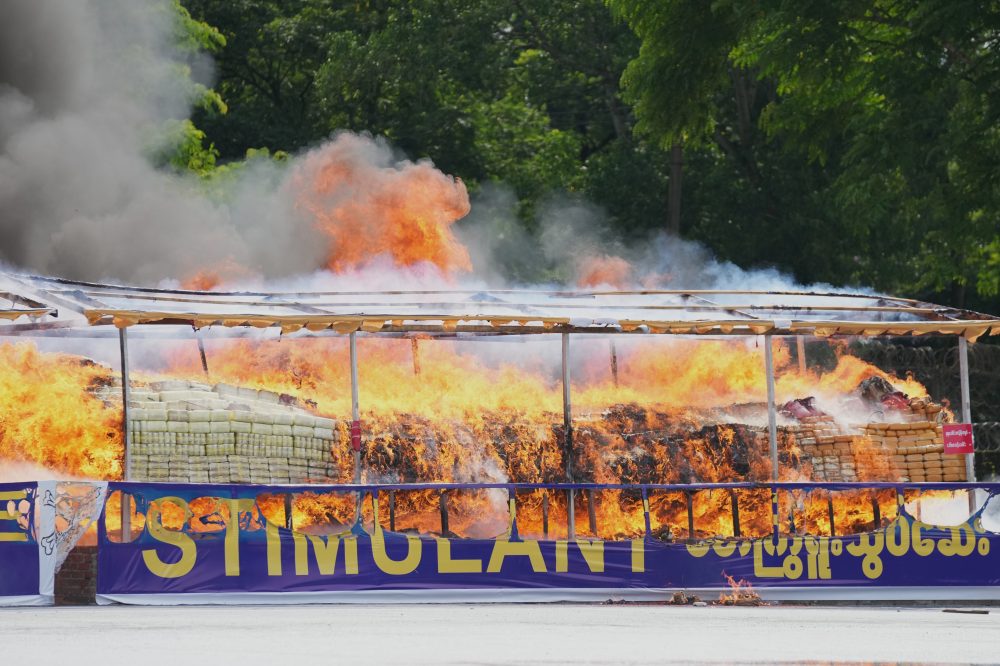

Massive plumes of dark smoke rose above the outskirts of Myanmar’s largest city Friday as government authorities incinerated over 50 tons of illegal substances — including heroin, opium, ketamine, methamphetamine, marijuana and crystal meth — representing roughly $600 million in confiscated narcotics destroyed across the country.
Myanmar, also referred to as Burma, has struggled for decades with drug production tied to political instability and economic hardship stemming from years of armed conflict.
Despite ongoing efforts to suppress the illegal drug trade, the country has long ranked among the world’s top producers of heroin and methamphetamine, serving as a primary supplier of illicit substances flowing into East and Southeast Asia.
Experts say that the violent political turmoil that followed the military’s seizure of power in 2021 — which sparked a civil war between the military government, pro-democracy forces, and various ethnic armed groups — has driven drug production even higher.
Back in January, the military government announced what it described as the country’s largest-ever seizures of illegal drugs and drug-manufacturing equipment, recovered from 12 production sites during raids conducted in the northern region of Shan state.
The street value of this year’s drug destruction was more than twice the total from last year, according to Police Lt. Col. Aung Myat Soe of Yangon’s Anti-Narcotics Police Force, who spoke with reporters at a bus station compound on the city’s outskirts where the burning took place.
In Yangon alone, authorities destroyed approximately $321 million worth of 31 different types of drugs, Aung Myat Soe said.
Similar destruction events were held in Mandalay and in Taunggyi, the capital of eastern Myanmar’s Shan state — regions closer to the drug production zones — in observance of the United Nations’ International Day Against Drug Abuse and Illicit Trafficking.
Large portions of Myanmar remain under the control of long-standing militias representing the country’s many ethnic groups. Several of these groups are engaged in fighting against the military-led government in a bloody civil war, alongside pro-democracy movements that emerged after the military ousted democratically elected Aung San Suu Kyi in 2021.
Earlier this year, elections took place that international observers described as neither free nor fair, with major opposition groups barred from participating. The military government won by a wide margin.
The government has argued that the country’s militias rely on drug profits to fund their armed campaigns and have little incentive to pursue peace because they benefit financially from the narcotics trade.
While some armed groups are known to be involved in drug trafficking — both now and historically — others have actually moved to suppress drug activity in areas they control.
One such group, the Ta’ang National Liberation Army, which seized large portions of northern Shan state during the civil war before agreeing to a ceasefire with the military in October, announced Thursday that it plans to destroy approximately $5.5 million worth of confiscated drugs within its own controlled territory.