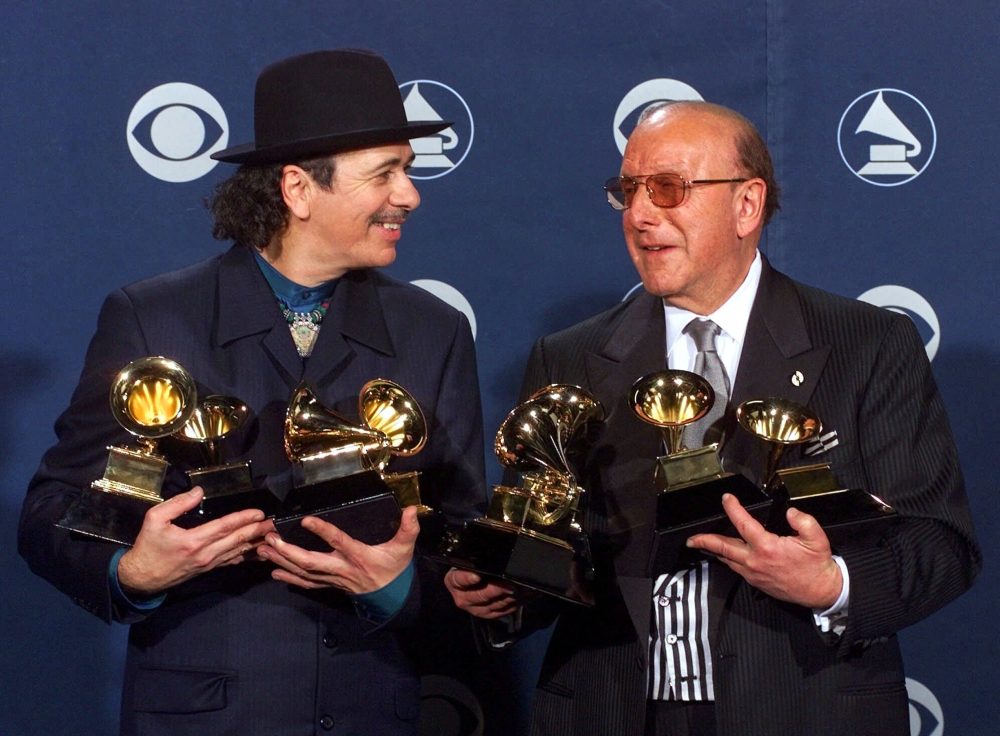

Clive Davis, a towering figure in the music business who passed away at the age of 94, was renowned for building deep, trusting bonds with the artists he worked with. That mutual respect allowed him to guide their careers — and in return, those artists helped shape who he became as an executive.
Over a career spanning six decades, Davis worked with an extraordinarily diverse roster of talent — from the Grateful Dead to Alicia Keys. Here is a look at some of the most notable partnerships he forged along the way.
Janis Joplin
Davis played a pivotal role in Janis Joplin’s career, though she may have had an even greater influence on him. After becoming president of Columbia Records at just 35 years old, he attended the Monterey Pop festival in California on the hunt for new talent. There, he encountered Big Brother & The Holding Company, with Joplin as its standout performer. In a 2022 speech, he described that moment as his first major test as head of the label: “Should I personally sign an artist just based on my gut?”
“I did make that decision, and my life would never be the same,” he said.
Davis convinced Joplin to release a shorter version of “Piece of My Heart” so it could get radio airplay, and he also encouraged her to step away from Big Brother and pursue a solo career. After her death in 1970, Davis discovered her recording of “Me and Bobby McGee” within the sessions for her album “Pearl,” which was released after her passing to widespread acclaim.
Santana
Davis first brought Santana to Columbia Records in 1968. The guitarist and singer went on to score major hits including “Black Magic Woman” and “Oye Como Va,” along with a legendary appearance at Woodstock in 1969.
Years later, Davis reconnected with Santana at a time when the artist was searching for renewed relevance. Davis proposed an album blending some of Santana’s original material with collaborations featuring contemporary musicians. The outcome was the 1999 release “Supernatural,” which included “Do You Like the Way” with Lauryn Hill, “Maria Maria” with Wyclef Jean, and “Smooth” with Rob Thomas. The album earned eight Grammys, tying the record previously set by Michael Jackson’s “Thriller.”
In a social media tribute, Santana wrote that Davis “believed in Santana from the beginning, and years later he believed in us again.”
Bruce Springsteen
Davis signed a 22-year-old Springsteen to Columbia Records in 1972. He later recalled being convinced that Springsteen was far more than a Bob Dylan imitator — that he had the makings of a “poet warrior” and one of the greatest live performers of all time.
When Springsteen delivered his debut album, Davis sent him back to the drawing board, saying it lacked any singles. Springsteen responded by writing two new songs: “Blinded by the Light,” which later became a hit for Manfred Mann, and “Spirit in the Night.” Davis also offered the young artist early advice about using a large stage fully rather than standing in one spot — advice he shared during an appearance on the “Late Show” with David Letterman.
“He changed my life when he signed me to Columbia Records,” Springsteen wrote in a social media post.
Whitney Houston
No artist was more closely linked to Davis than Whitney Houston. He first encountered her at a New York club called Sweetwater’s, where the 19-year-old was performing alongside her mother, Cissy Houston, a well-known gospel and soul singer. Houston sang “The Greatest Love of All,” a song Davis had originally commissioned for the Muhammad Ali film “The Greatest.”
“As soon as she started singing that song, I was stunned,” Davis recalled in a 2022 CNN interview.
He signed her to Arista in 1983, and the label spent a deliberate two years finding the right songs and producers before releasing her debut album — one of the biggest-selling debut albums ever. Houston went on to become the label’s top-selling artist and one of the most celebrated singers in history. Her relationship with Davis was so close that her team negotiated a “key man” clause allowing her to exit her contract if Davis ever departed from Arista.
Davis also had a hand in shaping the soundtrack to Houston’s 1992 film “The Bodyguard,” pushing for a stripped-down arrangement and her now-iconic a cappella introduction to her unforgettable cover of Dolly Parton’s “I Will Always Love You.”
The Grateful Dead
Davis had long wanted to sign the Grateful Dead — or at least frontman Jerry Garcia — to Columbia Records, dating back to the late 1960s. However, the band was under contract with a competing label. Instead, Davis signed the New Riders of the Purple Sage, a psychedelic country group that included Garcia. When the Dead were seeking a new major label in the late 1970s, Davis brought them to his newly established Arista Records.
Late guitarist Bob Weir once described Davis as “the one suit we weren’t distrustful of.” At concerts, Weir occasionally changed the lyrics to the band’s standard “Jack Straw” from “We used to play for silver, now we play for life” to “We used to play for acid, now we play for Clive.”
Davis took a relaxed approach to the band’s studio recording, telling them to record only when they felt ready, according to author Blair Jackson’s biography of Garcia. The Dead — famously indifferent to commercial success — ultimately delivered their biggest chart hit, 1987’s “Touch of Grey.”
Alicia Keys
Keys was just 15 when she signed with Columbia Records in 1996. Creative tensions arose quickly, with the label pushing to bring in outside professionals to work with her — an approach Keys later said left her feeling disrespected.
Davis, who was parting ways with Arista at the time, helped free her from that Columbia contract and eventually signed her to his new venture, J Records, in 2000. When she performed some of her songs for him at his office, he recognized her exceptional talent and believed she deserved full creative control over her music.
Her debut album, “Songs in A Minor,” was a critical and commercial triumph, winning five Grammys in 2002. Davis recognized, however, that her sound was difficult to categorize and might not receive the radio attention it deserved. In a 2002 interview, he recalled personally calling Oprah Winfrey and asking her to feature Keys on her show. Winfrey agreed, and the single “Fallin’” became a massive hit.
In a social media post, Keys described Davis as “the visionary who transformed dreams into reality, leaving an indelible mark on music and lives worldwide.”
Kenny G
The market for instrumental music was thin in the early 1980s, but Davis spotted soft jazz saxophonist Kenny G performing at a club and saw something special. He signed Kenny G to Arista in 1982, and the musician went on to become the best-selling instrumental artist of all time.
In a CNN interview, Kenny G credited Davis with his success, saying Davis had a gift for knowing when to give an artist freedom and when to step in with guidance. In his case, that meant not dictating how a saxophone solo should sound, but instead finding vocal artists — such as Michael Bolton — to collaborate with him.
“I wouldn’t be standing here if it wasn’t for him taking chances on me,” Kenny G said.