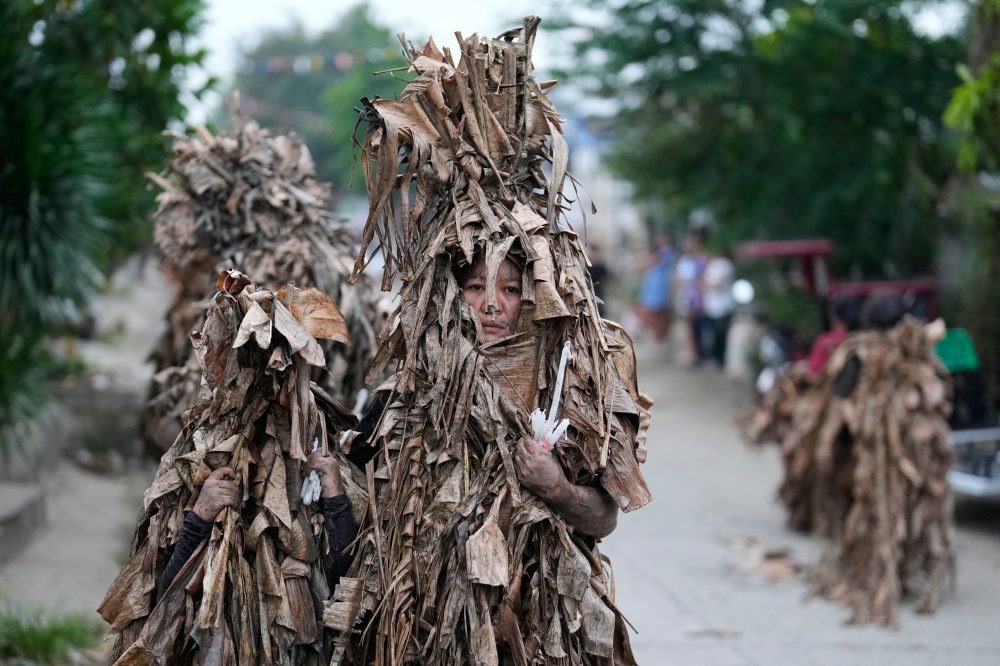

BIBICLAT, Philippines — In the Philippine village of Bibiclat, hundreds of Catholic faithful marked their devotion to St. John the Baptist on Wednesday by smearing their bodies with mud and wrapping themselves in dried banana leaves — a striking annual display of religious commitment in Asia’s largest Catholic country.
The event is known as the Taong Putik festival, which translates to “Mud People.” Each year, participants gather to give thanks to their local patron saint for miracles received and to fulfill promises made during prayer.
For 39-year-old construction worker Melencio Nenuda, the tradition carries deeply personal meaning. As a child, the sight of mud-covered worshippers terrified him, and he would hide whenever they passed. That fear gave way to devotion after he became seriously ill in sixth grade. His mother prayed to St. John the Baptist, vowing that her son would join the festival if he recovered — and he did.
“I will continue to go back to this tradition because it gives me a good future,” Nenuda said, noting that his wife and son now take part alongside him.
Preparations for the festival begin well before sunrise. Around 4 a.m., devotees head out to nearby fields to gather soft mud, spreading it across their bodies before draping themselves in dried banana leaves. They then walk barefoot to St. John the Baptist Church, carrying only cellphones and lit candles. While waiting for Mass to begin, they sing hymns near a small fire made from the gathered candle offerings.
According to local church leaders, the tradition dates back to the 1800s, when farmers originally covered themselves in mud as a sign of humility. The banana leaves served a different purpose at the time — concealing their identities to avoid discrimination against the poor.
The Rev. Elmer Villamayor, who led the parish from 2014 to 2021, said devotion to St. John the Baptist grew significantly after a group of local men narrowly escaped execution during the Japanese occupation in World War II. According to residents, a sudden rainstorm halted the proceedings at a critical moment — an event widely regarded by the community as divine intervention.
While official attendance figures are not tracked, Villamayor estimates that as many as 3,000 people now take part in the festival.
Rickmar Castilio, 43, has been a participant for the past two decades. This year, his 11-year-old son Nathan joined him for the very first time.
“There are a lot more devotees now,” Castilio said. “Maybe they have experienced miracles or they have seen good things and that is why there is an increasing number of people who believe in St. John.”
Castilio’s own participation stems from personal tragedy and answered prayer. After losing his first child, he vowed to continue honoring St. John the Baptist through the annual ritual if a future child survived. His prayers were answered, and he has returned to the festival every year since.
“(I bring my child so) that he will get closer to St. John,” Castilio said. “The youth now are starting that path.”