
JERUSALEM (AP) — During his captivity in Hamas tunnels beneath Gaza, Hersh Goldberg-Polin frequently shared a quote from Holocaust survivor Viktor Frankl with fellow hostages: “Those who have a ‘why’ to live, can bear with almost any ‘how.’”
Family and friends held onto hope that Hersh would return with an inspiring message, much like Frankl did. Instead, after spending nearly 11 months as a hostage, he was executed alongside five other captives in August 2024, likely as Israeli military forces approached their underground location.
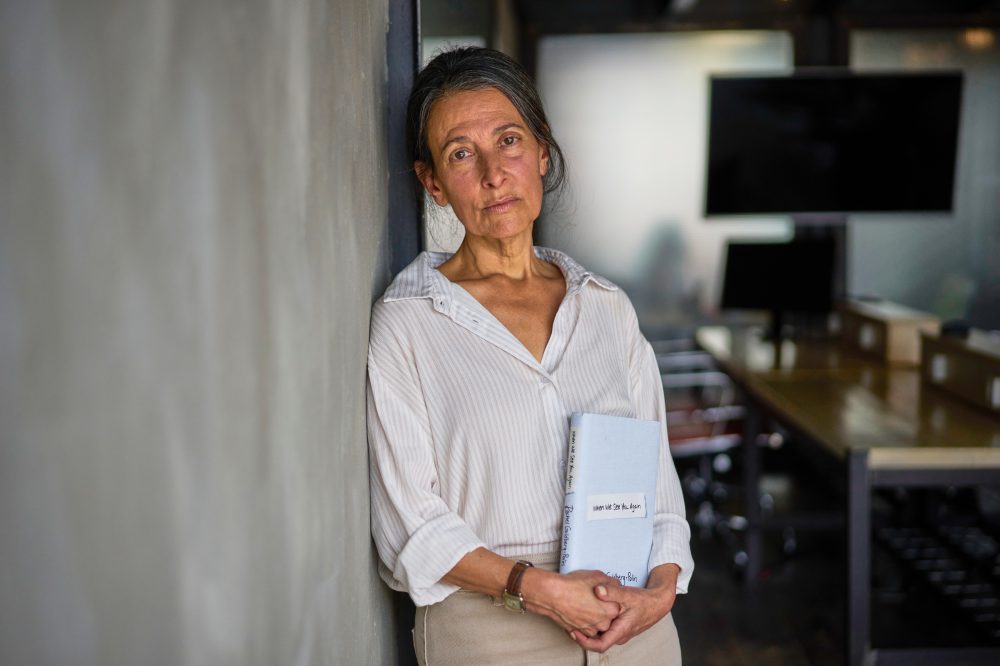
Now his mother, Rachel Goldberg-Polin, has taken on the mission to find that purpose. She released a memoir on Tuesday following her highly visible efforts to secure her son’s freedom.
The book, titled “When We See You Again,” offers no clear storyline, uplifting conclusion, or blame toward Hamas terrorists or Israeli officials many hold responsible for her son’s death. Instead, it provides an unflinching look at profound loss.
Goldberg-Polin remains uncertain whether her work represents “an exceptionally painful love story, or a love-filled pain story.”
“I’m still trying to figure out with clarity what is my why, but it’s clear to me that my why is not done,” Goldberg-Polin said, a photo of a smiling Hersh behind her. “I just really wanted to tell the truth. It’s very ugly.”
Hersh was one of 251 individuals taken hostage during Hamas’s October 7, 2023, assault. A grenade explosion severed his hand before militants forced him into Gaza’s underground tunnel network.
The resulting conflict claimed more than 70,000 Palestinian lives and devastated much of Gaza before an October ceasefire agreement secured the release of surviving hostages. Hersh and five others had already been murdered more than a year prior.
Rachel became a tireless advocate for her son’s freedom, participating in numerous media appearances, meeting with former President Joe Biden, and speaking at the Democratic National Convention. She also joined widespread demonstrations in Israel criticizing government officials for failing to negotiate a faster resolution.
Her son became one of the most recognizable hostages. His name and image continue appearing on posters and graffiti throughout the country, frequently accompanied by Frankl’s quote.
In her memoir, Rachel deliberately avoids idealizing Hersh. She mentions his childhood habit of picking scabs and his poor dishwashing skills.
“Hersh has become a symbol to many,” Goldberg-Polin writes in the book. “I don’t know what to do with that. But it’s OK. If people need Hersh to be something, he will be that. That is the essence of service, being what is needed.”
Rachel grew up in Chicago before relocating to Israel with her husband and three children when six-year-old Hersh was the eldest. She recalls memories from the “before time”: how young Hersh impressed people with his extensive knowledge of U.S. presidents and his devotion to Jerusalem’s local soccer team and their partner club in Bremen, Germany.
The memoir briefly addresses his abduction and captivity details, which have received extensive media coverage. She documents their frantic information search during the chaotic days following the attack, their extended battle for his release, and receiving news of Hersh’s death along with five others after 328 days.
The book primarily represents “very raw, peeled, oozing, throbbing pain,” Goldberg-Polin explained. She describes “hundreds of sodden days dripping with anguish.”
“The book really started just as a way of taking this tremendous weight of suffering that was causing my soul to buckle,” she said during a Jerusalem interview.
Her writing emerged spontaneously without a planned outcome, driven by the question “How do I survive the next 15 minutes?” she explained.
The memoir partly stemmed from her frustration when people inquired about her wellbeing. “I think, ‘Well, do you not see this dagger sticking out of my chest at my heart? How can you possibly be asking me that?’” she said. “But I realized they don’t see it. And it’s not because they’re mean or insensitive. They simply don’t see it.”
“Someone who’s born blind doesn’t know what blue is, and it’s very difficult to describe blue to someone who’s blind. But I’m desperate for people to see my blue, and I’m yearning for people to feel my pain,” she said.
Others wanted to share their own experiences with death and loss, even during her son’s shiva, the traditional Jewish mourning period following burial. She found this experience both overwhelming and enlightening, exposing the “surplus of suffering” that exists globally.
“They’re not trying to comfort me, they’re saying: ‘Let me stand next to you and we’ll be in this together,’” she said.
Throughout the hostage release campaign, Rachel’s motto was “Hope is mandatory,” even when optimism seemed impossible. Now, people everywhere ask her and her husband to share some of their worn and weathered hope.
She offers no simple solutions, as she explains to Hersh in a letter to her deceased son near the book’s conclusion.
“I will carry your why,” she writes. “I’ll do it, I’ll carry your why around the world.”