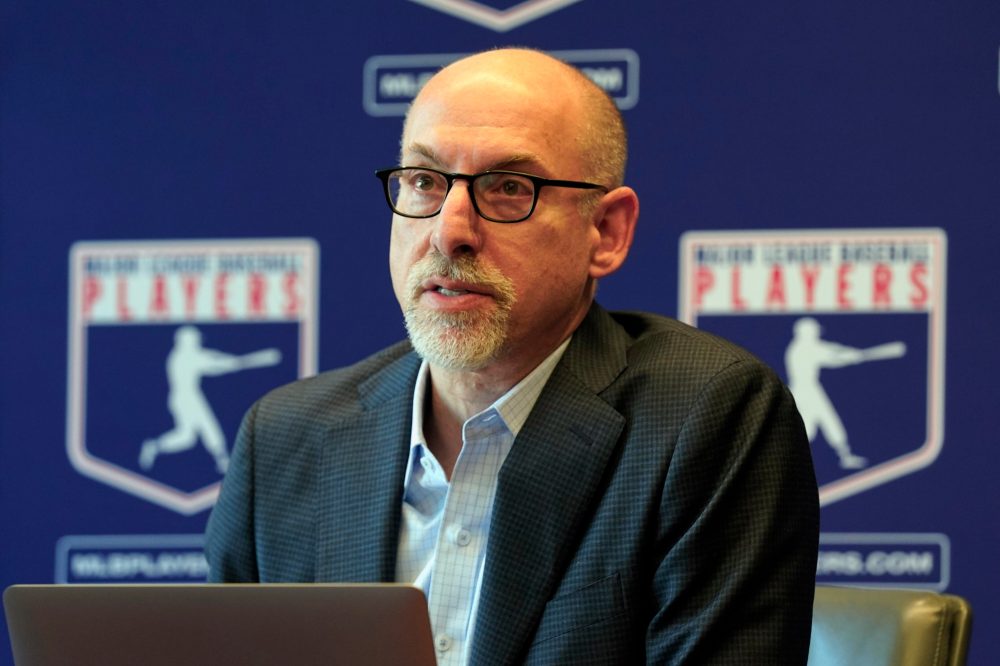

NEW YORK — Major League Baseball players launched their initial bargaining position Wednesday in what’s anticipated to be challenging labor contract talks, requesting broader free agency rules and salary arbitration eligibility alongside nearly doubling minimum wages and enhancing revenue distribution from high-earning teams to smaller-market franchises.
One day ahead of Major League Baseball’s anticipated salary cap presentation, the players’ union detailed their opening economic demands during negotiations at the union’s Manhattan headquarters.
The current labor agreement concludes December 1, with MLB anticipated to implement a lockout, which serves as management’s version of a work stoppage under federal labor regulations.
“Attendance, viewership, interest — by any measure you want to use, our game is moving in a positive direction,” Baltimore pitcher Chris Bassitt, a member of the union’s eight-man executive subcommittee, said in a statement. “We’ve put forward proposals designed to continue that trend. Support, incentivize, and reward clubs who are committed to competing, especially small-market clubs. Compensate players fairly for the work they are doing.”
MLB obviously opposes the union’s presentation and argues the union’s strategy would reduce revenue distribution.
“We understand their proposals are designed to benefit players. Unfortunately, they do not address and in fact exacerbate the competitive balance problem our fans are telling us we must address,” MLB spokesman Glen Caplin said in a statement. “The MLBPA’s proposal would reduce the amount transferred to lower-revenue clubs, weaken the competitive balance tax and lead to even more payroll disparity than exists today. For example, under the union’s proposal, the Dodgers would pay less in luxury tax payments, giving them an additional $70 million to spend on payroll.”
Marcus Semien and Sean Manaea of the Mets and Eugenio Suárez of Cincinnati were present for the meeting while additional players joined virtually.
“The players’ proposals provide increased revenue sharing initially guaranteeing every small-market club a minimum of $240 million in revenue every season,” interim union head Bruce Meyer, who replaced Tony Clark in February, said in a statement. “This enhanced revenue sharing includes added protections to ensure clubs prioritize winning over profiteering.”
Key proposal elements include raising the luxury tax ceiling from this season’s $244 million to $300 million by 2027, followed by $15 million annual increases. Draft pick penalties would be removed, and surcharge rates would decrease from the current 110% maximum to 10% above previous levels.
Free agency qualification, unchanged at six major league seasons since 1976, would drop to five seasons for players reaching age 30 by November 1. Teams could retain such players through qualifying offers, with refusal leading to arbitration eligibility.
Minimum salaries would jump from this year’s $780,000 to $1.5 million next season and $2.2 million by 2031.
Salary arbitration access would broaden with teams required to offer eligible players at least $3 million. The eligibility threshold moved from two to three years in 1986, with the super 2 classification beginning in 1991 at 17% and reaching 22% in 2013. The union proposes expanding this to 44%. Additionally, arbitration panel decisions would guarantee salaries, with some comparison salaries valued at 120%.
The pre-arbitration bonus fund, set at $50 million in the current 2022-26 agreement, would grow to $180 million next year with subsequent $15 million annual increases. Players signing multiyear contracts within their first 21 major league days would lose eligibility.
The qualifying offer system for six-year service players would end. This mechanism has limited some free agent markets since its 2012 introduction due to signing team penalties.
The amateur draft lottery would expand from six to eight teams.
Service time manipulation prevention rules from 2022 would broaden, including full service year credit for eligible prospects finishing top five in MVP balloting.
Lower-revenue franchises losing free agents would receive enhanced compensation, while low-revenue teams would gain additional draft picks.
A competitive integrity levy would target teams spending below 50% of the minimum tax threshold, with additional penalties for teams falling further behind. Franchises would face consequences for not investing received revenue-sharing funds in payrolls.
Every small-market franchise would receive guaranteed annual revenue of at least $240 million, while retaining more ballpark-generated income.
Low-revenue teams achieving winning records or playoff berths would earn additional revenue-sharing money, with local media income distributed more broadly among all teams.
The previous five-year agreement was finalized March 10, 2022, on the 99th day of a lockout, maintaining the 162-game regular season format. This marked baseball’s ninth work stoppage and first since the 7½-month strike spanning 1994-95 that cancelled the World Series for the first time since 1904.