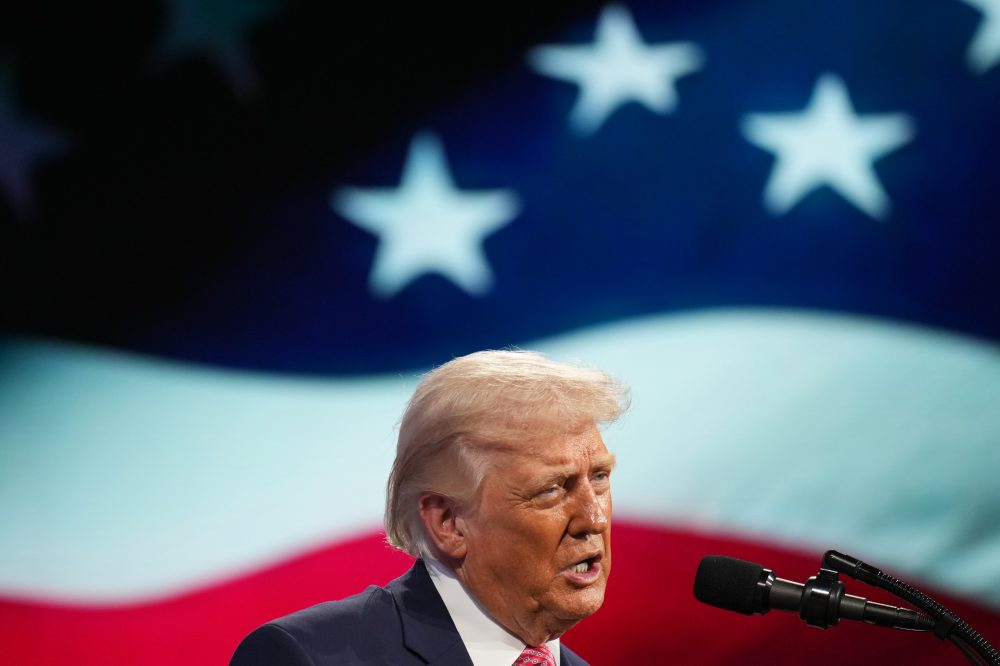

WASHINGTON — As the conflict with Iran continues into its second month, President Donald Trump’s contradictory public statements are generating uncertainty about the administration’s military strategy and objectives.
Trump has declared victory in the ongoing conflict while simultaneously ordering thousands more American service members to deploy to the Middle East region. The president has criticized allied nations for failing to support U.S. efforts, then later claimed their assistance wasn’t necessary.
The administration has extended deadlines twice for Iran to reopen the Strait of Hormuz shipping lane. Trump has alternately warned he would “obliterate” Iranian energy facilities if the crucial waterway stays closed, while also stating the closure has “not affected” the United States.
Earlier this month, Trump claimed a former president from the opposing party privately expressed support for his Iran approach. However, representatives for all living ex-presidents quickly refuted any such conversations took place.
Leon Panetta, who held positions as defense secretary, CIA director and White House chief of staff under Democratic administrations, observed he has “seen enough wars where truth becomes the first casualty.”
“It’s not the first administration that has not told the truth about war,” Panetta stated. “But the president has made it kind of a very standard approach to almost any question to in one way or another kind of lie about what’s really happening and basically describe everything as fine and that we’re winning the war.”
Michael Rubin, an American Enterprise Institute historian who advised the Pentagon on Iran and Iraq from 2002 to 2004, described Trump as “the first president of any party in recent history that hasn’t self-constrained to live within rhetorical boundaries.”
“So of course it creates a great deal of confusion,” Rubin added.
Critics view Trump’s approach as evidence of lacking a comprehensive long-term plan. However, the president appears to view his unpredictable messaging as strategic, keeping adversaries and observers constantly uncertain.
This pattern was evident recently when Trump discussed extending the Strait of Hormuz deadline. When asked about his plans, Trump said he was undecided and had another day to choose.
“In Trump time, a day, you know what it is, that’s an eternity,” the Republican president told his Cabinet, drawing laughter.
Financial markets have responded negatively, with U.S. stocks experiencing their worst week since the conflict began. Congressional leaders express growing frustration with the administration’s approach.
Representative Gregory Meeks of New York, the leading Democrat on the House Foreign Affairs Committee, criticized Trump for “going back and forth and constantly contradicting himself.”
“The administration is winging it,” Meeks said. “So how can you trust what the president says?”
While Republicans haven’t echoed such harsh criticism, their concerns are evident as Congress prepares for a two-week recess. Senator John Kennedy of Louisiana said his voters “support what the president has done.”
“But most of my people are also equally or even more so concerned about cost of living,” Kennedy noted.
Representative Chip Roy of Texas, a House Budget Committee member and conservative Freedom Caucus participant, said his constituents supported “blowing some crap up.” However, he expressed concerns about potential ground troops and criticized insufficient briefings that only contain information “read in the papers.”
“Taking out bad guys, taking out conventional (weapons), taking out or at least working to take out nuclear capability, pressing to keep the straits open, all those are good things and I’ve been supportive and will continue to be supportive,” Roy explained. “But we’ve got to have a serious conversation about how long this is going to go, boots on the ground, all those things, press for further briefings and understanding of where it’s all headed.”
A recent Associated Press-NORC Center for Public Affairs Research poll reveals potential political risks for Trump if the conflict becomes the type of extended Middle East war he promised to avoid.
While 63% of Republicans support airstrikes against Iranian military installations, only 20% back deploying American ground forces.
These findings highlight upcoming political challenges for Trump, who didn’t prepare Americans for such extensive overseas military involvement. If fighting continues or intensifies, Republican lawmakers could face increased pressure before November elections when their congressional majorities are threatened. Some party members consider ground troop deployment a boundary Trump shouldn’t cross.
The administration will likely require congressional approval for an additional $200 billion in war funding. Trump has called this amount “nice to have” while claiming the war was “winding down,” but such spending would challenge budget-focused Republicans during an election year.
White House spokesperson Anna Kelly defended the president’s approach, stating Trump is “right to highlight the vast success of Operation Epic Fury.”
“Iran desperately wants to make a deal because of how badly they are being decimated, but the President reserves all options, military or not, at all times,” Kelly said.
Rubin suggested there might be “logic” behind Trump’s changing rhetoric about the conflict. He theorized Trump’s mentions of negotiations, which Iran has denied, could “spread suspicion and fear within the regime circles.”
“Perhaps Donald Trump or those advising him simply want the Iranians to grow so paranoid they refuse to cooperate with each other or perhaps they even turn on each other,” Rubin explained. “But then again, there’s always a danger with Donald Trump of assuming that his rhetoric is anything more than shooting from the hip.”
Representative Adam Smith of Washington state, the top Democrat on the House Armed Services Committee, said Trump won’t fully accomplish his goals, including completely eliminating Iran’s nuclear capabilities, “in the current trajectory.”
Smith suggested Trump might use his communication abilities to simply declare victory and end the conflict.
“As I’ve jokingly said, nobody I have ever met or heard of in human history is better at exaggerating his own accomplishments than Donald Trump,” Smith observed. “So go knock yourself out and claim this was some great success.”