
JEFFERSON CITY, Mo. — Missouri residents will confront an extraordinary decision at the ballot box this November that no other state voters have faced in more than 100 years: whether to completely phase out their state’s individual income tax.
This historic ballot measure represents the first instance since modern income taxation began that a state legislature has directly asked citizens to eliminate their income tax entirely. Approval would simultaneously authorize lawmakers to broaden the state’s sales tax base.
This groundbreaking proposal represents the culmination of a nationwide five-year period of aggressive tax reduction efforts across states that benefited from surplus revenues during the post-COVID economic recovery. That trend only recently slowed as some Democratic-controlled states moved toward higher tax rates for wealthy residents. Throughout this period, nearly every state implemented either temporary or permanent reductions to various taxes including income, sales, property, or gasoline levies. More than half of all states with income taxes lowered their highest tax rates.
Unlike previous tax reduction efforts, Missouri’s approach openly recognizes the challenge of eliminating income tax revenue without finding alternative funding sources to maintain government operations.
Federal income taxation authority was established through the 16th Amendment’s ratification in 1913. Missouri followed suit with its own income tax in 1917, joining many states that adopted similar measures in subsequent years.
However, several states including Florida, Nevada, South Dakota, Texas, and Wyoming never implemented individual income taxes, instead depending on sales taxes, oil revenues, or other funding mechanisms. New Hampshire and Tennessee, which previously taxed investment income but not wages, both eliminated those taxes within the last five years.
Alaska stands alone as the only state to have implemented and later abolished a general individual income tax, eliminating it in 1980 during a period of substantial oil revenue.
Massachusetts citizens voted down income tax elimination proposals in both 2008 and 2002, though those measures originated from citizen initiatives rather than budget-responsible lawmakers.
Kentucky passed legislation in 2022 that reduced income tax rates and established revenue-based milestones that could gradually eliminate the tax entirely. The law also extended sales tax coverage to services like personal fitness training and website design. However, these revenue triggers require legislative approval for each additional rate reduction.
Mississippi enacted legislation last year that gradually decreases income tax rates from 4% to 3% by 2030, with revenue growth benchmarks that could trigger further cuts. Complete elimination could take more than a decade if all benchmarks are achieved.
Oklahoma also passed legislation last year establishing gradual income tax rate reductions tied to revenue growth until complete phase-out. The state won’t determine until next year whether it has met the revenue threshold for the initial rate reduction.
South Carolina recently joined this movement when Republican Governor Henry McMaster signed legislation last month that could eventually eliminate individual income tax as revenues increase.
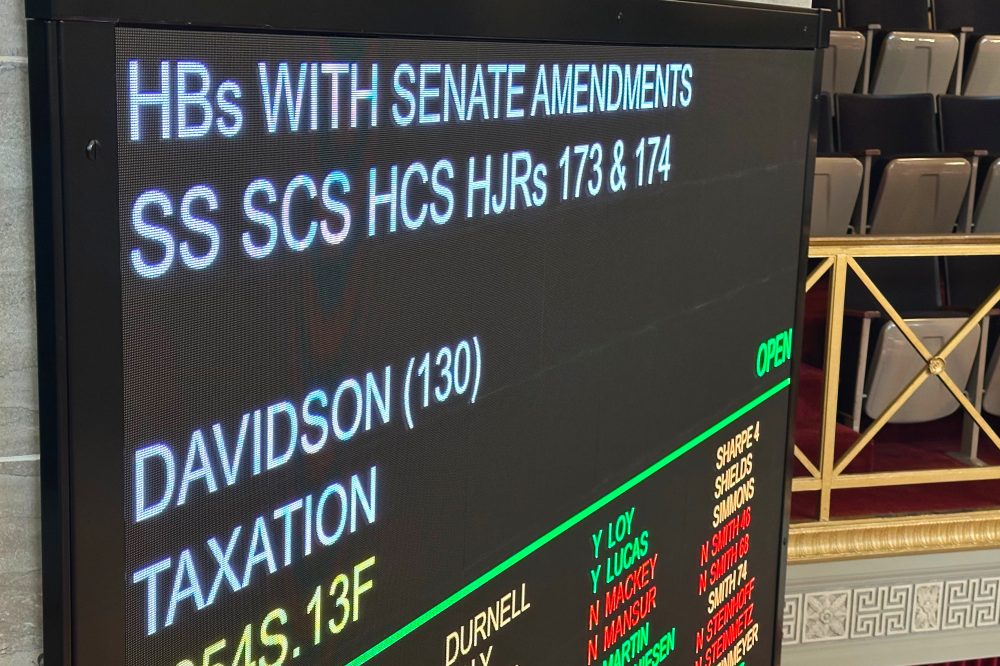
Missouri’s proposed constitutional amendment instructs the General Assembly to eliminate individual income tax through gradual reductions based on revenue growth. To facilitate this transition, it grants lawmakers authority to generate revenue by applying sales tax to “any goods and services,” bypassing a constitutional restriction on sales tax base expansion that voters approved in 2016.
Lawmakers would have five years to determine which additional sales to tax without requiring another public vote.
However, some voters may not understand they are authorizing expanded sales taxes. The ballot language asks whether to phase out income tax and “modify” sales tax, avoiding terms like “increase” or “expand.”
The amendment, approved by the legislature last week, will appear on November’s ballot unless Republican Governor Mike Kehoe schedules an earlier election.
Governor Kehoe has prioritized individual income tax repeal, contending it will stimulate economic growth while attracting businesses and new residents.
During a House committee hearing this year, Will Spartin testified that although he attended business college in St. Louis, he established his beverage company headquarters in Florida due to that state’s lack of individual income tax. He expressed interest in returning to Missouri, but only if financially viable.
“If Missouri moves in this direction, even gradually, it would be a meaningful signal to people like us that Missouri wants to compete for modern industries,” Spartin told lawmakers.
Sharon Wells, a retired elementary school teacher from suburban St. Louis, reported paying several hundred dollars in state income tax this past year. She worries her total tax burden could increase if income tax is replaced with broader sales tax coverage.
Wells employs lawn care services, visits a hair salon twice monthly, and requires periodic medical, dental, and automotive maintenance services. None of these services currently face taxation, but all could under Missouri’s proposal.
“I think it’s a huge mistake,” she said. “We’re already paying far more than we have in the past for groceries, medicine, all kind of services. Everything has gone up.”
According to estimates from the nonprofit Institute on Taxation and Economic Policy, families earning between $49,000 and $78,000 annually would pay an average of $535 more in taxes if Missouri repeals its income tax and implements higher sales taxes. Lower-income earners would face even larger increases, the organization stated.
“Pretty clearly, this is going to be a tax increase for most people,” said Carl Davis, the institute’s research director.
Additional data indicates that income tax policies, while not the primary factor, can influence interstate migration patterns. Texas, Florida, and Tennessee all ranked among the top five states for net interstate migration of federal income tax filers in 2023, while higher-tax states California, New York, and New Jersey ranked near the bottom, according to IRS data analysis by the nonprofit Tax Foundation.
If Missouri voters approve this referendum, “it could embolden other states to accelerate their own planned income tax reductions,” said Katherine Loughead, the foundation’s director of state tax projects.