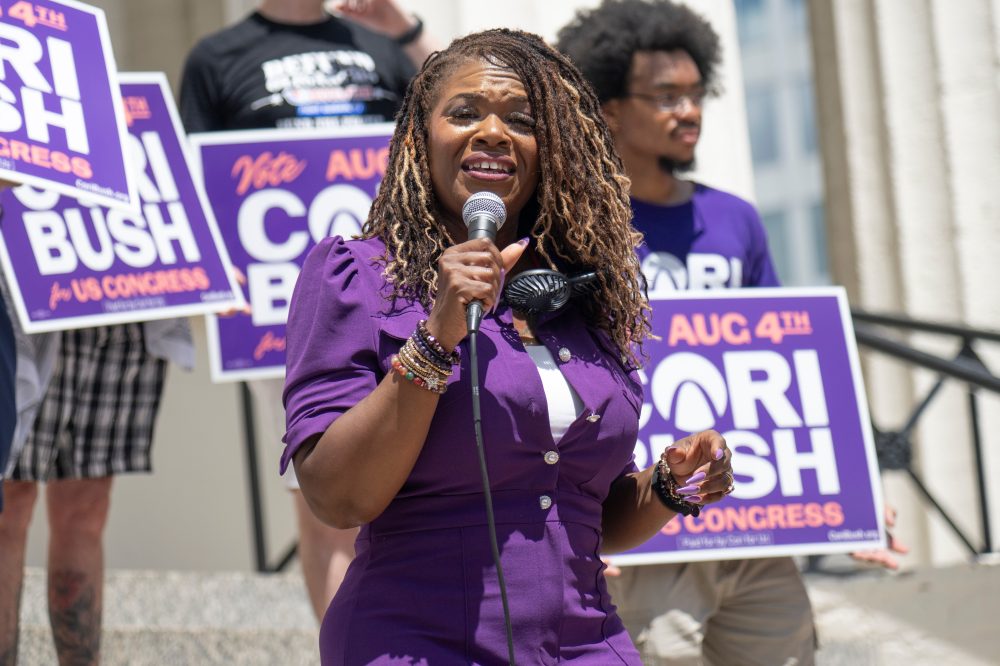

ST. LOUIS (AP) — Standing outside the courthouse where the landmark Dred Scott slavery case was argued in 1847, former Rep. Cori Bush framed her bid to return to Congress as a historic moment of redemption.
“We’re standing here saying, send back that descendant, send her back to the place that enslaved people built,” Bush declared to the crowd. “This is our moment.” Supporters responded by chanting “send her back.”
Bush, a progressive who launched her political career as a Black Lives Matter organizer in Ferguson, served two terms in Congress before losing a primary challenge to Wesley Bell, a moderate local prosecutor. Now the two are facing each other again in a rematch that political observers say will serve as one of the clearest tests of where the Democratic Party is headed — touching on frustration with party leadership, growing skepticism toward the U.S.-Israel relationship, and the rising influence of democratic socialists.
Both candidates are Black and have political roots in the civil rights movement that gained momentum following the police shooting of Michael Brown in 2014. But their paths since then have diverged sharply. The race will ultimately determine whether voters want to stick with Bell, who has positioned himself as a practical problem-solver, or bring back Bush, who sees political activism and lawmaking as one and the same.
Bush lost to Bell by fewer than six percentage points two years ago. She has attributed that defeat to spending by the American Israel Public Affairs Committee and told her supporters that “all they did was radicalize me.” This cycle, her sharp criticism of the war in Gaza and Democratic leadership has become more mainstream within the party, and she says she holds the “moral authority” heading into the rematch.
“It’s not that they’re necessarily scared of me. They’re scared of what comes with me. They’re scared of y’all,” Bush told a crowd of pro-Palestinian activists, Black Lives Matter organizers, and democratic socialists who had come from across the country to knock on doors for her in the summer heat. Some attendees used portable fans or poured water on themselves to stay cool during hours of speeches near St. Louis’ Gateway Arch.
While Bush addressed her supporters in the park, Bell was across town meeting with senior citizens at a historic Black church. He has brushed aside Bush’s attacks, arguing that he has been a more productive lawmaker. On Friday night, he appeared alongside former House Speaker Nancy Pelosi at a rally — a clear signal of backing from the Democratic establishment.
“She’s not a serious candidate,” Bell said in an interview. “In this election, the choices are clear. I wake up every day working for St. Louis, and the folks in St. Louis know that I’m going to wake up working for them. And then we’ve got an opponent, Cori, who wakes up thinking about Cori. And we’ve seen it over and over. And that’s why she was fired.”
Early voting for the August 4 primary got underway Tuesday, though the two candidates have been trading accusations for months. Each has leveled charges of misconduct and impropriety against the other.
Bush has pointed to a lawsuit Bell is facing from protesters who claim they were assaulted at one of his town hall events last year, as well as a settlement involving employment discrimination allegations made by a former staffer from his time as a prosecutor.
Bell, meanwhile, has highlighted a previous Justice Department investigation into Bush’s campaign finances, including payments made to her husband as part of her security detail.
Both candidates deny any wrongdoing.
The role of AIPAC — which advocates for a stronger U.S.-Israel relationship — has drawn national scrutiny to the race at a time when the organization has become deeply controversial within the Democratic Party.
“Cori is the knockout blow to AIPAC,” said former Rep. Jamaal Bowman, a close ally of Bush who was himself defeated in 2024 by an AIPAC-backed primary challenger in a redrawn New York congressional district. Ahead of a recent rally, Bowman posted a social media video calling on progressives “from New York to California” to help turn out voters during the early voting period.
The intensifying hostility toward Israel has raised concerns about antisemitism among some moderate Democrats and Jewish Americans, who worry that anti-Israel rhetoric can slide into outright prejudice. Bush’s recent campaign event included Jewish faith leaders who share her criticisms of Israel, but also featured remarks that echoed troubling tropes.
One former union leader, Jay Ozier, referred to Israeli Prime Minister Benjamin Netanyahu as a “war monger,” condemned the “Israel lobby buying elections,” and declared that “we need a representative who is willing to turn over the tables of the money changers.”
The crowd, including Bush, applauded those remarks. Ozier later defended the comment by saying it was a biblical reference to Jesus driving merchants from the Jerusalem Temple.
Bush declined to directly address the “money changers” remark.
“We condemn anti-Semitism. We condemn anti-Muslim hate, behavior and rhetoric at every chance we get,” Bush said in an interview. “But will Wesley Bell call out those who won’t stand against anti-Muslim sentiment, even in our own community? Will he stand up and fight for the liberation of the Palestinian people?”
AIPAC has directed more than $1.2 million in opposition spending against Bush this cycle through its political action committee, United Democracy Project — roughly the same amount it spent against her in 2024. New Democrat Majority, a group that supports moderate House Democrats, has spent an additional $1 million in opposition to Bush.
“She was a terrible, ineffective member of Congress who didn’t deliver for St. Louis. We were happy to see her go,” said Patrick Dorton, a spokesperson for United Democracy Project.
Bell has touted his assignments on the House Armed Services and Foreign Affairs committees and has stood by his support for U.S. military funding to Israel.
“I think it’s important that we stand with our allies, and there’s going to be times when we disagree and we work those out,” Bell said. “But what we’ve learned in Iraq, what we learned in Afghanistan, is that we can’t do it alone. We need our allies and we also need to be transparent with the American people.”
For many voters in the district, the deciding factor may come down to more immediate local concerns — such as how candidates have handled the push to secure recovery funding following a tornado that struck the St. Louis metropolitan area last year. Many residents also expressed unease about the level of outside money flooding into the race.
One voter, Allison Johnson, said she and her husband were split on who to support. Her husband leaned toward Bell based on his record in office, but she was troubled by how much money AIPAC had “dumped” into the district.
“It doesn’t seem like it should be big money should be influencing this race,” she said.
For some longtime St. Louis-area residents, the primary has been a disheartening spectacle — watching two figures who both rose through the Black Lives Matter movement turn on each other.
Bell previously served on the Ferguson city council before being elected as the prosecuting attorney for St. Louis County.
“He’s the best person for the job. When he was on council, he and I worked together to get the police reform done,” said Ella Jones, the former mayor of Ferguson and the first Black person to hold that office in the city’s history.
Bush, a pastor-turned-activist and triage nurse who became politically prominent during the 2014 Ferguson protests, won her House seat by promising to bring her outsider energy to Washington.
“I like Cori, I think she is the best choice and has a clear commitment to St. Louis,” said DeRay McKesson, an activist who rose to prominence as a lead organizer during the 2014 Ferguson protests. “She’s not afraid to challenge power.”