
VIENNA (AP) — Military and nuclear experts warn that any U.S. operation to forcibly secure Iran’s uranium reserves would present enormous challenges, involving radiation hazards, chemical dangers, and complex logistics requiring hundreds of specialized personnel.
President Donald Trump has cited various justifications for military action against Iran while maintaining that a key goal is preventing the nation from ever obtaining nuclear weapons. However, the extent of measures he would authorize to capture Iran’s nuclear materials remains uncertain.
Considering the dangers of deploying up to 1,000 specially trained military personnel into an active conflict zone to extract the stockpile, experts suggest a diplomatic agreement allowing Iran to voluntarily surrender the materials could be preferable.
According to the International Atomic Energy Agency, the United Nations nuclear monitoring organization, Iran possesses 440.9 kilograms (972 pounds) of uranium enriched to 60% purity — requiring only minor technical advancement to reach weapons-grade concentration of 90%.
IAEA Director General Rafael Grossi previously told The Associated Press that this stockpile could potentially produce up to 10 nuclear weapons if Iran chose to weaponize its nuclear program, though he emphasized this doesn’t indicate Iran currently possesses such weapons.
While Iran continues to maintain its nuclear program serves peaceful purposes, the IAEA and Western governments assert that Tehran operated an organized nuclear weapons development program until 2003.
IAEA inspectors have been unable to verify the location of the near-weapons-grade uranium since June 2025, following Israeli and American strikes that significantly damaged Iran’s air defenses, military command structure, and nuclear facilities. This inspection gap has created uncertainty about the precise whereabouts of the materials.
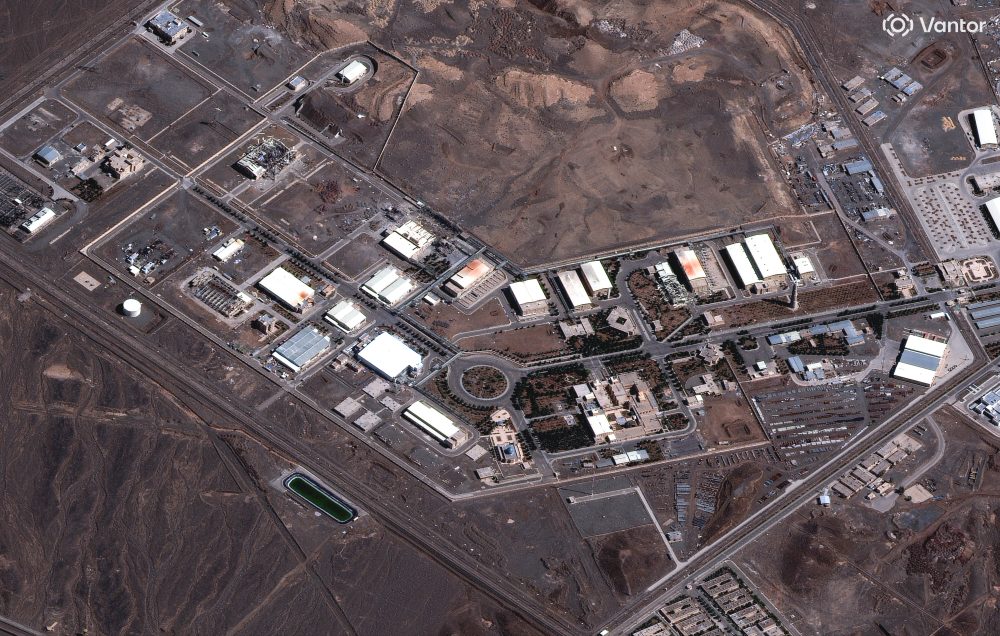
Grossi has indicated that the IAEA believes approximately 200 kilograms (about 440 pounds) of highly enriched uranium is housed in underground tunnels at Iran’s nuclear facility near Isfahan. This location was primarily used for manufacturing uranium gas that feeds into centrifuges for enrichment processing.
He has also stated that additional amounts are likely located at the Natanz nuclear installation, with smaller quantities possibly stored at the Fordo facility.
Whether additional stockpiles exist at other locations remains unknown.
During a House hearing on March 19, U.S. Director of National Intelligence Tulsi Gabbard stated that American intelligence agencies have “high confidence” in their knowledge of where Iran’s highly enriched uranium stockpiles are located.
Iran’s highly enriched uranium supply is contained in canisters weighing approximately 50 kilograms (110 pounds) when filled. The material exists as uranium hexafluoride gas. Expert estimates suggest between 26 and roughly 50 canisters exist, depending on how completely each cylinder is filled.
David Albright, a former nuclear weapons inspector in Iraq and founder of the nonprofit Institute for Science and International Security in Washington, described the canisters containing the highly enriched uranium as “pretty robust” and engineered for both storage and transportation.
However, he cautioned that “safety issues become paramount” if the canisters sustain damage — such as from air strikes — allowing moisture to penetrate.
Under such circumstances, fluorine would create a significant hazard, as this highly toxic chemical causes severe damage to skin, eyes, and lungs. Personnel attempting to enter the tunnels to recover the canisters “would have to wear hazmat suits,” Albright explained.
Maintaining proper distance between the various canisters would also be essential to prevent a self-sustaining critical nuclear reaction that would generate “a large amount of radiation,” he noted.
To prevent such a radiological incident, the canisters would need to be placed in specially designed containers that maintain separation during transportation, he said.
Albright indicated that the optimal approach for handling the uranium would involve removing it from Iran using specialized military aircraft and then “downblending” it — combining it with lower-enriched materials to reduce it to levels appropriate for civilian applications.
Processing the material within Iran through downblending would likely prove impractical, given that the necessary infrastructure may have been damaged during the conflict, he added.
Darya Dolzikova, senior research fellow at the Royal United Services Institute, shared this assessment.
Downblending the material within Iran is “probably not the most likely option just because it’s a very complicated and long process that requires specialized equipment,” she explained.
Christine E. Wormuth, who served as Army Secretary under former President Joe Biden, characterized securing Iran’s nuclear materials through ground forces as a “very complex and high risk military operation.”
This assessment stems from the material’s distribution across multiple locations and the reality that such an undertaking would “probably take casualties,” added Wormuth, who now serves as president and CEO of the Washington-based Nuclear Threat Initiative.
She estimated that operations at the Isfahan location alone would require no fewer than 1,000 military personnel.
Since tunnel entrances are likely buried beneath debris, helicopters would need to transport heavy machinery like excavators, and U.S. forces might need to construct a nearby airstrip to accommodate all necessary equipment and personnel, Wormuth explained.
She indicated that special operations forces, potentially including the 75th Ranger Regiment, would need to coordinate “in tandem” with nuclear specialists who would search underground for the canisters, with special forces likely establishing a defensive perimeter against potential attacks.
Wormuth identified the Nuclear Disablement Teams within the 20th Chemical, Biological, Radiological, Nuclear, Explosives Command as one possible unit for deployment in such an operation.
“The Iranians have thought this through, I’m sure, and are going to try to make it as difficult as possible to do this in an expeditious way,” she stated. “So I would imagine it will be a pretty painstaking effort to go underground, get oriented, try to discern … which ones are the real canisters, which ones may be decoys, to try to avoid booby traps.”
Scott Roecker, former director of the Office of Nuclear Material Removal at the National Nuclear Security Administration, a semiautonomous agency within the U.S. Department of Energy, suggested the optimal solution would be “to have an agreement with the (Iranian) government to remove all of that material.”
A comparable mission took place in 1994 when the United States, working with Kazakhstan’s government, covertly removed 600 kilograms (about 1,322 pounds) of weapons-grade uranium from the former Soviet republic in an operation called “Project Sapphire.” The material remained from the USSR’s nuclear program.
Roecker, now serving as vice president for the Nuclear Materials Security Program at the Nuclear Threat Initiative, explained that the Department of Energy’s Mobile Packaging Unit was developed based on the Kazakhstan experience. This unit has successfully removed nuclear materials from multiple countries, including Georgia in 1998 and Iraq in 2004, 2007, and 2008.
The unit comprises technical specialists and specialized equipment capable of deployment anywhere to safely extract nuclear materials, and Roecker believes it would be perfectly suited to remove the uranium under a negotiated agreement with Iran. However, Tehran maintains distrust toward Washington, which under Trump abandoned a nuclear agreement and has conducted attacks twice during high-level diplomatic talks.
Under a diplomatic solution, IAEA inspectors could also participate in the mission. “We are considering these options, of course,” IAEA’s Grossi stated on March 22 during CBS’s “Face the Nation” when questioned about such a possibility.
Iran has “a contractual obligation to allow inspectors in,” he noted. “Of course, there’s common sense. Nothing can happen while bombs are falling.”