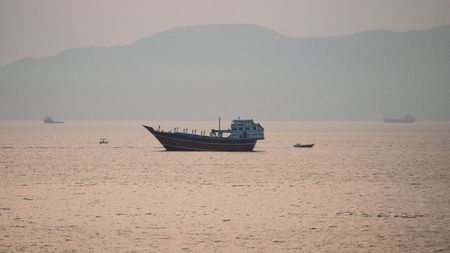

A delicate four-week ceasefire in the Middle East appeared on the verge of collapse Tuesday following renewed hostilities between American and Iranian forces battling for dominance over the strategically vital Strait of Hormuz.
According to U.S. military officials, American forces eliminated six Iranian patrol boats along with cruise missiles and unmanned aircraft on Monday. This action came as part of President Donald Trump’s naval escort mission dubbed “Project Freedom,” designed to guide stranded commercial vessels through the contested waterway.
Mohammad Baqer Qalibaf, Iran’s parliamentary speaker, declared via social media Tuesday that shipping security and energy transportation routes faced danger due to ceasefire violations by America and its partners.
This narrow passage serves as a critical conduit for worldwide shipments of petroleum, fertilizer, and various commodities. The waterway has remained essentially blocked since American and Israeli forces initiated strikes against Iran on February 28, triggering global price increases.
Multiple commercial vessels in the Persian Gulf experienced explosions or fires Monday, while Iranian missiles ignited an oil facility in the United Arab Emirates, a nation housing a significant American military installation.
Iran’s Islamic Revolutionary Guard Corps has successfully sealed the narrow channel using threats of naval mines, unmanned aircraft, missiles, and patrol boats. The United States has countered by implementing a blockade of Iranian harbors.
Iranian Foreign Minister Abbas Araqchi stated that Monday’s incidents demonstrated the impossibility of a military resolution to the conflict. He noted that peace negotiations continue with Pakistani mediation and cautioned the U.S. and UAE against becoming entangled in a “quagmire.”
American military representatives confirmed that two U.S. commercial vessels successfully navigated the strait with assistance from Navy guided-missile destroyers, though they did not specify timing.
Iran disputed any successful crossings occurred, but shipping company Maersk confirmed the Alliance Fairfax, flying an American flag, departed the Gulf through the Strait of Hormuz with U.S. military escort Monday.
The regional U.S. forces commander reported destroying six small Iranian vessels, which Iran also contested. Iranian media cited a military official claiming American forces targeted civilian boats, resulting in five civilian deaths.
Iran also announced Monday that it had fired upon a U.S. warship approaching the strait, compelling it to retreat. Iranian officials later characterized the gunfire as warning shots.
Reuters was unable to independently confirm the complete situation in the strait Monday due to conflicting accounts from both sides.
South Korea reported that one of its merchant vessels, HMM Namu, experienced an explosion and fire in its engine compartment while in the strait, though no crew members were injured. A South Korean government representative said it remained unclear whether the fire resulted from an attack.
Additionally Monday, the British maritime security organization UKMTO reported two vessels were struck off the UAE coast, and Emirati oil corporation ADNOC said one of its empty tankers was hit by Iranian drones.
Iranian officials published a map showing what they claimed was an expanded maritime zone under their authority, stretching well beyond the strait to encompass extensive portions of the UAE’s shoreline.
Following reported drone and missile strikes throughout the UAE during the day, including one causing a fire at Fujairah, a major oil port, the UAE characterized Iranian attacks as a significant escalation and stated it maintained the right to retaliate.
Fujairah sits outside the strait, positioning it as one of the few Middle Eastern oil export channels that bypasses the waterway.
Iran’s state television reported that military commanders confirmed attacking the UAE in response to “U.S. military’s adventurism.”
Oil markets declined 1% Tuesday after rising as much as 6% in the prior session amid indications the U.S. Navy was weakening Iran’s control over the Strait of Hormuz.
The Middle Eastern conflict has claimed thousands of lives and disrupted the global economy. American and Iranian representatives have conducted one direct peace negotiation session, but efforts to arrange additional meetings have been unsuccessful.
Trump has stated that the U.S.-Israeli operations aimed to eliminate what he termed immediate threats from Iran, referencing its nuclear and ballistic missile programs, its backing of Hamas and Hezbollah, and its “menacing activities.”
Iranian state media reported Sunday that the U.S. had transmitted its response to a 14-point Iranian proposal through Pakistan, and Iran was examining it. Neither party provided specifics.
The Iranian proposal would delay discussions of Iran’s nuclear energy and research programs until after reaching an agreement to end the conflict and resolve the shipping dispute. Trump said over the weekend he was still reviewing it but would likely decline it.
Recent U.S. intelligence indicates minimal damage to Iran’s nuclear program since hostilities began, officials informed Reuters.
Trump seeks to eliminate Iran’s enriched uranium stockpiles to prevent further processing that could enable nuclear weapon production. Iran denies any plans to develop nuclear weapons.