
HONG KONG — Asian stock markets fell and oil prices surged Thursday as the conflict between the United States and Iran deepened, with both sides launching new attacks.
U.S. stock futures moved slightly higher.
The United States carried out additional airstrikes targeting Iran, and Iran retaliated by launching attacks against Bahrain, Kuwait, and Qatar. The escalation came one day after President Donald Trump announced that a temporary ceasefire between the two countries was “over.”
Japan’s Nikkei 225 recovered some ground lost earlier in the week, climbing 1.6% to close at 67,849.98. Technology stocks provided much of the lift, with chip equipment manufacturer Tokyo Electron jumping 5% and artificial intelligence-focused investment firm SoftBank Group adding 0.4%.
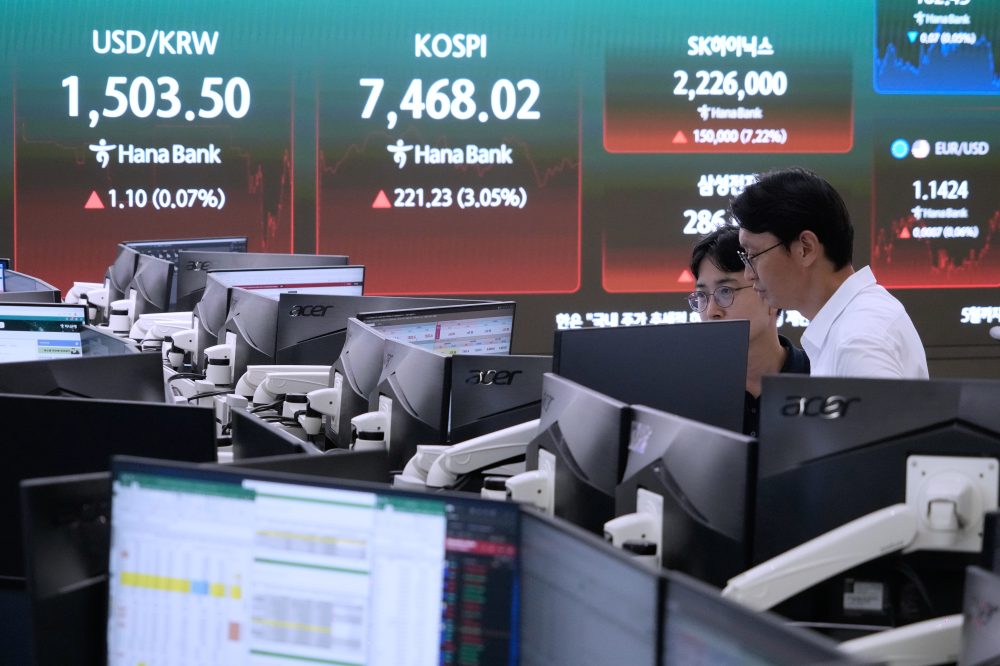
South Korea’s Kospi index ended 0.1% higher at 7,255.09, bouncing back after falling 5.4% on Wednesday. Samsung Electronics dropped 1.3% on Thursday, while memory chip manufacturer SK Hynix posted a 3.6% gain.
China’s Shanghai Composite index dipped 0.5% to 3,952.49. The decline followed a report showing China’s producer price index rose 4.1% in June compared to the same time last year, up from May’s 3.9% increase. Some economists are linking that accelerating inflation to rising costs tied to the ongoing Iran war.
Hong Kong’s Hang Seng index dropped 0.8% to 24,011.61. Shares of Apple supplier Luxshare fell 5% on its first day of trading in Hong Kong. Meanwhile, Chinese artificial intelligence company Zhipu, also known as Z.ai, surged 11.5% after announcing plans to raise approximately $4 billion through a share sale.
Australia’s S&P/ASX 200 fell 0.5% to 8,745.20. Taiwan’s Taiex finished flat, and India’s Sensex gained 0.7%.
Oil prices were on the rise early Thursday. Brent crude, the international benchmark, was up 1.1% at $78.88 per barrel. It briefly crossed $80 on Wednesday before giving back some of those gains. Before the Iran war started, Brent crude was trading near $72 a barrel. A period of optimism surrounding an interim peace agreement had recently pushed prices back down to pre-war levels.
U.S. benchmark crude was also up 1.1%, trading at $74.32 a barrel.
Commodities strategists Warren Patterson and Ewa Manthey of ING offered this assessment: “The oil market has continued to rally as the ceasefire between the U.S. and Iran appears to be on life support.”
The two analysts noted that vessel tracking data shows tanker traffic through the Strait of Hormuz — a critical passage for global oil shipments — has declined in recent days, rekindling investor worries about oil supply disruptions.
On Wednesday, Wall Street’s S&P 500 closed down 0.3% at 7,482.71, having fallen as much as 1.1% following Trump’s ceasefire comments. The Dow Jones Industrial Average lost 1.1%, settling at 52,348.39. The technology-focused Nasdaq composite edged up 0.2% to 25,870.65 after recovering from an earlier decline.
U.S. chipmaker Broadcom jumped 4.8% after Apple announced a multiyear partnership with the company.
In currency markets, the U.S. dollar slipped to 162.45 Japanese yen from 162.59 yen. The euro rose to $1.1430 from $1.1417.