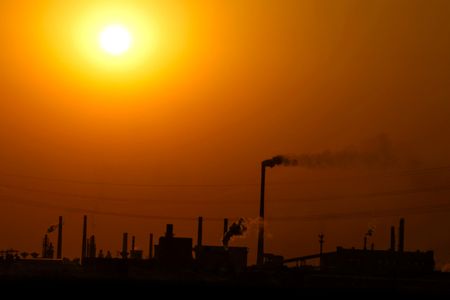

Manufacturing facilities worldwide are experiencing major economic impacts from the Middle East conflict, with European producers reporting decreased demand and the steepest increase in raw material expenses in four years, while their Asian counterparts have expanded operations through stockpiling efforts, according to recent industry surveys released Monday.
The conflict involving the U.S., Israel and Iran that started in late February has disrupted global commerce, created instability in financial markets and sparked worries about worldwide energy availability, especially regarding shipments through the Strait of Hormuz, a critical pathway for oil and natural gas transport.
The survey results were released following warnings from leadership at the International Energy Agency, International Monetary Fund, World Bank and World Trade Organization about the conflict’s impact on global energy availability.
The S&P Global Eurozone Manufacturing PMI dropped to 51.6 in May, down from April’s nearly four-year peak of 52.2, though it exceeded the preliminary projection of 51.4. Any measurement over 50.0 signals expansion.
“Although euro area manufacturers reported an expansion for a fourth successive month in May, the sector is showing signs of struggling under the weight of rising prices and supply disruptions emanating from the war in the Middle East,” said Chris Williamson, chief business economist at S&P Global Market Intelligence.
Manufacturing in Germany, Europe’s biggest economy, came to a standstill while French production facilities experienced their first decline since November.
A majority of economists surveyed by Reuters in May expect the European Central Bank to raise its deposit rate this month and at least one additional time this year to prevent higher energy costs from affecting core inflation.
Government data expected Tuesday is projected to reveal that inflation climbed further beyond the ECB’s 2% goal last month.
Manufacturing facilities in Britain increased their prices at the quickest pace since June 2022 last month in reaction to substantial cost increases.
Despite these challenges, production activity grew across most Asian markets.
China’s private sector measurement expanded for six consecutive months while South Korea reached its fastest growth in five years, demonstrating a regional effort to create reserves against possible conflict-related disruptions.
The RatingDog China General Manufacturing PMI, produced by S&P Global, declined to 51.8 in May from April’s 52.2, but performed slightly better than analysts’ prediction of 51.6.
This result differed from an official survey indicating that factory activity in the world’s second-largest economy stagnated last month as new orders declined and input expenses continued rising.
Japan’s manufacturing activity also grew with the PMI reaching 54.5 in May, down from April’s more than four-year peak of 55.1, though companies there experienced the steepest increase in input costs since September 2022 due to higher raw material prices.
South Korea’s PMI climbed to its highest level since March 2021 at 54.8 in May, up from 53.6, again demonstrating companies’ efforts to secure supplies.
In Vietnam, the factory PMI measurement increased to 52.8 from 50.5, while Taiwan’s rose to 56.1 from 55.3, surveys indicated. The Philippines’ index jumped to 50.8 from 48.3.