
GENEVA – The escalating Middle East conflict is severely hampering international humanitarian operations, creating bottlenecks in critical supply routes that deliver emergency aid worldwide, according to ten relief officials who spoke with Reuters.
As the U.S.-Israeli military action against Iran reaches its seventh day, the conflict has triggered widespread disruption across global transportation networks. Airspace restrictions and the complete shutdown of shipping through the vital Strait of Hormuz have sent shockwaves through international markets and supply chains.
Emergency assistance to Gaza and Sudan has nearly come to a standstill, while expenses for feeding hundreds of millions facing hunger worldwide continue to climb dramatically.
“People in dire need of assistance will have to wait longer for food,” stated Jean-Martin Bauer, Director of Food Security at the World Food Programme.
Essential supplies including emergency shelters, tarps, and lighting equipment intended for Gaza and the West Bank have become trapped in logistics networks, according to the International Organization for Migration.
DUBAI RELIEF CENTER STRUGGLES WITH TRANSPORT BARRIERS
Relief organizations report that escalating operational expenses are putting additional pressure on budgets already strained by significant reductions in donor funding. The IOM revealed that shipping companies are now imposing emergency fees of roughly $3,000 per shipping container.
International aid groups that maintain emergency supply stockpiles at Dubai’s Humanitarian Hub for quick regional deployment are encountering major obstacles in moving materials through transportation networks.
The International Federation of Red Cross and Red Crescent Societies is unable to transport medical trauma supplies to assist the Iranian Red Crescent with search and rescue operations from its Dubai facility, which houses emergency inventory worth 10 million Swiss francs ($13 million), explained Cecile Terraz, an IFRC director.
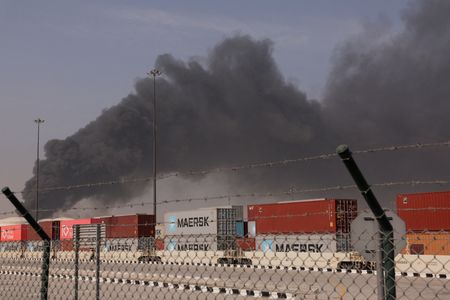
The organization cannot move supplies through Jebel Ali port – the region’s primary container facility, which sustained fire damage from intercepted missile debris – a critical transit point for cargo moving to aircraft or through the Strait of Hormuz.
Operations at the World Health Organization’s Dubai hub have also been suspended, according to regional director Hanan Balkhy, blocking 50 emergency requests from 25 nations and disrupting critical programs including polio immunization campaigns.
The disruption is expected to create widespread secondary effects across other regions.
Sudan, already experiencing severe famine conditions, faces particular vulnerability due to additional shipping restrictions implemented February 28 affecting the Suez Canal and the Bab el-Mandeb Strait at the Red Sea’s southern entrance, the UNHCR reported.
“We are particularly concerned about Africa,” a UNHCR spokesperson stated, noting that some shipments are being rerouted around the Cape of Good Hope, adding up to three weeks to delivery times.
Expenses for fuel, transportation, and insurance coverage are also increasing, with Terraz indicating the IFRC may need to reduce shipments to the Iranian Red Crescent.
Emma Maspero, senior manager at UNICEF’s Copenhagen supply division, expressed hope that aircraft carrying time-sensitive humanitarian cargo such as vaccines could receive priority treatment despite airspace limitations.