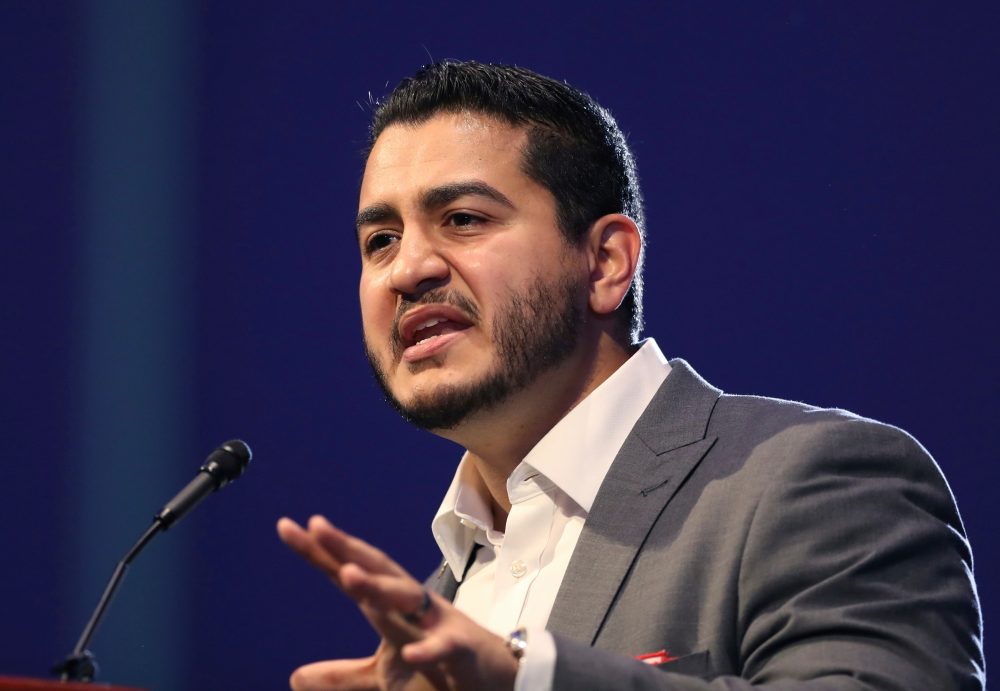

ANN ARBOR, Mich. — A contentious debate is unfolding within the Democratic Party after a Michigan Senate candidate scheduled campaign appearances with Hasan Piker, an online content creator whose past statements have drawn sharp criticism from fellow Democrats.
The controversy surrounding Piker’s Tuesday events with Abdul El-Sayed, a progressive seeking the Democratic nomination for U.S. Senate, has exposed deep divisions about the party’s direction. While supporters view the popular streamer as a bridge to younger voters who have increasingly moved toward conservative politics, critics worry about embracing figures they consider too extreme.
Piker has faced scrutiny for inflammatory statements, including claims that “Hamas is a thousand times better” than Israel, referring to some Orthodox Jews as “inbred,” and declaring that “America deserved 9/11.”
The Turkish American content creator, who boasts 3.1 million Twitch followers and 1.8 million YouTube subscribers, told The Associated Press that the backlash reflects a larger struggle over the party’s identity.
“There is definitely, I think, a battle right now for who gets to be more representative of the national Democratic Party,” he said.
Piker defended his record, showing little remorse for his previous comments while acknowledging some were “poorly worded.” He dismissed the renewed attention as “totally ridiculous, especially considering that there are far more consequential things happening in the world right now.”
“The super wealthy are picking apart the scraps of the American carcass like a bunch of vultures, and some of the Democrats are talking about their affiliations with a Twitch streamer,” Piker said. “I think Americans understand that this is totally ridiculous.”
The 34-year-old influencer, who has featured prominent Democrats like Rep. Alexandria Ocasio-Cortez and New York City Mayor Zohran Mamdani on his unscripted, interactive livestreams, positions himself as a voice for frustrated Americans. He believes the criticism stems less from personal animosity and more from what his presence represents within the party’s evolving landscape.
“I think they find me to be a more appropriate target than to just actively disparage the voters,” he said.
El-Sayed, who has received endorsement from progressive Sen. Bernie Sanders, hopes to harness that appeal during events at Michigan State University and the University of Michigan. The physician and former county health official faces a competitive primary against U.S. Rep. Haley Stevens and state Sen. Mallory McMorrow for the seat currently held by Democratic Sen. Gary Peters, who is not seeking reelection. The primary winner will likely face former Republican Rep. Mike Rogers in November.
Foreign policy toward Israel has become a dividing line among the three Democratic candidates. El-Sayed and McMorrow have both characterized the conflict in Gaza as genocide, though El-Sayed advocates for ending all military aid while McMorrow supports a two-state solution. Stevens has identified herself as a “proud pro-Israel Democrat.”
McMorrow criticized Piker to Jewish Insider, saying he “says extremely offensive things in order to generate clicks and views and followers,” drawing comparisons to white supremacist Nick Fuentes. Stevens accused El-Sayed of “choosing to campaign with someone who has a history of antisemitic rhetoric.”
El-Sayed defended his decision to appear with Piker, stating that “if we want to have a conversation where we’re actually bringing people together about the things that we need and deserve, we’re gonna have to go to unlikely and uncommon places.”
However, not all Democrats support that approach. Rep. Brad Schneider of Illinois, who leads the moderate New Democratic Coalition and co-chairs the Congressional Jewish Caucus, labeled Piker “an unapologetic antisemite.”
Rabbi Davey Rosen, CEO of Michigan Hillel, expressed disappointment with the University of Michigan event. “We are deeply disappointed by the decision to host a speaker at the University of Michigan with a documented record of antisemitic rhetoric,” he said. “Such invitations normalize hate and contribute to a hostile environment for Jewish students.”
Piker rejects accusations of antisemitism, describing his position as anti-Zionist. Anti-Israel sentiment has grown throughout the political landscape and created significant divisions within the Democratic Party during the Gaza conflict.
Much of the criticism focuses on Piker’s previous statements. Following the Oct. 7 attack on Israel, Piker suggested that whether reports of sexual violence were accurate “doesn’t change the dynamic” of the conflict, consistently arguing that Israel’s actions in Gaza remain the central issue.
Piker has also faced criticism for a 2019 livestream comment that “America deserved 9/11,” made during a discussion about U.S. foreign policy. While he has acknowledged the statement was poorly phrased, he clarified in his AP interview that he “didn’t mean that Americans deserved to die.”