
VATICAN CITY — One of the world’s most celebrated Renaissance masterpieces is undergoing a delicate cleaning process as restoration specialists work to eliminate a crusty white salt layer that has built up on Michelangelo’s “The Last Judgment” over the past thirty years since its previous major restoration.
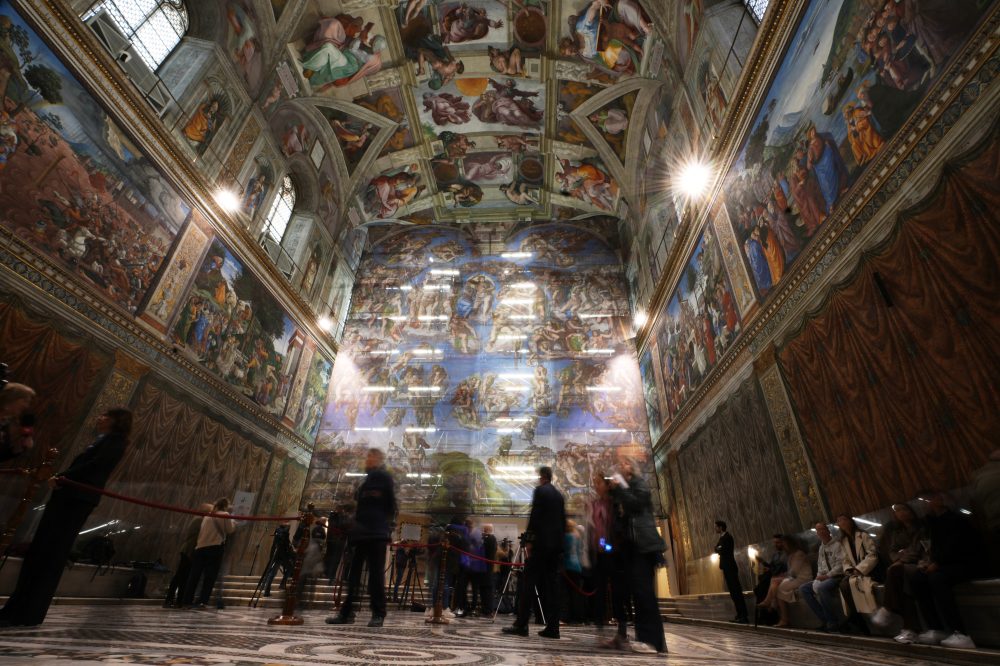
Vatican officials provided media access on Saturday to observe the restoration work, which requires extensive floor-to-ceiling scaffolding that currently blocks the massive fresco depicting heaven and hell on the chapel’s front wall.
The restoration project should wrap up by Easter during the first week of April. Tourists can still tour the chapel during the work, though they’ll view a digital reproduction displayed on a screen covering the scaffolding instead of the original artwork.
Vatican Museum representatives explained Saturday that this straightforward yet crucial cleaning addresses the white salt deposits formed by the approximately 25,000 daily visitors to the Vatican Museums.
“This salt is created because, above all, when we sweat, we emit lactic acid, and unfortunately lactic acid reacts with the calcium carbonate present on the wall,” said Fabio Moresi, in charge of the scientific research team at the Vatican Museums that is overseeing the cleaning.
Rising temperatures due to climate change worsen the problem, as visitors perspire more heavily, generating additional moisture that interacts with the artwork, Moresi explained.
Vatican Museums director Barbara Jatta compared the salt coating to a “cataract” that can be removed through a relatively simple process: restoration specialists soak Japanese rice paper sheets in distilled water, then gently press and wipe them across the fresco surface to lift away the salt layer.
The dramatic transformation becomes apparent when viewing the work up close from the scaffolding platform: untreated areas appear covered in chalky powder, while cleaned sections reveal brilliant colors and intricate details from the original painting. On the central figure of Christ, for instance, observers can now clearly see Michelangelo’s brushwork depicting hair texture and crucifixion wounds.
The chapel bears the name of Pope Sixtus IV, an arts supporter who directed construction of the primary papal chapel during the 1400s.
However, a subsequent pope, Julius II, hired Michelangelo to create the renowned ceiling artwork featuring “Creation of Adam” with God’s extended hand from 1508 to 1512. Later, Pope Clement VII brought Michelangelo back in 1533 to complete “The Last Judgment.”
Other Sistine Chapel frescoes, located where Pope Leo XIV was chosen in May, receive annual maintenance with workers using mobile lifts during overnight hours, removing equipment each morning before public tours begin.
Those mobile units cannot reach all portions of “The Last Judgment” because the fresco sits behind the altar, which stands elevated on marble steps. This access challenge necessitated installing permanent scaffolding to reach the entire artwork for proper cleaning.
The Sistine Chapel received comprehensive restoration from 1979 through 1999, eliminating centuries of accumulated smoke, dirt and wax residue. Vatican officials preserved small unchanged sections to demonstrate the contrast, now visible from upper scaffolding levels showing walls that were nearly black before treatment.
Instead of dramatically limiting visitor numbers to the Sistine Chapel, Vatican officials are exploring humidity control solutions through air filtration and other technologies to prevent future salt film formation.