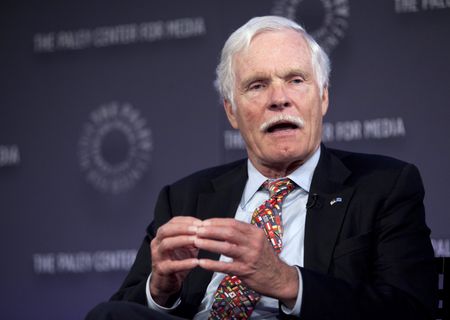

Ted Turner, the bold entrepreneur who revolutionized television news by creating CNN, has passed away at age 87, according to a statement from Turner Enterprises released Wednesday.
Officials did not specify what caused Turner’s death. The media mogul had publicly disclosed in September 2018 that he was battling Lewy body dementia, a progressive neurological condition.
Turner earned several colorful monikers throughout his career, including “Mouth of the South,” “Captain Outrageous,” and “Terrible Ted” – nicknames that reflected his larger-than-life personality and willingness to speak his mind.
Born Robert Edward Turner III in Cincinnati on November 19, 1938, he transformed his father’s billboard advertising company into a media dynasty worth billions. His journey began when he took control of the family business at just 24 years old following his father’s suicide.
Turner’s media ventures started in 1970 when he purchased a struggling Atlanta UHF station for $2.5 million, despite advisors urging against the deal. That station, now known as WTBS, became profitable through innovative 24-hour programming and eventually became America’s first “superstation” when satellite technology allowed cable systems nationwide to carry its signal.
His most significant achievement came in 1980 with the launch of CNN from Atlanta. Turner positioned the network as an alternative to what he called “sleazy” coverage by established networks CBS, NBC, and ABC. Despite initial mockery and the derisive nickname “Chicken Noodle Network,” CNN became the world’s first 24-hour news service and set new standards for global news coverage.
“Barring satellite problems, we won’t be signing off until the world ends,” Turner stated in a 2013 CNN interview. However, by 2018, he admitted he rarely watched the network anymore, feeling it had become too focused on politics during President Trump’s administration.
Time magazine recognized Turner as “Man of the Year” in 1991, calling him a “televisionary” for “influencing the dynamic of events and turning viewers in 150 countries into instant witnesses of history.”
Turner’s business empire expanded to include sports teams, with ownership of the Atlanta Braves baseball team and Atlanta Hawks basketball franchise. In a memorable moment in 1977, he appointed himself manager of the Braves for one game, resulting in a 2-1 loss to Pittsburgh before baseball officials forced him to step down.
The entrepreneur also made his mark in sailing, captaining the yacht Courageous to victory in the America’s Cup during the 1970s. His personal life drew attention as well, particularly his decade-long marriage to Academy Award-winning actress Jane Fonda, which ended in 2001.
In 1996, Turner sold his Turner Broadcasting System to Time Warner for $7.5 billion, creating what was then the world’s largest communications company. However, he struggled to adapt to corporate structure after years of independent operation and eventually lost control of his networks following Time Warner’s merger with AOL in 2001.
Beyond media, Turner became a prominent environmental advocate and philanthropist. His most notable charitable act was a historic $1 billion pledge to the United Nations in 1997, which he later called “the best investment I’ve ever made” upon completing the final payment in 2017.
Turner accumulated vast land holdings, becoming one of America’s largest private landowners with more than 1.9 million acres across six states, primarily in Montana. He maintained a herd of approximately 50,000 bison, which supplied his restaurant chain Ted’s Montana Grill, founded in 2002.
Known for his unfiltered comments, Turner once told The New Yorker: “I don’t have any idea what I’m going to say. I say what comes to my mind.” This approach sometimes created controversy, including conflicts with the Catholic Church and a long-standing feud with media rival Rupert Murdoch that began with a yacht collision in 1983 and escalated when Murdoch launched Fox News as a conservative competitor to CNN.
Turner also demonstrated self-awareness about his personality, once remarking: “If I only had a little humility, I’d be perfect.”
According to Forbes, Turner’s wealth was estimated at $2.8 billion. He was married three times and had five children. Throughout his later years, he battled depression and, according to his biographer, frequently discussed thoughts of suicide.
Turner’s legacy includes transforming how the world receives news, pioneering satellite television, and demonstrating how media can shape global events while maintaining a commitment to environmental causes and international cooperation.