
BELGRADE, Serbia — Global media watchdog organizations have sounded the alarm alongside Serbian reporters about deteriorating conditions for press freedom in the Balkan nation, citing unprecedented levels of physical assaults, digital harassment campaigns, and death threats targeting journalists.
Media freedom advocacy groups partnered with the Council of Europe’s Platform for the Safety of Journalists and the Media Freedom Rapid Response coalition issued a warning this week stating that “the past year had seen a continued deterioration, leaving the country in a prolonged and worsening press freedom crisis.”
The organizations cautioned that “chances of further escalation in the severity of attacks against journalists remain dangerously high.”
Representatives from these groups conducted a fact-finding mission in Serbia from March 26-27, meeting with both news media professionals and government officials.
“The mission came at a time of unprecedented physical attacks on journalists and rampant online smear campaigns, led or amplified by influential members of the ruling party,” the coalition stated. “The delegation is fearful that journalists are caught in a spiral of violence with few protections in place.”
Serbia’s information ministry did not immediately respond when contacted by The Associated Press for comment.
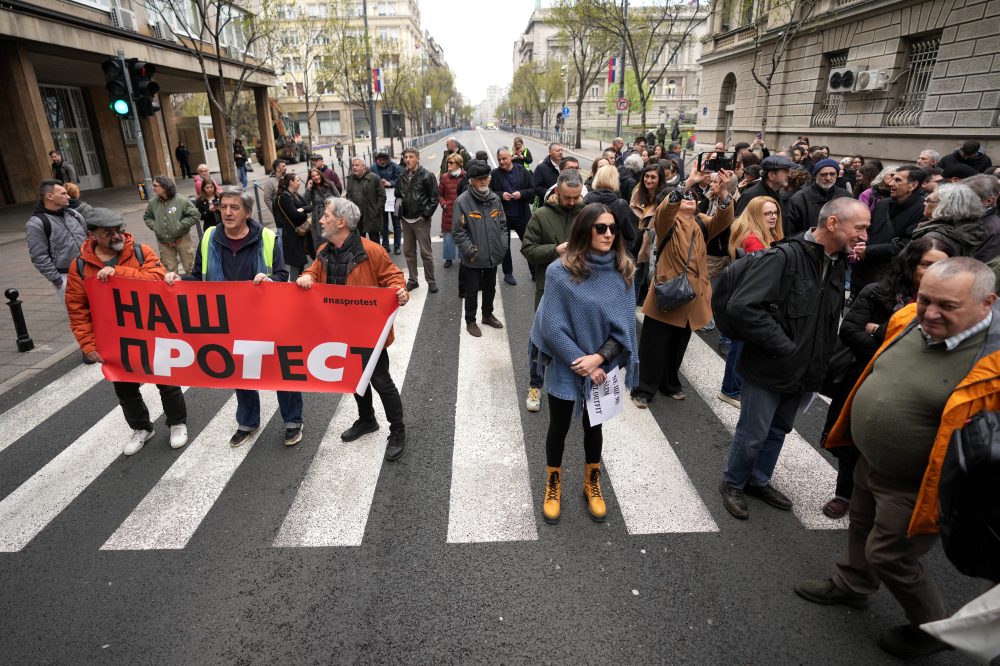
On Wednesday, dozens of Serbian reporters staged a traffic-blocking demonstration outside populist President Aleksandar Vucic’s office, protesting a recent wave of assaults documented during Sunday’s violence-plagued municipal elections.
According to the Independent Journalists’ Association of Serbia, 20 news workers faced attacks during Sunday’s voting, contributing to approximately 100 documented incidents targeting media personnel this year alone.
International election monitors who observed the polling reported witnessing both violent incidents and voting irregularities. The elections took place across 10 Serbian municipalities and were viewed as a crucial test for Vucic following more than a year of youth-driven protests that began after a November 2024 train station disaster that claimed 16 lives.
Despite officially pursuing European Union membership for Serbia, the increasingly authoritarian Vucic administration faces accusations from human rights organizations of undermining democratic institutions, particularly press freedoms.
The international media coalition noted in their statement that harassment and violence against news workers have intensified since the Novi Sad station collapse and the emergence of student-led mass protests. They highlighted “alarming levels of impunity” with virtually no accountability for those responsible for attacks.
“Clear political will is needed to break the downward spiral and ensure all attacks on the media are properly sanctioned under the law,” the statement concluded.